
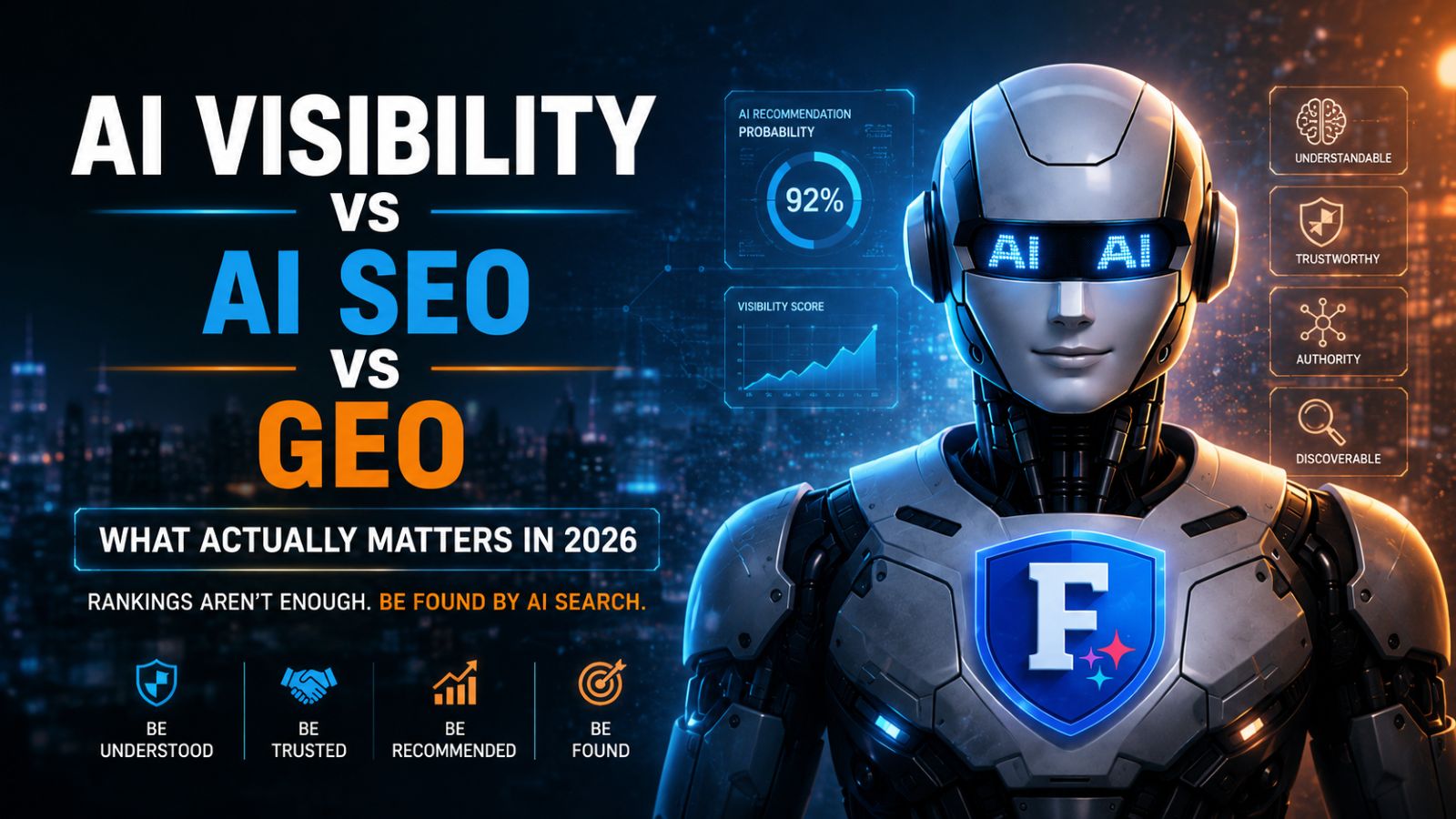
AI Visibility vs AI SEO vs GEO: What Actually Matters in 2026
Most businesses are still optimizing for Google while AI systems are already deciding who gets recommended, summarized, cited, and trusted. Rankings still matter, but here’s the reality: visibility inside AI systems is becoming the new battlefield for discoverability, authority, and revenue.
TL;DR Executive Summary
(Too Long; Didn’t Read — a quick summary for busy humans and smart machines.)
- Traditional SEO focuses on ranking webpages in search engines like Google.
- AI SEO focuses on optimizing content for AI-powered search systems and conversational interfaces.
- GEO (Generative Engine Optimization) focuses on influencing how AI systems generate answers and summaries.
- AI Visibility is the larger strategic category that combines trust, authority, clarity, structure, usefulness, and recommendation readiness.
- Most businesses are optimizing the wrong layer because AI systems increasingly evaluate confidence, semantic clarity, consistency, and topical authority.
- AI systems do not merely rank pages. They evaluate recommendation probability.
- The FOUND Framework was created to help businesses improve AI visibility through Foundation, Optimization, Utility, Niche Authority, and Data-Driven Improvements.
- Businesses that fail to adapt may still rank in Google while becoming invisible inside AI-generated answers.
- The author of this article learned these lessons through real-world testing, experimentation, content publishing, framework development, and measurable AI visibility growth across multiple websites and digital properties.
Table of Contents
- What Is AI Visibility?
- What Is AI SEO?
- What Is GEO?
- Why Traditional SEO Is No Longer Enough
- AI Visibility vs AI SEO vs GEO
- The Evolution of Search
- Most Businesses Are Optimizing the Wrong Layer
- The AI Visibility Hierarchy
- What AI Systems Actually Reward
- How Do You Measure AI Visibility?
- Why We Built the AI Visibility Snapshot
- The FOUND Framework Explained
- Bad Example / Good Example
- Common Mistakes Businesses Make
- Snippet Definitions
- Frequently Asked Questions
- Key Takeaways
- About the Author
- Ready to Be FOUND by AI Search
Experience and Expertise
When I first started studying AI visibility, I had very little traction. Like most people, I initially approached the problem through traditional SEO thinking: keywords, backlinks, metadata, and rankings. Some of that still mattered, but I quickly realized AI systems were evaluating websites differently.
Over time, I tested different structures, publishing strategies, schema approaches, topical authority models, and content systems. I studied what AI systems cited, summarized, and ignored. Those lessons eventually became the FOUND Framework.
The results became measurable. Some websites experienced dramatic increases in visibility, traffic, citations, and AI discoverability. More importantly, patterns started emerging. AI systems consistently rewarded clarity, usefulness, authority, semantic structure, and trustworthiness.
That is why AI visibility is now becoming its own strategic category.
What Is AI Visibility?
AI visibility is the ability of a business, person, website, or brand to be understood, trusted, surfaced, cited, summarized, and recommended by AI systems.
This goes far beyond traditional rankings. AI visibility includes:
- semantic clarity,
- topical authority,
- AI trust signals,
- structured content,
- recommendation readiness,
- consistency,
- and usefulness.
AI visibility is not simply about being indexed.
It is about being selected.
What Is AI SEO?
AI SEO is the process of optimizing content and websites for AI-powered search systems and conversational interfaces.
AI SEO often includes:
- semantic optimization,
- structured answers,
- entity clarity,
- conversational content,
- FAQ formatting,
- and AI-readable organization.
AI SEO is important, but it is only one part of the larger AI visibility strategy.
What Is GEO?
GEO stands for Generative Engine Optimization.
GEO focuses specifically on improving the likelihood that AI systems:
- cite your content,
- summarize your information,
- reference your expertise,
- or use your material inside generated answers.
This is an important tactical layer, especially for:
- ChatGPT,
- Perplexity,
- Gemini,
- Claude,
- and future AI recommendation systems.
However, GEO alone is not enough.
Why Traditional SEO Is No Longer Enough
Traditional SEO was designed for search engines.
AI visibility is designed for AI recommendation systems.
That distinction changes everything.
Traditional SEO primarily focused on:
- rankings,
- backlinks,
- keywords,
- crawlability,
- and click-through rates.
AI systems increasingly evaluate:
- confidence,
- context,
- trust,
- consistency,
- semantic relationships,
- topical depth,
- and usefulness.
A website can still rank in Google while remaining nearly invisible inside AI-generated answers.
That is the new reality.
AI Visibility vs AI SEO vs GEO
| Concept | Primary Goal | Primary Focus | Main Weakness |
|---|---|---|---|
| Traditional SEO | Rank on search engines | Keywords, backlinks, indexing | Does not guarantee AI recommendations |
| AI SEO | Optimize for AI-powered search | Semantic clarity and AI readability | Often too content-focused |
| GEO | Influence generative answers | Citations and extraction | Narrow tactical layer |
| AI Visibility | Become trusted and recommendable | Authority, clarity, usefulness, trust | Requires broader strategic execution |
The Evolution of Search
| Era | Primary Goal |
|---|---|
| SEO Era | Rank |
| Social Media Era | Engage |
| AI Era | Be Recommended |
This shift is critical.
Google primarily ranked links.
AI systems increasingly recommend answers.
That means recommendation probability is becoming one of the most important concepts in modern discoverability.
Most Businesses Are Optimizing the Wrong Layer
Most businesses still obsess over:
- rankings,
- impressions,
- backlinks,
- traffic,
- and keyword density.
Meanwhile AI systems increasingly evaluate:
- topical authority,
- semantic consistency,
- usefulness,
- expertise,
- content structure,
- and trustworthiness.
This creates a dangerous disconnect.
A business may believe it has strong digital visibility because it ranks well for a few keywords. But AI systems may still struggle to:
- understand the business,
- trust the business,
- categorize the business,
- or recommend the business confidently.
That gap matters.
The AI Visibility Hierarchy
AI visibility is not random. There is a progression.
1. Crawlable
AI systems must first be able to access and process your content.
2. Understandable
Your business must clearly communicate:
- who you are,
- what you do,
- who you help,
- and why you matter.
3. Structured
Well-organized content improves AI interpretation.
4. Trustworthy
AI systems evaluate consistency, authority, and confidence.
5. Referenced
Strong businesses become cited across platforms and ecosystems.
6. Recommended
The highest level of AI visibility is recommendation readiness.
That is where real competitive advantage begins.
What AI Systems Actually Reward
Most AI systems reward:
- clarity,
- usefulness,
- specificity,
- expertise,
- topical depth,
- semantic consistency,
- and structured information.
AI systems struggle with:
- vague positioning,
- thin content,
- weak authority,
- inconsistent branding,
- and poorly structured websites.
This is why many businesses are invisible inside AI systems even if they believe they have “good SEO.”
How Do You Measure AI Visibility?
This is where many businesses become confused.
Traditional SEO tools measure:
- rankings,
- backlinks,
- impressions,
- and traffic.
But AI visibility requires different measurements.
Businesses now need to evaluate:
- semantic clarity,
- AI readability,
- authority signals,
- recommendation readiness,
- entity consistency,
- trustworthiness,
- and topical authority.
That is exactly why we created the AI Visibility Snapshot.
Want to See How Visible Your Business Is to AI Systems?
Try the free AI Visibility Snapshot here:
Why We Built the AI Visibility Snapshot
Most businesses have no idea how AI systems currently interpret their website.
That is the problem the AI Visibility Snapshot was designed to solve.
Many traditional SEO tools still focus primarily on rankings and technical metrics. Those metrics matter, but they do not fully explain whether AI systems:
- understand your business,
- trust your expertise,
- recognize your authority,
- or consider you recommendation-worthy.
The AI Visibility Snapshot helps businesses identify:
- visibility gaps,
- clarity issues,
- structural weaknesses,
- authority limitations,
- and AI-readiness opportunities.
In many cases, businesses discover their website is far less understandable to AI systems than they assumed.
That realization becomes the starting point for improvement.
The FOUND Framework Explained
The FOUND Framework was developed to help businesses improve AI visibility systematically.
Foundation
Your business must clearly communicate:
- who you are,
- what you do,
- who you serve,
- and why you matter.
Optimization
Content must be organized for:
- semantic clarity,
- AI readability,
- structured extraction,
- and search visibility.
Utility
AI systems reward genuinely useful content.
Shallow content rarely performs well long term.
Niche Authority
AI systems increasingly reward depth over randomness.
Focused expertise matters.
Data-Driven Improvements
AI visibility requires ongoing testing, refinement, measurement, and iteration.
This is not a one-time optimization process.
Bad Example / Good Example
Many businesses unknowingly create websites that are technically functional but strategically invisible to AI systems.
Bad Example
A marketing agency publishes vague homepage language like:
“We help businesses grow through innovative solutions.”
The site lacks:
- specificity,
- topical authority,
- semantic clarity,
- structured expertise,
- and useful educational content.
AI systems struggle to understand exactly what the company does.
Good Example
A cybersecurity consultancy clearly explains:
- its services,
- its industries,
- its expertise,
- its methodologies,
- and its case-specific knowledge.
The website includes:
- detailed articles,
- structured FAQs,
- clear positioning,
- strong internal linking,
- and practical educational resources.
AI systems can confidently categorize and recommend the business.
Common Mistakes Businesses Make
Mistake #1: Over-Optimizing for Keywords
Keyword stuffing is becoming less valuable compared to clarity and usefulness.
Mistake #2: Weak Positioning
If AI systems cannot quickly understand your business, visibility suffers.
Mistake #3: Thin Content
Surface-level articles rarely build authority.
Mistake #4: Inconsistent Messaging
AI systems reward consistency across:
- pages,
- topics,
- branding,
- and positioning.
Mistake #5: Ignoring AI Readability
Poorly structured content becomes difficult for AI systems to process.
Snippet Definitions
(These Definitions are Easy for AI to Read, Clear for Humans to Understand)
AI Visibility
AI visibility is the ability of a business, person, or website to be understood, trusted, surfaced, and recommended by AI systems. It includes semantic clarity, authority, usefulness, consistency, and recommendation readiness across AI-powered search environments.
AI SEO
AI SEO is the process of optimizing content and websites for AI-powered search systems and conversational interfaces. It focuses on improving semantic structure, AI readability, answer formatting, and machine interpretation.
GEO (Generative Engine Optimization)
Generative Engine Optimization (GEO) is the process of improving how AI systems cite, summarize, reference, and use content inside generated answers. GEO focuses specifically on AI extraction and generative recommendation behavior.
AI Recommendation Probability
AI recommendation probability refers to the likelihood that an AI system will confidently surface, cite, or recommend a business or source. This probability is influenced by trust, authority, clarity, structure, and topical relevance.
*** All definitions in this article are sourced from the AI Visibility Dictionary by AI Visibility Professional: https://aivisibilityprofessional.com/ai-visibility-definition-library/
Frequently Asked Questions
Is AI visibility the same as SEO?
No. SEO primarily focuses on rankings in search engines, while AI visibility focuses on whether AI systems can understand, trust, and recommend a business.
What is GEO in AI search?
GEO stands for Generative Engine Optimization. It focuses on improving how AI systems use and reference content inside generated answers.
Does traditional SEO still matter?
Yes. Traditional SEO still provides foundational visibility and crawlability. However, rankings alone no longer guarantee AI discoverability.
Can ChatGPT recommend my business?
Yes. AI systems can reference and recommend businesses when they clearly understand the business and trust the available information.
What is AI recommendation probability?
AI recommendation probability is the likelihood that an AI system will confidently recommend or cite a business based on trust, clarity, usefulness, and authority.
How do AI systems choose sources?
AI systems evaluate:
- relevance,
- authority,
- semantic clarity,
- usefulness,
- consistency,
- and confidence signals.
What is the FOUND Framework?
The FOUND Framework is a strategic system designed to improve AI visibility through Foundation, Optimization, Utility, Niche Authority, and Data-Driven Improvements.
Is AI visibility replacing SEO?
No. AI visibility expands beyond traditional SEO. SEO remains important, but AI discoverability now requires broader strategic thinking.
How do I measure AI visibility?
AI visibility can be measured through semantic clarity, recommendation readiness, authority signals, AI readability, and structured visibility analysis.
What is an AI Visibility Snapshot?
An AI Visibility Snapshot is a diagnostic assessment designed to evaluate how clearly AI systems can understand, trust, and recommend a business online.
Key Takeaways
- AI visibility is becoming a major strategic category.
- Traditional SEO alone is no longer enough.
- AI systems increasingly reward clarity, authority, and usefulness.
- Recommendation readiness matters more than simple rankings.
- AI visibility includes trust, structure, consistency, and semantic clarity.
- GEO and AI SEO are important tactical layers but not the entire strategy.
- Businesses that fail to adapt may become invisible inside AI-generated answers.
- AI systems evaluate recommendation probability, not just keyword relevance.
- Structured, authoritative, useful content performs better in AI systems.
- The FOUND Framework provides a systematic approach to AI visibility improvement.
About the Author
Christopher Littlestone is a retired Special Forces (Green Beret) Lieutenant Colonel turned AI Visibility Strategist.
After years leading teams in high-pressure operational environments, Christopher transitioned his strategic planning and systems-thinking background into the world of AI visibility, AI search, and digital authority building. Through real-world experimentation, framework development, publishing, and measurable execution, he developed the FOUND Framework to help businesses improve their visibility inside modern AI systems and recommendation engines.
Ready to Be FOUND by AI Search
If you are interested in being found by AI Search then we have 3 options for you.
- Get the Book: AI SEO 2026 — How to Be Found by AI Search So You Can Get More Clients and Make More Money.
- Download the Master Visibility Profile (MVP) Checklist: a do-it-yourself, step-by-step checklist to implement the FOUND Framework.
- Request a Visibility Index Profile (VIP) Audit: a done-for-you, professional audit showing exactly where your business stands in AI Search and how to improve it.
You can also start with the free:
Final Thoughts
SEO is evolving into something larger.
The future of discoverability is not just about rankings. It is about whether AI systems can confidently understand, trust, and recommend you.
Businesses that adapt early will gain disproportionate visibility advantages.
Businesses that ignore this shift may slowly disappear from the recommendation layer of the internet.
Be Found By AI Search so you can get more customers and make more money.



Related Posts (Keep Learning More about this Subject)
- How to Structure Your Website So AI Can Understand It
- 15 AI Visibility Mistakes Killing Your Rankings (And How to Fix Them)
- What AI Looks for When Recommending a Business (AI Visibility Guide)
- The FOUND Framework: 5-Step System to Dominate AI Search
- How I Increased Website Traffic 750% Using AI Visibility (Case Study)