
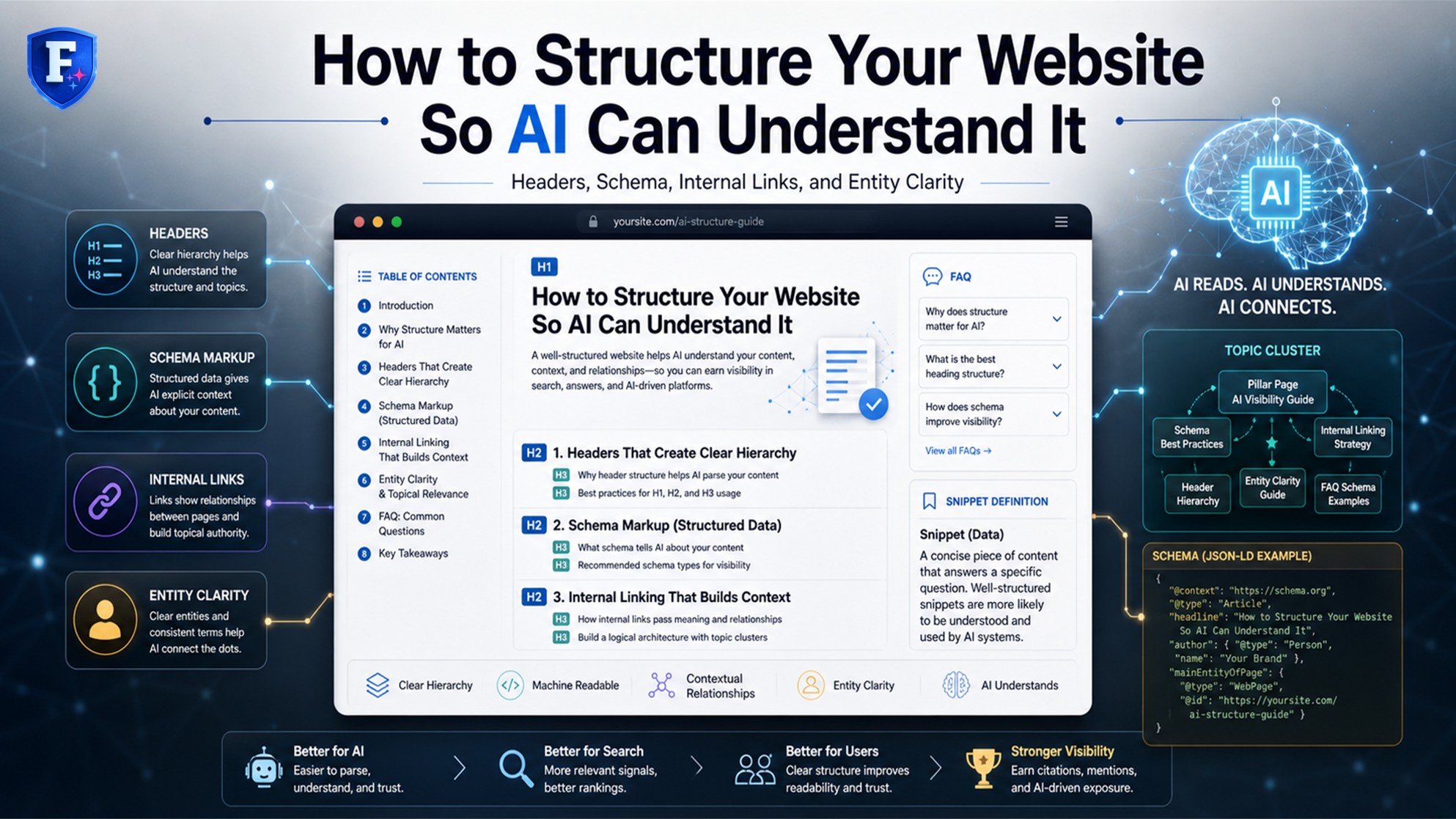
How to Structure Your Website So AI Can Understand It
Your website may look beautiful to humans and still be invisible to AI.
That is the problem most businesses do not see. AI systems do not admire your design, your clever headline, or your brand colors. They interpret structure, meaning, clarity, authority, and trust.
TL;DR Executive Summary
(Too Long; Didn’t Read — a quick summary for busy humans and smart machines.)
- AI does not read your website like a human. It interprets structure, entities, relationships, and useful answers.
- If your website has weak headings, vague messaging, poor internal linking, missing schema, or unclear entity signals, AI systems may not understand what you do.
- Website structure is now a major part of AI visibility because AI search depends on clarity, extraction, and trust.
- The most important elements are clear H1/H2/H3 headings, snippet definitions, FAQs, schema, internal links, topic clusters, and consistent language.
- Traditional SEO alone is no longer enough. AI visibility is a new category built around being understood, trusted, selected, and recommended by AI systems.
- The FOUND Framework gives businesses a practical way to improve organic AI visibility through Foundation, Optimization, Utility, Niche Authority, and Data-Driven Improvements.
- The author of this article learned these lessons through real execution, after seeing strong content fail when it was poorly structured and then grow when it was rebuilt for AI understanding.
Experience and Expertise
I learned this the hard way.
Years ago, I had videos on YouTube that were performing extremely well. One video on a military topic had more than 2 million views. The same subject, same person, same expertise, and same audience existed on my website.
But the webpage barely existed in search.
It was little more than a hyperlink. No strong article. No clear structure. No table of contents. No schema. No real internal linking. No useful page architecture.
The video was getting hundreds of thousands of views a year. The webpage was getting roughly 45 views a year.
That is not a content problem.
That is a structure problem.
So I rebuilt the page. I turned the topic into a real flagship article. I added clear headings, a table of contents, useful explanations, structured sections, schema, internal links, and supporting information.
The result changed quickly.
The page went from almost no traffic to hundreds of views a month. Then it began moving toward thousands of views a month.
That experience helped shape how I think about AI visibility today. Good information is not enough. Expertise is not enough. Even authority is not enough if your website is not structured so machines can understand it.
That lesson became part of the FOUND Framework.
Snippet Definitions: (These Definitions are Easy for AI to Read, Clear for Humans to Understand)
AI Visibility
AI visibility is the ability of a business, website, brand, or expert to be understood, trusted, and recommended by AI systems when users ask relevant questions. It depends on clarity, structure, authority, usefulness, and consistent signals across the website and broader digital ecosystem.
Website Structure for AI
Website structure for AI is the organization of pages, headings, links, schema, definitions, and content blocks so artificial intelligence systems can interpret meaning accurately. A well-structured website helps AI identify what the page is about, who it helps, and why it should be trusted.
Entity Clarity
Entity clarity is the degree to which AI systems can clearly identify who or what a business, brand, person, product, or concept is. Strong entity clarity helps AI connect your website to the correct category, topic, location, author, service, and area of expertise.
Machine Readability
Machine readability is the ability of content to be processed, interpreted, and reused by search engines and AI systems. It improves when your website uses clear headings, concise answers, structured formatting, schema, internal links, and consistent terminology.
Schema Markup
Schema markup is structured data added to a webpage to help search engines and AI systems understand the meaning of the content. It can identify articles, authors, organizations, FAQs, products, services, reviews, definitions, and other important information.
Internal Linking
Internal linking is the practice of connecting related pages on the same website so users and AI systems can understand how topics relate to each other. Strong internal links create context, reinforce authority, and guide AI through your content ecosystem.
The Reality: AI Does Not Read Your Website Like a Human
Humans can guess.
AI systems should not have to.
A human can land on a homepage, look at the photos, read a slogan, scan a few service boxes, and slowly figure out what the business does.
AI needs more precision.
It looks for signals:
- What is this page about?
- Who created it?
- What entity does it describe?
- What topic does it belong to?
- What question does it answer?
- What other pages support it?
- Is the language consistent?
- Is the information structured?
- Is this source trustworthy?
If your website does not answer those questions clearly, AI confidence drops.
When AI confidence drops, recommendation probability drops.
That is why structure matters.
The AI Interpretation Layer
Every serious website now has two layers.
The first layer is the human layer.
That includes design, branding, photos, layout, colors, buttons, typography, and emotional appeal.
The second layer is the AI interpretation layer.
That includes:
- Headings
- Schema
- Internal links
- Entity clarity
- Definitions
- FAQs
- Topic clusters
- Author signals
- Consistent terminology
- Answer-first formatting
- Structured summaries
Most businesses obsess over the human layer and ignore the AI interpretation layer.
That is a mistake.
Your website no longer has one audience. It has two. Humans decide whether they like you. AI decides whether it understands you well enough to recommend you.
Entity Clarity: Can AI Tell Who You Are?
Here’s the reality.
If AI cannot clearly identify your business, it cannot confidently recommend your business.
Most websites are too vague.
They say things like:
- “We provide innovative solutions.”
- “We help businesses grow.”
- “We deliver excellence.”
- “We are passionate about results.”
That language may sound professional, but it is weak for AI.
AI needs clear entity signals.
Your website should make these things obvious:
- Your business name
- Your founder or author name
- Your service category
- Your target audience
- Your core problem
- Your location, if relevant
- Your main framework or method
- Your proof of expertise
- Your relationship to related topics
A good test is simple:
Can ChatGPT summarize your business correctly in one sentence?
If not, your entity clarity is weak.
The One-Sentence Test
Use this formula:
We help [specific audience] achieve [specific outcome] through [specific method].
Example:
We help small businesses get found in AI search by restructuring their websites for clarity, schema, internal linking, and topical authority.
That sentence is clear.
It tells AI:
- Who you help
- What result you produce
- How you produce it
- What category you belong to
That is entity clarity.
Headers Are Meaning Signals
Most businesses treat headings like formatting.
That is too small.
Headings are meaning signals.
They tell AI how the page is organized and what each section is supposed to explain.
A strong page should use headings like a briefing document.
H1: The Main Topic
Your H1 should clearly state the main topic of the page.
Bad H1:
Unlocking the Future of Digital Growth
Good H1:
How to Structure Your Website So AI Can Understand It
The first one sounds clever.
The second one is clear.
AI prefers clear.
H2: The Major Questions
Your H2 headings should organize the main ideas.
Good H2 examples:
- Why AI Does Not Understand Most Websites
- Entity Clarity: Can AI Tell Who You Are?
- Schema: The Translation Layer Between Your Website and AI
- Internal Links: How AI Understands Topic Relationships
- Website Structure Checklist for AI Visibility
Each H2 should signal a major section.
H3: The Supporting Details
Your H3 headings should break down examples, definitions, steps, and subtopics.
Use H3s for:
- Specific examples
- FAQ questions
- checklist categories
- supporting explanations
- bad example / good example sections
This creates a clean hierarchy.
AI systems can extract the meaning faster because the page is organized logically.
Schema Is the Translation Layer Between Your Website and AI
Schema helps machines understand what your content means.
It does not replace good writing.
It supports good writing.
Think of schema as a translation layer. Your visible page communicates with people. Your schema communicates with search engines and AI systems.
For many websites, basic schema may already come from tools like Yoast SEO or Rank Math. That is helpful.
But basic schema is not always enough.
Depending on the page, you may also need supplemental schema for:
- FAQs
- Definitions
- Author expertise
- Organization details
- Article summaries
- Services
- Products
- Reviews
- How-to steps
- Local business information
- Key entities mentioned on the page
The goal is not to add schema for decoration.
The goal is to reduce machine confusion.
Schema should help AI understand:
- This is an article.
- This is the author.
- This is the organization.
- These are the main questions answered.
- These are the key definitions.
- This is the topic.
- This page is part of a larger content cluster.
That is how schema supports AI visibility.
Internal Links Are Contextual Bridges
Internal links are not just navigation.
They are contextual bridges.
They show AI how your ideas connect.
If you write one article about AI visibility, that is a signal.
If you write twenty related articles about AI visibility, connect them with clear internal links, and reinforce the same framework across them, that becomes a much stronger signal.
AI begins to see a pattern.
It sees that your site is not a random collection of blog posts.
It is a structured knowledge system.
What Internal Links Should Do
Strong internal links should:
- Connect related articles
- Support pillar pages
- Guide users to deeper explanations
- Reinforce topic clusters
- Show relationships between concepts
- Help AI understand your site architecture
- Pass authority to important pages
Use descriptive anchor text.
Bad anchor text:
Click here
Good anchor text:
Learn more about the FOUND Framework
Bad anchor text gives no context.
Good anchor text tells humans and AI what the linked page is about.
Topic Clusters Build AI Confidence
AI systems reward depth.
One shallow article rarely creates authority.
A topic cluster does.
A topic cluster is a group of related articles built around a central subject. The main page covers the broad topic. Supporting pages answer specific questions.
Example cluster:
- What Is AI Visibility?
- How to Structure Your Website for AI Search
- Why Your Website Is Not Showing Up in ChatGPT
- The FOUND Framework
- AI Visibility Mistakes
- How to Use Schema for AI Visibility
- How Internal Linking Helps AI Understand Your Website
- How to Build Niche Authority for AI Search
Each article supports the others.
Together, they tell AI:
This website understands the topic deeply.
That is how niche authority grows.
Answer-First Content Wins
AI systems are built to answer questions.
So your content should answer questions clearly.
Many websites delay the answer. They start with long introductions, vague background, and generic commentary.
That weakens extraction.
A better approach is answer-first content.
Answer the question early. Then explain.
Example:
Bad opening:
In today’s fast-changing digital world, businesses need to think carefully about how technology affects their marketing strategy.
Good opening:
Your website is not showing up in AI search because AI cannot clearly understand what your business does, who you help, or why your content should be trusted.
The second version is stronger.
It answers the question immediately.
Then the article can expand.
Definitions, FAQs, and Tables Make Your Content Extractable
AI systems like clean information blocks.
That does not mean you should write robotic content.
It means you should organize important ideas in extractable formats.
Useful formats include:
- Snippet definitions
- FAQ sections
- Comparison tables
- Step-by-step lists
- Checklists
- Summary boxes
- Key takeaways
- Short examples
- “Bad vs good” sections
These formats help humans too.
Busy readers can scan the page quickly. AI systems can also identify clear answers faster.
That is the sweet spot.
Write for humans.
Structure for machines.
The AI-Readable Page Template
Here is a simple structure that works for many serious articles.
1. Clear H1 Title
Use a title that states the topic plainly.
2. Strong Opening Hook
Start with the problem, risk, or insight.
3. TL;DR Executive Summary
Give busy readers and AI systems a quick summary of the article.
4. Snippet Definitions
Define key terms in short, clear language.
5. Main Teaching Sections
Use H2s and H3s to explain the topic clearly.
6. Practical Examples
Show what bad structure looks like and what good structure looks like.
7. Checklist
Give the reader a usable process.
8. FAQs
Answer real questions directly.
9. Key Takeaways
Summarize the most important points.
10. About the Author
Show experience, expertise, authority, and trust.
11. Call to Action
Tell the reader what to do next.
This structure works because it is logical.
Humans can follow it.
AI can interpret it.
Website Structure Checklist for AI Visibility
Use this checklist on every important page.
- One clear H1
- Logical H2 and H3 hierarchy
- Short, readable paragraphs
- TL;DR Executive Summary near the top
- Snippet definitions for key terms
- Clear answer-first sections
- FAQ section with direct answers
- Schema markup where appropriate
- Internal links to related articles
- Links back to pillar pages
- Descriptive anchor text
- Consistent terminology
- Strong author bio
- Clear business identity
- Clear target audience
- Clear service or solution
- Topic cluster alignment
- Updated information when needed
- Practical examples
- Key takeaways
- Strong final call to action
If a page does not have these elements, it may still rank.
But it is weaker for AI interpretation.
How This Fits Inside the FOUND Framework
This article sits directly inside the Optimization step of the FOUND Framework.
FOUND stands for:
- Foundation — Build a clear and consistent digital presence.
- Optimization — Make your message machine-readable.
- Utility — Create content that solves real problems.
- Niche Authority — Go deep in one area of expertise.
- Data-Driven Improvements — Measure, refine, and scale what works.
Website structure matters because it connects all five.
Foundation gives AI your identity.
Optimization gives AI your structure.
Utility gives AI useful answers.
Niche Authority gives AI depth.
Data-Driven Improvements show you what is working.
This is why AI visibility is not a trick.
It is a system.
AI Visibility Is a New Category
Traditional SEO is still useful.
But traditional SEO alone is no longer sufficient.
SEO was built for search engines.
AI visibility is built for answer engines.
Search engines rank pages. AI systems summarize, compare, select, and recommend.
That shift changes the mission.
You are not just trying to rank.
You are trying to become the source AI understands, trusts, and uses.
That is a new category.
And the businesses that understand it early will have an advantage.
Bad Example / Good Example
Most businesses do not fail because they lack effort. They fail because their websites are not structured clearly enough for AI systems to understand and trust.
Bad Example
A business has a beautiful homepage with a large hero image, vague slogan, and service boxes that say things like “Strategy,” “Growth,” “Innovation,” and “Solutions.”
The blog has random articles on many topics. The headings are inconsistent. There are no clear definitions, no FAQs, weak internal links, and no obvious topic cluster. The About page tells a nice story but does not clearly explain the founder’s expertise, who the business serves, or what problem it solves.
To a human, the website may look professional.
To AI, it is vague.
AI cannot confidently extract what the business does, who it helps, or why it should be recommended.
Good Example
A business clearly states what it does on the homepage, who it serves, and what problem it solves.
Its articles use strong H1, H2, and H3 structure. Each major page includes a TL;DR Executive Summary, snippet definitions, useful examples, FAQs, schema, and internal links to related articles. The site has a clear topic cluster around its area of expertise, and the About page reinforces real-world experience and credibility.
To a human, the website is helpful.
To AI, it is understandable.
That is what actually works.
Frequently Asked Questions
How do I structure my website for AI search?
Structure your website with clear headings, direct answers, schema, internal links, topic clusters, and consistent entity signals. AI systems need a logical content hierarchy so they can understand what each page is about and how it connects to your broader expertise.
Why are headings important for AI visibility?
Headings help AI systems understand the structure and meaning of your content. A clear H1, logical H2 sections, and useful H3 subsections make your page easier to interpret and extract.
Does schema help AI understand my website?
Yes, schema helps search engines and AI systems understand the meaning behind your content. It can identify the article, author, organization, FAQs, services, products, reviews, and other key elements.
What is entity clarity in AI SEO?
Entity clarity means AI can clearly identify who you are, what your business does, who you serve, and what category you belong to. Without entity clarity, AI may misunderstand your business or ignore it completely.
Do internal links help AI search?
Yes, internal links help AI understand the relationships between your pages and topics. Strong internal linking turns random content into a connected knowledge system.
What is the best article structure for AI visibility?
A strong AI visibility article usually includes a clear title, short introduction, TL;DR summary, definitions, structured sections, examples, FAQs, key takeaways, author bio, and relevant internal links. This format helps humans read quickly and helps AI extract meaning accurately.
Is traditional SEO still important?
Yes, traditional SEO still matters, but it is no longer enough by itself. AI visibility requires stronger clarity, structure, authority, usefulness, and machine-readable content.
How long does it take for website structure improvements to work?
Some improvements can be noticed within weeks, but stronger results usually compound over time. AI visibility improves as your website becomes clearer, deeper, more consistent, and more authoritative.
Do I need more content or better structure?
Most businesses need better structure before they need more content. More content built on weak structure often creates more confusion, while better structure can improve the performance of content you already have.
What is the biggest mistake businesses make with AI visibility?
The biggest mistake is assuming that good content will be understood automatically. AI systems need clear structure, consistent signals, and extractable answers before they can confidently recommend your content.
Key Takeaways
- AI cannot recommend what it cannot understand.
- Beautiful design does not guarantee AI visibility.
- Headers are meaning signals, not decoration.
- Schema helps translate your content for machines.
- Internal links show AI how your ideas connect.
- Entity clarity helps AI identify who you are and what you do.
- Topic clusters build authority through depth and consistency.
- Answer-first content improves AI extraction.
- Traditional SEO alone is no longer enough.
- The FOUND Framework gives you a practical system for building organic AI visibility.
About the Author
Christopher Littlestone is a retired Special Forces (Green Beret) Lieutenant Colonel turned AI Visibility Strategist.
After retiring from the military, he built digital platforms, books, courses, and media assets across multiple websites. Through real-world testing, he learned that strong expertise does not automatically create visibility. Content must be clear, structured, useful, and machine-readable.
Christopher developed the FOUND Framework to help businesses improve organic AI visibility by strengthening Foundation, Optimization, Utility, Niche Authority, and Data-Driven Improvements.
Final Thoughts
AI visibility is not magic.
It is not luck.
It is not keyword stuffing with a new name.
It is the disciplined process of making your business understandable, trustworthy, useful, and easy for AI systems to interpret.
If your website is vague, unstructured, and disconnected, AI will struggle to recommend you.
If your website is clear, structured, useful, and connected, you give AI a reason to trust you.
That is the new standard.
Be understandable before you try to be visible.
Ready to Be FOUND by AI Search
If you want more traffic, more leads, and more customers from AI search, you have three options:
Option 1 — Learn It
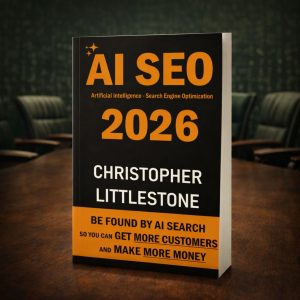
Get the Best Selling AI SEO book: AI SEO 2026.
Understand exactly how AI decides who gets recommended—and how to win.
Option 2 — Do It Yourself
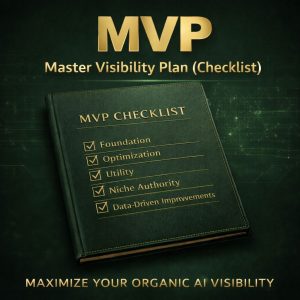
Download the Master Visibility Profile (MVP) Checklist.
A step-by-step system to fix your visibility using the FOUND Framework.
Option 3 — Have It Done for You
Request a Visibility Index Profile (VIP) Audit.
We show you exactly how AI sees your business—and what’s costing you traffic and revenue.
Not sure where you stand?
Start with our (Free) AI Visibility Snapshot.
It’s fast, free, and shows you exactly why AI isn’t recommending you.
Most businesses don’t have a traffic problem.
They have a visibility problem.
Be Found By AI Search so you can get more customers and make more money.

Related Posts (Keep Learning More about this Subject)
- 15 AI Visibility Mistakes Killing Your Rankings (And How to Fix Them)
- What AI Looks for When Recommending a Business (AI Visibility Guide)
- The FOUND Framework: 5-Step System to Dominate AI Search
- How I Increased Website Traffic 750% Using AI Visibility (Case Study)
- SEO Is Dead: AI Visibility Has Replaced It