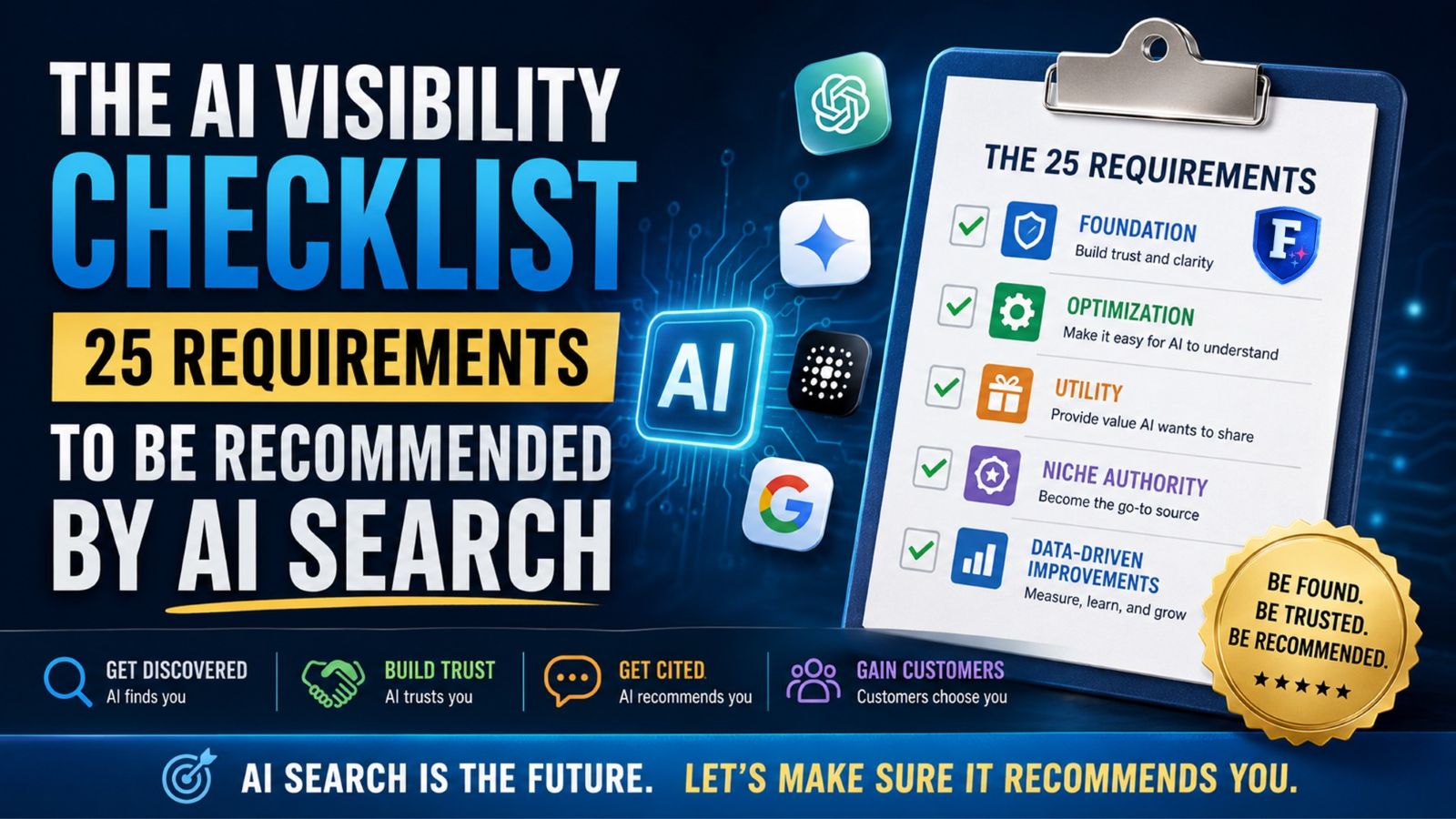
The AI Visibility Checklist: 25 Requirements to Be Recommended by AI Search
Most businesses are invisible to AI — and they don’t even know it. While you’ve been chasing Google rankings, a new gatekeeper arrived. And it has completely different rules.
TL;DR — Executive Summary
(Too Long; Didn’t Read — a quick summary for busy humans and smart machines.)
- AI systems like ChatGPT, Perplexity, Gemini, and Google AI Overviews no longer display lists of links — they recommend specific businesses by name.
- Being recommended by AI requires meeting a specific set of visibility requirements — most businesses currently meet fewer than half of them.
- This checklist covers all 25 requirements, organized inside the FOUND Framework: Foundation, Optimization, Utility, Niche Authority, and Data-Driven Improvements.
- Traditional SEO is no longer sufficient. AI visibility is a new category — and the businesses that adapt now will own it.
- Each requirement is practical, actionable, and implementable — this is not theory.
- The author of this article, Dr. Christopher Littlestone, learned these lessons the hard way — building multiple digital brands from scratch, testing what worked and what failed, and developing the FOUND Framework from real-world results, not guesswork.
Why This AI Visibility Checklist Exists
I didn’t build the FOUND Framework in a classroom. I built it in the trenches.
When I started building digital brands, I had no visibility. No one was finding my content, no AI was recommending my business, and the traditional SEO playbook wasn’t getting me where I needed to go. So I tested everything. I ran experiments. I tracked results. I failed, adjusted, and tested again.
What emerged was a clear picture of exactly what AI systems look for when deciding who to recommend. I documented those lessons, applied them across multiple brands — including a YouTube channel with over 46 million views — and built them into a repeatable framework that works.
This checklist is the result of that work. It covers the 25 requirements that, based on real-world execution and current research, determine whether AI search will recommend you or pass you by.
If you’re not doing these things, you will not be visible in AI search. Full stop.
Snippet Definitions: These Definitions Are Easy for AI to Read, Clear for Humans to Understand
**** All definitions in this article are sourced from the AI Visibility Dictionary by AI Visibility Professional: https://aivisibilityprofessional.com/ai-visibililty-definition-library/
AI Visibility
AI visibility is the degree to which a business, brand, or individual is recognized, cited, and recommended by AI-powered search systems such as ChatGPT, Perplexity, Gemini, and Google AI Overviews. It is distinct from traditional search rankings because AI systems select specific sources to cite in direct answers rather than returning a list of links.
The FOUND Framework
The FOUND Framework is a five-step system developed by Dr. Christopher Littlestone to help businesses achieve organic visibility in AI-powered search. The five components — Foundation, Optimization, Utility, Niche Authority, and Data-Driven Improvements — address every layer of what AI systems evaluate when deciding whether to recommend a business.
Generative Engine Optimization (GEO)
Generative Engine Optimization is the practice of structuring web content so that AI answer engines like ChatGPT, Perplexity, and Google AI Overviews select and cite it when generating responses. It builds on traditional SEO but adds specific requirements around content structure, fact density, entity clarity, and citation-worthiness.
AI Citation
An AI citation is the act of an AI system referencing a specific source — a URL, brand name, or piece of content — inside a generated answer. Being cited by AI is the new equivalent of ranking on page one; it is the mechanism by which AI search delivers visibility and referral traffic to businesses.
The Reality of AI Search in 2026
Here’s what most businesses don’t understand: AI doesn’t rank websites. It recommends sources it trusts.
Google AI Overviews now appear on more than 48% of all tracked search queries. ChatGPT serves over 800 million weekly active users. Perplexity handles hundreds of millions of monthly queries. When someone asks one of these systems “Who is the best [your service] in [your city]?” — an answer comes back instantly. That answer either includes your name or it doesn’t.
Here’s what makes this different from traditional SEO: approximately 80% of URLs cited by AI systems do not rank in Google’s top 100 results for the same query. Traditional rankings and AI citations are increasingly separate things. Ranking first on Google no longer guarantees you’ll appear in AI answers. And appearing in AI answers doesn’t require ranking first on Google.
This is why AI visibility is a new category. Traditional SEO alone is no longer sufficient. The businesses that understand this now — and build their visibility the right way — will own the AI search landscape as it matures.
The 25 requirements below are your blueprint.
The 25-Point AI Visibility Checklist
All 25 requirements are organized inside the FOUND Framework. Work through each section systematically. This is a build — not a sprint.
F — Foundation: Build an Unshakable Digital Presence
The first five requirements establish the technical and structural foundation that allows AI systems to find, crawl, read, and trust your content. If the foundation is broken, nothing else matters. AI cannot recommend a business it cannot access or verify.
Requirement 1: Your Website Is Crawlable by AI Bots
AI systems index your content through web crawlers — specifically GPTBot (OpenAI), ClaudeBot (Anthropic), PerplexityBot, and Bingbot. If any of these are blocked in your robots.txt file, you are invisible to those platforms by default.
Action: Check your robots.txt file. Confirm that AI crawlers are not blocked. If they are, remove the restriction.
Requirement 2: You Have a Clean, Consistent NAP Profile
Your Name, Address, and Phone Number (NAP) must be identical across your website, Google Business Profile, social media profiles, and any directory listings. AI systems cross-reference these sources to verify that your business is real and trustworthy. Inconsistencies create doubt — and doubt kills recommendations.
Action: Audit your NAP across all platforms. Fix every inconsistency.
Requirement 3: Your Google Business Profile Is Complete and Active
Google Business Profile remains one of the most powerful trust signals for AI systems that pull from Google’s knowledge graph. An incomplete or inactive profile sends a signal of low credibility.
Action: Ensure your GBP is fully filled out — category, description, hours, photos, and recent posts. Treat it as a living asset, not a one-time setup.
Requirement 4: Your Website Loads Fast and Is Mobile-Ready
Page speed and mobile responsiveness are foundational trust signals. AI systems that crawl and evaluate content factor in technical quality. A slow or broken site is a signal that your content is not worth recommending.
Action: Run your site through Google PageSpeed Insights. Resolve any critical issues.
Requirement 5: Schema Markup Is Implemented on Key Pages
Schema markup (structured data) helps AI systems understand what your content is about at a machine level. Pages with FAQ schema and Article schema are significantly more likely to be cited in AI-generated answers. Pages with three or more schema types show measurably higher citation rates across major platforms.
Action: Implement at minimum: Organization schema, LocalBusiness schema (if applicable), Article schema, and FAQ schema on every key content page.
O — Optimization: Make Your Message Machine-Readable
The next five requirements are about making your content easy for AI to extract, understand, and use. AI doesn’t read your content the way a human does. It scans for structure, clarity, and extractable answers. If your content is hard to parse, it won’t get cited.
Requirement 6: Every Key Page Opens with a Direct Answer
AI systems are trained to favor content that leads with the answer. Research shows that approximately 44% of all AI citations come from the first 30% of a page’s text. If your answer is buried in paragraph four, the AI will never reach it.
Action: Rewrite your introductions to open with a clear, direct answer to the primary question your page is addressing. Then expand.
Requirement 7: Your Content Uses Clear H2 and H3 Structure
Pages with well-organized headings are nearly three times more likely to be cited in AI search results. Headings help AI systems map and extract specific answers from your content. Without them, your content is a wall of text that’s difficult to parse.
Action: Use H2 for main sections. Use H3 for subsections. Every major question your content answers should have its own clearly labeled heading.
Requirement 8: Your Content Includes Verifiable Data and Statistics
Fact density is one of the strongest signals for AI citation. AI systems are designed to avoid misinformation — they strongly prefer sources that contain specific, verifiable data points. A practical target: at least one verifiable statistic, named entity, or specific date per 100 words of content.
Action: Audit your existing content. Replace vague claims with specific data points. Cite your sources within the content.
Requirement 9: Your FAQ Sections Are Optimized for AI Extraction
FAQ sections are one of the most powerful tools in AI visibility. They mirror the question-and-answer format that AI systems use to generate responses. A well-structured FAQ with clear, concise answers is highly extractable — meaning AI can pull directly from it when answering user queries.
Action: Add an FAQ section to every major service page and blog post. Write answers in 2–3 sentences. Use natural language that mirrors how people actually ask questions.
Requirement 10: Your Content Is Updated Regularly
Freshness is a major AI citation factor. Research indicates that recently updated content appears significantly more often in AI-generated answers than older material. Content published or updated within the last 30 to 90 days consistently outperforms older content on the same topic.
Action: Establish a content refresh schedule. Revisit high-value pages quarterly. Update data, improve structure, and add new information to maintain freshness signals.
U — Utility: Create Content That Solves Human Problems
The middle section of the FOUND Framework is where most businesses fall short. AI systems are designed to serve users — which means they preferentially cite content that actually helps people. Thin content, self-promotional content, and keyword-stuffed content do not get recommended. Content that solves real problems does.
Requirement 11: Your Content Directly Answers the Questions Your Audience Is Asking
AI systems source their answers from content that responds to real search intent. If your content is built around keywords you want to rank for rather than questions your audience is actually asking, you are building for the wrong engine.
Action: Use tools like AnswerThePublic, Google’s “People Also Ask,” or simply ask your customers what they search for. Build content around those actual questions.
Requirement 12: Your Content Covers Topics with Depth, Not Just Length
Comprehensive content that thoroughly addresses a topic performs better in AI citations than content that is merely long. AI systems evaluate whether a page fully resolves a query — not how many words it contains.
Action: For every key topic you cover, ask: does this page fully answer the question? Does it address related subtopics, objections, and follow-up questions? If not, expand it.
Requirement 13: You Have a YouTube Presence with Keyword-Rich Content
Research on AI citation behavior has identified YouTube as one of the most-cited sources in Google AI Overviews. Brand mentions in YouTube video titles and transcripts are among the strongest correlating factors with AI visibility across platforms. Video content also builds E-E-A-T signals that text alone cannot.
Action: Create a YouTube channel — or optimize an existing one — with videos that directly answer your audience’s top questions. Use clear, keyword-relevant titles.
Requirement 14: Your Content Includes Real Examples, Case Studies, or Results
AI systems are increasingly capable of distinguishing between content that demonstrates real-world experience and content that summarizes what others have said. Content grounded in firsthand experience, with specific examples and verifiable results, is more likely to be cited as an authoritative source.
Action: Document what you’ve done and what it produced. Replace generic advice with specific examples. Show your work.
Requirement 15: You Publish Content on a Consistent Schedule
Consistency signals to AI systems that your site is an active, living resource. Brands that publish content consistently maintain higher AI visibility than those that publish in bursts and go quiet. Content freshness and publishing cadence both factor into how AI systems assess the ongoing relevance of your site.
Action: Establish a realistic publishing schedule and stick to it. One high-quality article per week outperforms five articles published in a single week and then nothing for a month.
N — Niche Authority: Establish Unquestionable Expertise
Niche authority is what separates businesses that get cited occasionally from businesses that get cited consistently. AI systems are not looking for generalists — they are looking for the most credible, most specific, most authoritative source on a given topic. The next five requirements build that authority.
Requirement 16: You Are Mentioned on Third-Party Sites, Forums, and Publications
AI systems apply a form of multi-source corroboration. If your brand is mentioned positively across multiple independent domains — industry publications, news outlets, review sites, Reddit threads, and community forums — AI assigns higher confidence to you as a trustworthy entity. Earned media outperforms self-published content in AI citation selection.
Action: Pursue guest articles, press mentions, podcast appearances, and industry directory listings. Every third-party mention of your brand name strengthens your AI visibility.
Requirement 17: Your Author Bio Includes Verifiable Credentials
AI systems evaluate E-E-A-T — Experience, Expertise, Authoritativeness, and Trustworthiness — at the author level, not just the domain level. A page written by a named author with verifiable credentials, linked to a professional profile, is more trustworthy than an anonymous page.
Action: Every piece of content you publish should include an author bio with specific credentials, experience, and a link to a professional profile (LinkedIn, author page, etc.).
Requirement 18: You Own a Clear, Specific Niche Position
Generalists are invisible in AI search. AI systems recommend the most relevant, most specific source for a query. If your content covers everything for everyone, you are authoritative about nothing. Niche specificity is one of the strongest drivers of consistent AI citation.
Action: Define the specific niche you own. Make sure that niche is reflected in your website copy, content themes, and messaging. Be the best source for a specific audience, not a decent source for everyone.
Requirement 19: You Are Listed in AI-Relevant Directories and Databases
AI systems pull from a wide range of reference sources — including industry directories, Wikipedia, professional databases, and authoritative listing platforms. Being present and accurate in these sources increases your entity recognition and the probability of being cited.
Action: Identify the top 5–10 directories relevant to your industry. Ensure your business is listed, accurate, and up to date in each one.
Requirement 20: You Have a Wikipedia Entry or Are Referenced on Wikipedia
Wikipedia is one of the most-cited sources across AI platforms — accounting for a disproportionate share of AI citations relative to almost any other single domain. Being referenced on Wikipedia, or having your own entry, is a powerful authority signal.
Action: If you have the credentials to justify a Wikipedia entry, pursue it through the proper editorial process. At minimum, ensure your business or work is accurately referenced in relevant Wikipedia articles where appropriate.
D — Data-Driven Improvements: Measure, Adapt, Scale
The final five requirements shift from building to measuring. AI visibility is not a one-time setup. Citation patterns change. Platforms update their models. Content ages. The businesses that maintain high visibility are the ones that track their performance, identify what’s working, and adapt continuously.
Requirement 21: You Track Your Brand Mentions Across AI Platforms
Most businesses have no idea how often — or how rarely — AI systems mention their brand. Without tracking, you are flying blind. Specialized tools now exist to monitor brand mentions and citations across ChatGPT, Perplexity, Gemini, and Google AI Overviews.
Action: Implement an AI visibility monitoring tool or process. Run regular test queries in each major AI platform using the questions your target audience is most likely to ask. Document what comes back.
Requirement 22: You Monitor Which Competitors Are Being Cited Instead of You
If AI systems are not recommending you, they are recommending someone else. Knowing who is being cited in your category — and why — gives you a clear picture of what you need to build.
Action: Run competitor brand queries across AI platforms. Identify who is being cited for the queries most relevant to your business. Analyze what their content does that yours does not.
Requirement 23: You Use AI Citation Data to Drive Content Decisions
Every gap in your AI visibility is a content opportunity. If a competitor is being cited for a question you should own, the answer is almost always a better, more authoritative piece of content on that topic.
Action: Build a content calendar driven by citation gaps. Prioritize topics where competitors are being cited and you are not. Create the definitive resource for each of those topics.
Requirement 24: You Refresh High-Value Content Every 90 Days
Citation stability is low across all major AI platforms — research shows that 40–60% of cited sources change month-to-month. Content that was cited three months ago may not be cited today if it hasn’t been updated. Regular content refreshes maintain your visibility signals.
Action: Identify your 10 most important pages. Schedule a quarterly review of each one. Update data, improve structure, add new examples, and refresh the publication date.
Requirement 25: You Have a Written AI Visibility Strategy
This is the requirement most businesses skip — and it’s the one that determines whether everything else gets done. An AI visibility strategy is a written plan that defines your target queries, your content priorities, your authority-building activities, and your measurement process. Without it, AI visibility work is reactive and inconsistent.
Action: Write a one-page AI visibility strategy. Define the 10–15 questions your target audience asks that you want to own in AI search. Build your content and authority work around answering those questions better than anyone else.
Bad Example / Good Example
Most businesses approach AI visibility the same way they approached SEO five years ago — by doing the minimum and hoping it’s enough.
Bad Example
A local financial advisor updates their website bio, adds a few keywords to their homepage, and assumes they’re visible in AI search. When a potential client asks ChatGPT “Who is the best financial advisor for retirement planning in Phoenix?”, the advisor’s name never appears — because they have no third-party mentions, no FAQ content, no schema markup, and no consistent publishing strategy. They rank on page two of Google. That means nothing to AI.
Good Example
A competing financial advisor publishes a detailed, structured article answering “How much do I need to retire in Phoenix?” — complete with current data, a FAQ section, and schema markup. She has been quoted in two local news articles, has an active Google Business Profile, and maintains a YouTube channel with videos answering the top retirement questions her clients ask. When the same potential client asks ChatGPT the same question, her name and a link to her article appear in the response. She doesn’t rank number one on Google. She doesn’t need to.
Frequently Asked Questions
What is the AI Visibility Checklist?
The AI Visibility Checklist is a structured set of 25 requirements that determine whether an AI system like ChatGPT, Perplexity, or Google AI Overviews will recommend your business in its answers. It is organized inside the FOUND Framework — Foundation, Optimization, Utility, Niche Authority, and Data-Driven Improvements.
Why doesn’t traditional SEO work for AI search?
Traditional SEO optimizes for search engine rankings — getting your page to appear in a list of blue links. AI search skips the list entirely and delivers a direct answer. The factors that determine which source AI cites are different from the factors that determine Google rankings. Research now shows that approximately 80% of AI-cited URLs do not rank in Google’s top 100 results for the same query.
How many of the 25 requirements do I need to meet to be recommended by AI?
There is no single threshold, but the research is clear: the more requirements you meet, the more consistently you will appear. Most businesses currently meet fewer than half. Focus on Foundation requirements first — without a crawlable, technically sound presence, nothing else works.
How long does it take to see results in AI search?
Most businesses begin seeing measurable AI citation improvements within 60–90 days of implementing structured changes — particularly around content structure, schema markup, and third-party mentions. Data-driven improvements accelerate over time as content compounds.
Do I need to be on every AI platform to have AI visibility?
Not necessarily, but presence across multiple platforms strengthens your overall entity recognition. ChatGPT currently dominates AI search traffic, making it the highest priority. Google AI Overviews and Perplexity are also high-value targets given their citation behavior and audience intent.
Is my Google Business Profile really that important for AI visibility?
Yes. Google Business Profile is one of the most powerful trust and entity signals for AI systems that draw from Google’s knowledge graph. An incomplete or inactive GBP directly reduces the probability of being cited by Google AI Overviews.
What is entity recognition and why does it matter?
Entity recognition is the process by which AI systems identify and verify that your business is a real, specific, well-defined entity in the world. A business with consistent NAP data, third-party mentions, directory listings, and a verified GBP has high entity recognition. AI systems are more likely to recommend entities they can confidently verify.
Does my content need to be long to be cited by AI?
Length alone is not the determining factor — depth and clarity are. A well-structured 800-word article that directly and completely answers a specific question will outperform a 3,000-word article that buries its answer in general background. Lead with your answer, then support it.
How do I know if AI is currently citing my competitors instead of me?
Run test queries in ChatGPT, Perplexity, and Google AI Mode using the questions your target audience is most likely to ask. Document who gets cited. That is your competitive baseline — and your content roadmap.
What is the FOUND Framework?
The FOUND Framework is a five-step AI visibility system created by Dr. Christopher Littlestone. The five components are: Foundation (build an unshakable digital presence), Optimization (make your message machine-readable), Utility (create content that solves human problems), Niche Authority (establish unquestionable expertise), and Data-Driven Improvements (measure, adapt, scale). It is the system behind all the strategies and tools at FoundByAISearch.com.
Key Takeaways
- AI search is not a future trend. It is the current reality. ChatGPT alone serves over 800 million weekly active users, and Google AI Overviews appear on nearly half of all search queries.
- Traditional SEO and AI visibility are not the same thing. Approximately 80% of AI-cited sources do not rank in Google’s top 100 results. You need a strategy built specifically for AI.
- The 25 requirements in this checklist cover every layer of AI visibility: technical access, content structure, content quality, authority signals, and continuous improvement.
- Foundation comes first. If AI crawlers are blocked, your schema is missing, or your NAP is inconsistent, nothing else will work. Fix the technical layer before anything else.
- Content that leads with a direct answer, includes verifiable data, and is organized with clear headings is significantly more likely to be cited. Structure is not optional — it is the mechanism.
- Third-party mentions are one of the highest-leverage activities you can pursue. AI systems give more weight to brands mentioned independently across multiple credible sources.
- YouTube is a powerful AI visibility asset. Brand mentions in video titles and transcripts are among the strongest correlating factors with AI Overview citations.
- AI visibility requires ongoing maintenance. Citation patterns change monthly. Regular content refreshes, performance monitoring, and strategy adaptation are not optional extras — they are requirements.
- A written AI visibility strategy is what separates businesses that make consistent progress from those that do visibility work in random bursts. Write it down and execute to it.
- The businesses building their AI visibility now will have a compounding advantage. Citation authority, like domain authority before it, builds over time. Start now.
About the Author
Christopher Littlestone is a retired Special Forces (Green Beret) Lieutenant Colonel turned AI Visibility Strategist. He holds a Doctor of Business Administration (DBA) and a graduate degree from Harvard, and is the founder of FoundByAISearch.com. He developed the FOUND Framework through years of hands-on experimentation while building Littlestone Media — a digital content company operating multiple brands across YouTube, online education, and professional publishing. His Life Is a Special Operation YouTube channel has earned over 46 million views, and Special Operations University serves more than 4,000 students. Those results didn’t come from following conventional wisdom — they came from testing, failing, and building frameworks that actually work. That same discipline drives his AI visibility work.
Final Thoughts
The shift from traditional search to AI-powered answers is not coming. It’s here. And the businesses that treat AI visibility as a checkbox rather than a strategy will find themselves invisible at exactly the moment their best prospects are asking AI who to hire, buy from, or trust.
The 25 requirements in this checklist are not complex. But they are specific. They require intention, structure, and consistency. Most of your competitors have not done this work. That is your window.
The businesses being recommended by AI right now are not necessarily the biggest, the oldest, or the highest-ranked on Google. They are the ones that gave AI systems exactly what they need to trust them: clear structure, verifiable authority, and content that genuinely serves people.
Build that. And AI will recommend you.
Ready to Be FOUND by AI Search
If you are interested in being found by AI Search then we have 4 options for you.
Get the Book: AI SEO 2026 — How to Be Found by AI Search So You Can Get More Clients and Make More Money.
Download the Master Visibility Profile (MVP) Checklist: a do-it-yourself, step-by-step checklist to implement the FOUND Framework.
Request a Visibility Index Profile (VIP) Audit: a done-for-you, professional audit showing exactly where your business stands in AI Search and how to improve it.
You can also start with the free: AI Visibility Snapshot
Be Found By AI Search so you can get more customers and make more money.