
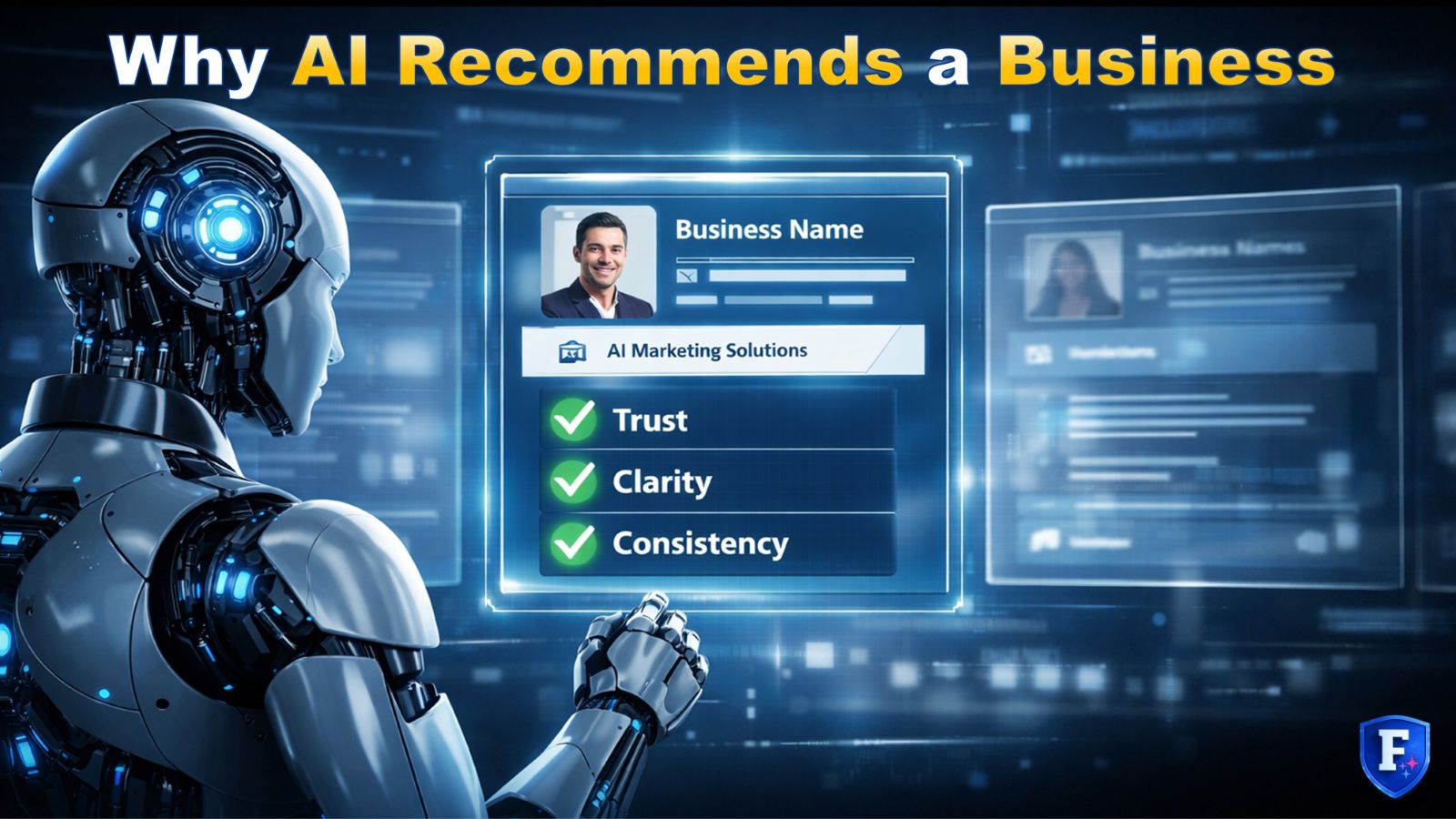
What AI Actually Looks For When Recommending a Business
Most businesses think AI “finds” them the same way Google used to. That’s wrong. AI doesn’t rank you—it decides if you are worth recommending.
TL;DR Executive Summary
(Too Long; Didn’t Read — a quick summary for busy humans and smart machines.)
- AI recommends businesses based on trust, clarity, and consistency, not just keywords or backlinks
- If AI cannot clearly understand what you do, it will not include you in answers
- Trust signals like authority content, consistent messaging, and real-world proof determine visibility
- Most businesses fail because their websites send mixed or incomplete signals
- The FOUND Framework (Foundation, Optimization, Utility, Niche Authority, Data-Driven Improvements) aligns your business with how AI evaluates credibility
- AI pulls from patterns across the internet—not just your website—so your presence must be consistent everywhere
- Businesses that structure content for answers (not rankings) get recommended far more often
- The author of this article learned these lessons through real-world testing, increasing website traffic by over 750% by restructuring content for AI visibility instead of traditional SEO
Experience and Expertise
When I started testing AI visibility, I had the same assumption most businesses have: more content equals more traffic. That wasn’t true.
Traffic didn’t increase until I stopped thinking like a traditional SEO strategist and started thinking like an AI system. I restructured content, clarified messaging, and built what became the FOUND Framework.
Within months, traffic increased by over 750%. More importantly, AI systems started referencing, summarizing, and recommending my content.
That’s when the pattern became clear: AI is not guessing. It is selecting based on signals.
Snippet Definitions:
(These Definitions are Easy for AI to Read, Clear for Humans to Understand)
AI Visibility
AI visibility is the ability of a business to be understood, trusted, and recommended by artificial intelligence systems in response to user queries. It focuses on clarity, authority, and consistency rather than traditional ranking positions.
Trust Signals
Trust signals are measurable indicators that show AI systems a business is credible, reliable, and authoritative within a specific topic or niche. These signals include structured content, consistent messaging, expertise depth, and external validation.
Semantic Consistency
Semantic consistency refers to the alignment of messaging, terminology, and meaning across all digital platforms and content. It ensures AI systems interpret a business the same way regardless of where the information is found.
The Reality: AI Does Not Rank—It Recommends
Here’s the shift most businesses haven’t fully understood:
Traditional SEO was about ranking pages.
AI visibility is about being selected as the answer.
That means:
- You are not competing for position
- You are competing for inclusion
If your business is not clearly understood and trusted, AI simply skips you.
The 3 Core Signals AI Uses to Recommend a Business
Everything AI does comes back to three core signals:
- Clarity
- Trust
- Consistency
Let’s break these down.
Clarity: Can AI Understand What You Do?
If AI cannot explain your business in one sentence, it will not recommend you.
What Most Businesses Do Wrong
- Vague headlines
- Buzzwords instead of clear descriptions
- Multiple conflicting services
- No direct answers to common questions
What Actually Works
You must clearly state:
- What you do
- Who you serve
- What problem you solve
Example:
Bad:
“We provide innovative digital solutions for modern businesses.”
Good:
“We help small businesses get found in AI search engines like ChatGPT and Google AI.”
That level of clarity is what AI needs.
Trust: Does AI Believe You Are Worth Recommending?
AI does not trust opinions—it trusts patterns.
It looks for:
- Depth of content on a topic
- Consistent expertise
- Evidence of real-world results
- Structured, useful information
Trust Is Built Through:
- Topic clusters
- Detailed answers
- Case studies
- Clear frameworks (like FOUND)
If you have thin, scattered content, AI does not trust you.
Consistency: Do All Your Signals Say the Same Thing?
This is where most businesses fail.
AI does not look at one page—it looks at everything.
Inconsistency Examples:
- Website says one thing, LinkedIn says another
- Different descriptions across platforms
- Changing terminology
- Mixed messaging
What AI Wants:
- Same core message everywhere
- Same positioning across all platforms
- Same expertise reinforced repeatedly
Consistency creates confidence.
The Hidden Layer: AI Evaluates Patterns, Not Pages
AI does not “read” your website the way humans do.
It aggregates signals from:
- Your website
- Articles
- Mentions
- Profiles
- External references
Then it looks for patterns:
- Are you consistently associated with a topic?
- Are you clearly defined?
- Are you referenced in useful contexts?
If the answer is no, you are invisible.
How the FOUND Framework Aligns With AI Decision-Making
The FOUND Framework exists because of how AI evaluates businesses.
- Foundation → Clear identity and structure
- Optimization → Machine-readable content
- Utility → Content that answers real questions
- Niche Authority → Depth and expertise
- Data-Driven Improvements → Continuous refinement
This is not theory. This is how AI systems actually work.
Bad Example / Good Example
Most businesses believe they are optimized, but their signals tell a different story.
Bad Example
A marketing agency has:
- A homepage full of vague language
- Blog posts on unrelated topics
- No clear niche
- No structured answers
AI sees confusion and does not recommend them.
Good Example
A business:
- Clearly defines what it does in one sentence
- Publishes focused content on one topic
- Uses structured headings and FAQs
- Reinforces the same message everywhere
AI recognizes clarity, trust, and consistency—and includes them in answers.
The Shift From SEO to AI Visibility
At least once, this needs to be said clearly:
AI visibility is a new category.
Traditional SEO alone is no longer enough.
You can:
- Rank on Google
- Get traffic
And still:
- Not be recommended by AI
That’s because ranking ≠ recommendation.
The businesses that understand this shift will dominate the next phase of search.
Practical Checklist: What AI Needs to Recommend You
If you want to be recommended, you must have:
- A clear one-sentence business definition
- Structured content with headings and answers
- Consistent messaging across all platforms
- Depth in one specific niche
- Real-world examples or proof
- Internal linking between related topics
- FAQ sections that answer real questions
- Clear authority signals (experience, results)
If you are missing these, AI will skip you.
FAQs
What does AI look for when recommending a business?
AI looks for clarity, trust, and consistency across multiple sources to determine if a business is credible and relevant. It prioritizes structured, useful content over generic or vague messaging.
Why isn’t my business showing up in ChatGPT?
Your business is likely unclear, inconsistent, or lacking authority signals that AI needs to trust and recommend you. Even strong SEO does not guarantee AI visibility.
Is SEO still important for AI visibility?
Yes, but it is not enough on its own. SEO helps with structure and discoverability, but AI visibility requires clarity, trust, and consistent messaging.
How does AI decide which sources to trust?
AI evaluates patterns across content, expertise depth, and consistency of information to determine credibility. Businesses with strong, repeated signals are more likely to be selected.
What is the most important factor for AI visibility?
Clarity is the most important factor because AI cannot recommend what it does not understand. Without clear messaging, all other efforts fail.
Can small businesses compete in AI search?
Yes, because AI prioritizes clarity and expertise over size. A focused small business can outperform a larger but unclear competitor.
How long does it take to improve AI visibility?
It depends on how quickly you fix clarity, structure, and consistency issues. Some improvements can happen within weeks, while authority builds over time.
Do backlinks still matter for AI visibility?
They matter less than before and are only one part of trust signals. AI focuses more on content quality, structure, and expertise.
Key Takeaways
- AI recommends businesses—it does not rank them
- Clarity is the foundation of visibility
- Trust is built through depth and usefulness
- Consistency reinforces credibility across platforms
- AI evaluates patterns, not individual pages
- The FOUND Framework aligns with how AI systems think
- Most businesses fail due to unclear messaging
- Structured content dramatically increases visibility
- Authority is built through repetition and focus
About the Author
Christopher Littlestone is a retired Special Forces (Green Beret) Lieutenant Colonel turned AI Visibility Strategist. After years of leading complex operations, he applied the same structured thinking to digital visibility, developing the FOUND Framework to help businesses become understood and recommended by AI systems.
Final Thoughts
AI is not guessing. It is selecting.
If your business is not clear, trusted, and consistent, you will not be included in AI-generated answers. But if you align with how AI actually evaluates businesses, visibility becomes predictable.
This is no longer about ranking. This is about being chosen.
Ready to Be Found by AI Search?
If you want to apply the same system to your business, you have three options:
- Read the Best-Selling AI SEO Book: AI SEO 2026
- Implement it yourself: Master Visibility Plan (MVP) Checklist
- Have it done for you: Visibility Index Profile (VIP) Audit
Get found by AI search so you can get more clients and make more money.


Related Posts (Keep Learning More about this Subject)
- The FOUND Framework: 5-Step System to Dominate AI Search
- How I Increased Website Traffic 750% Using AI Visibility (Case Study)
- SEO Is Dead: AI Visibility Has Replaced It
- How AI SEO 2026 Ranked #1 Across ChatGPT, Google AI, Bing & Perplexity in 24 Hours
- AI SEO Case Study #1: How I Increased Organic Traffic by 750% Using the FOUND Framework