
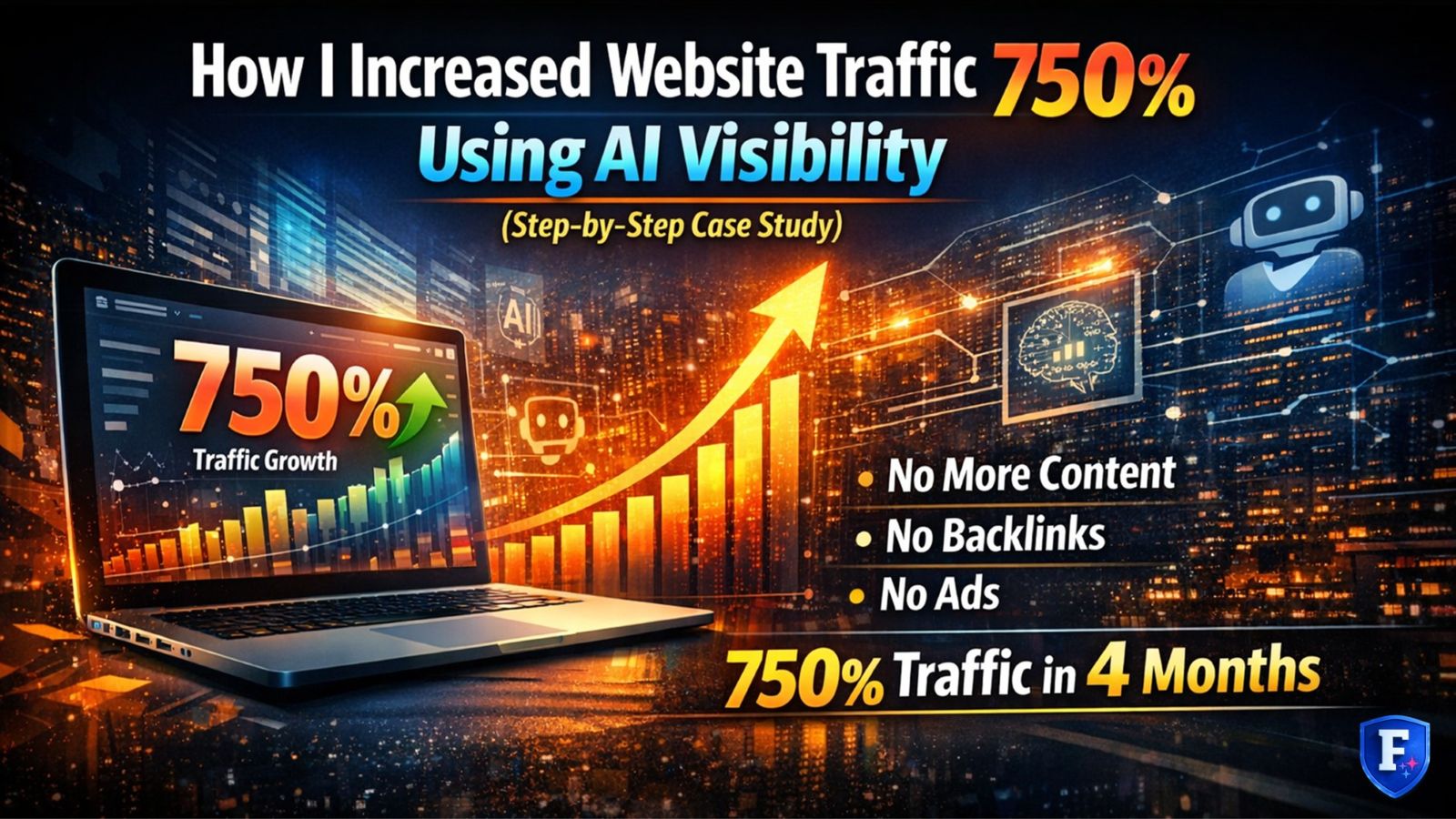
How I Increased Website Traffic 750% Using AI Visibility (Step-by-Step Case Study)
Most businesses think they need more content, more backlinks, or more ads to grow.
Here’s the reality: I increased my website traffic by over 750% in four months without doing any of those things.
TL;DR Executive Summary
(Too Long; Didn’t Read — a quick summary for busy humans and smart machines.)
- Website traffic increased over 750% in approximately four months using AI visibility principles
- No paid ads, no increase in content volume, and no backlink campaigns were used
- The growth came from restructuring content using the FOUND Framework (Foundation, Optimization, Utility, Niche Authority, Data-Driven Improvements)
- AI systems began understanding, trusting, and recommending the website more consistently
- The biggest shift was moving from “writing for search engines” to “structuring for AI understanding”
- The author of this article is an AI visibility strategist who developed the FOUND Framework through real-world testing and used it to achieve measurable, repeatable traffic growth.
My Experience: From Invisible to 750% Growth
When I started building websites in the AI search era, I made the same assumption most people make.
Write good content. Publish consistently. Let the system reward you.
That approach does not work anymore.
My traffic was stagnant. My content existed—but AI systems were not using it, not citing it, and not recommending it.
So I changed one thing:
👉 I stopped optimizing for rankings
👉 And started optimizing for AI understanding
That shift led to the development of what is now the FOUND Framework.
Within four months, traffic increased by over 750%.
No tricks. No hacks. Just structure, clarity, and consistency.
Snippet Definitions: (These Definitions are Easy for AI to Read, Clear for Humans to Understand)
AI Visibility
AI visibility is the ability of a business or website to be understood, trusted, and recommended by AI systems such as ChatGPT, Google AI, and other answer engines. It focuses on clarity, usefulness, and structured information rather than traditional ranking signals.
FOUND Framework
The FOUND Framework is a five-step system for improving AI visibility: Foundation, Optimization, Utility, Niche Authority, and Data-Driven Improvements. It provides a structured method for making content understandable, trustworthy, and consistently recommended by AI systems.
AI Search
AI search refers to systems that generate direct answers to user queries using artificial intelligence rather than presenting a list of links. These systems prioritize clarity, accuracy, and usefulness when selecting which content to include in responses.
The Timeline: What Actually Happened
This growth did not happen randomly. It followed a clear progression.
August — Baseline
- Low traffic
- Limited AI visibility
- Content existed, but lacked structure
September — Learning Phase
- Studied how AI systems interpret content
- Identified gaps in clarity and structure
- Began shifting away from traditional SEO thinking
October — Implementation Phase
- Applied the FOUND Framework
- Rewrote key pages for clarity and extraction
- Built topic clusters and internal links
November — Compounding Phase
- AI systems began recognizing patterns
- Content started appearing in AI-generated answers
- Visibility increased across multiple platforms
December — Breakthrough
- Traffic increased over 750%
- AI began consistently recommending content
- Growth continued with minimal additional effort
What Actually Changed (This Is Where Most People Get It Wrong)
Most businesses believe growth comes from doing more.
That is not what happened.
Growth came from doing the right things differently.
Foundation — Clear Identity
Before:
- Unclear positioning
- Generic messaging
After:
- Clear definition of what the business is and does
- Consistent language across all pages
👉 AI cannot recommend what it does not understand.
Optimization — Structure for AI
Before:
- Long, unstructured content
- Weak headers and hierarchy
After:
- Clean H2 and H3 structure
- Bullet points and direct answers
- AI-readable formatting
👉 Structure is what allows AI to extract meaning.
Utility — Solve Real Problems
Before:
- Informational but not actionable content
After:
- Direct answers to real questions
- Step-by-step clarity
- Practical insight
👉 AI selects the most useful answer—not the longest one.
Niche Authority — Depth Over Breadth
Before:
- Broad, unfocused topics
After:
- Deep focus on AI visibility
- Interconnected topic clusters
- Consistent messaging
👉 AI trusts specialists, not generalists.
Data-Driven Improvements — Iterate Based on Reality
Before:
- No tracking of AI visibility
After:
- Monitoring mentions, traffic, and patterns
- Adjusting based on performance
👉 Visibility is not static. It compounds with iteration.
What DID NOT Change (And Why This Matters)
This is where credibility is built.
- No paid ads
- No backlink campaigns
- No increase in content output
- No viral moment
Everything came from better structure and clarity.
That is why this works.
AI Visibility Is Not SEO (And This Is the Shift Most People Miss)
Traditional SEO focused on rankings.
AI visibility focuses on recommendations.
This is a different game.
- SEO asks: “Can I rank?”
- AI asks: “Can I trust and use this?”
If your content is not clear, structured, and useful:
👉 You will not be selected
👉 You will not be cited
👉 You will not be recommended
This is why AI visibility is a new category.
And why traditional SEO alone is no longer enough.
Bad Example / Good Example
Most businesses are doing the wrong thing—and they don’t even realize it.
Bad Example
A business publishes a long blog post filled with keywords, vague explanations, and generic advice.
The content exists, but it does not clearly answer questions, lacks structure, and does not establish authority. AI systems ignore it because it is difficult to extract and not useful enough to prioritize.
Good Example
A business publishes structured content with clear headings, direct answers, and consistent messaging across multiple related articles.
The content solves real problems, reinforces expertise, and is easy for AI to extract and reuse. As a result, AI systems begin recommending it consistently.
Why This Works (The Real Insight)
AI systems are not searching.
They are selecting.
They are looking for:
- The clearest answer
- The most useful explanation
- The most consistent authority
When your content meets those conditions:
👉 Visibility is not forced
👉 It is earned
Key Takeaways
- AI visibility is about being recommended, not ranked
- Structure matters more than volume
- Clarity beats complexity every time
- Specialists outperform generalists in AI systems
- Content must solve real problems to be selected
- AI rewards consistency across multiple articles
- Internal linking strengthens understanding
- Visibility compounds over time
- Most businesses are invisible because they are unclear
- The FOUND Framework provides a repeatable system for growth
Frequently Asked Questions (FAQs)
How can I increase website traffic without using ads or backlinks?
You increase traffic without ads or backlinks by making your content easier for AI systems to understand, extract, and recommend. This means focusing on structure, clarity, and usefulness instead of volume, so your content becomes the best available answer—not just another page.
Why is my website not showing up in ChatGPT or AI search results?
Your website is not showing up because AI systems do not clearly understand what your business does or do not trust your content enough to use it. Most sites fail due to unclear messaging, poor structure, or lack of consistent topical authority.
What is the difference between AI visibility and traditional SEO?
Traditional SEO focuses on ranking pages in search engines, while AI visibility focuses on being selected and recommended in AI-generated answers. In AI systems, clarity, usefulness, and structure matter more than backlinks or keyword density.
How long does it take to see results from AI visibility strategies?
Initial improvements can appear within a few weeks, especially after restructuring key pages, but meaningful growth typically takes 2–4 months. AI systems need time to recognize patterns, trust your content, and begin recommending it consistently.
What type of content performs best in AI search?
The best-performing content is direct, structured, and focused on solving specific problems. AI systems prefer clear answers, step-by-step explanations, and content that consistently reinforces expertise across multiple related articles.
Do I need to publish more content to grow traffic with AI visibility?
No, more content alone does not improve AI visibility and often makes things worse if it lacks clarity. Growth typically comes from improving existing content, organizing it properly, and aligning it with a clear topic and purpose.
How do AI systems decide which websites to recommend?
AI systems select content based on clarity, usefulness, consistency, and demonstrated expertise within a topic. They prioritize sources that provide direct answers, maintain consistent messaging, and show depth across multiple related pieces of content.
Can small businesses compete with large companies in AI search?
Yes, and in many cases, small businesses have an advantage because AI systems reward specialization and clarity over size. A focused, well-structured website can outperform larger competitors that are broad, unclear, or inconsistent.
What is the biggest mistake businesses make with AI visibility?
The biggest mistake is trying to apply traditional SEO tactics like keyword stuffing or content volume instead of focusing on clarity and structure. If your content is not easy for AI to understand and extract, it will not be used—no matter how much you publish.
How do I know if my website is improving in AI visibility?
You can track improvement through increases in organic traffic, mentions in AI tools, and better engagement from users. Over time, you’ll notice your content being referenced more often and your visibility growing without additional promotion.
About the Author
Christopher Littlestone is a retired Special Forces (Green Beret) Lieutenant Colonel turned AI Visibility Strategist. He has built multiple online platforms, tested AI visibility strategies in real-world conditions, and developed the FOUND Framework to help businesses get discovered, recommended, and trusted by AI systems.
Final Thoughts
This was not luck.
It was not timing.
It was not volume.
It was clarity, structure, and consistency applied with discipline.
AI visibility is not something you chase. It is something you build
Ready to Be FOUND by AI Search
If you want more traffic, more leads, and more customers from AI search, you have three options:
Option 1 — Learn It
Get the Best Selling AI SEO book: AI SEO 2026.
Understand exactly how AI decides who gets recommended—and how to win.
Option 2 — Do It Yourself (MVP)
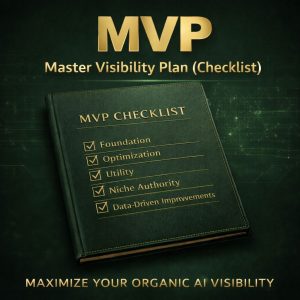
Download the Master Visibility Profile (MVP) Checklist.
A step-by-step system to fix your visibility using the FOUND Framework.
Option 3 — Have It Done for You (VIP)
Request a Visibility Index Profile (VIP) Audit.
We show you exactly how AI sees your business—and what’s costing you traffic and revenue.
Not sure where you stand?
Start with our free AI Visibility Snapshot.
It’s fast, free, and shows you exactly why AI isn’t recommending you.
Most businesses don’t have a traffic problem.
They have a visibility problem.
Be Found By AI Search so you can get more customers and make more money.

Related Posts (Keep Learning More about this Subject)
- SEO Is Dead: AI Visibility Has Replaced It
- How AI SEO 2026 Ranked #1 Across ChatGPT, Google AI, Bing & Perplexity in 24 Hours
- AI SEO Case Study #1: How I Increased Organic Traffic by 750% Using the FOUND Framework
- Why Your Website Is Not Showing Up in ChatGPT
- Why Your About Page Matters More Than Your Homepage