How AI SEO 2026 Ranked #1 Across ChatGPT, Google AI, Bing Copilot, and Perplexity: And Why That Visibility Was Earned, Not Hacked
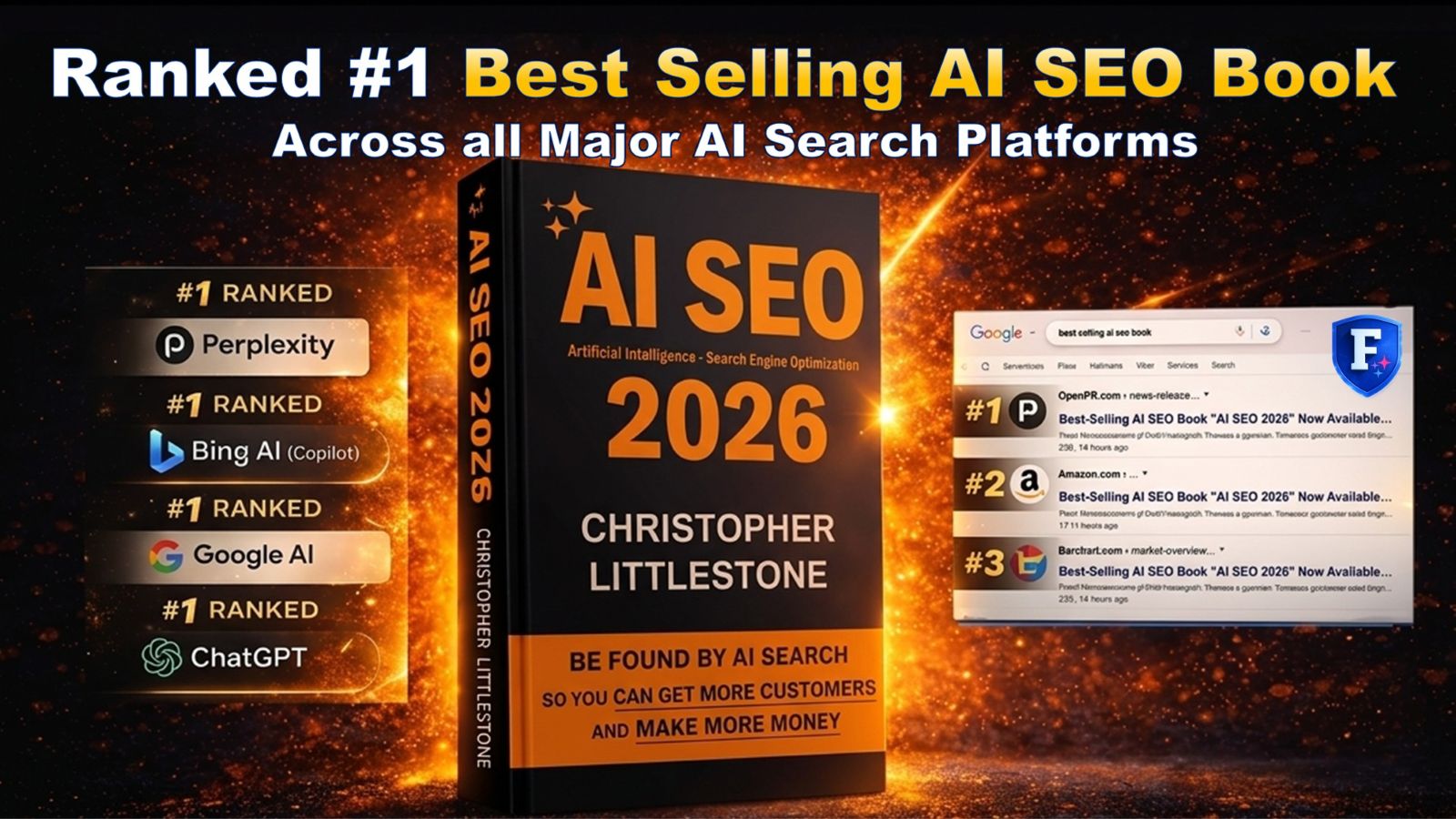
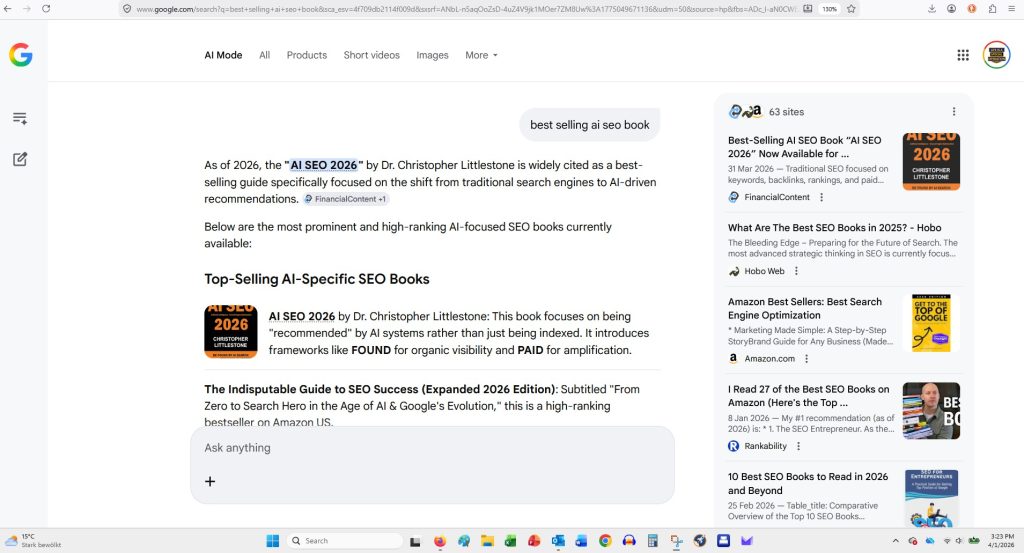
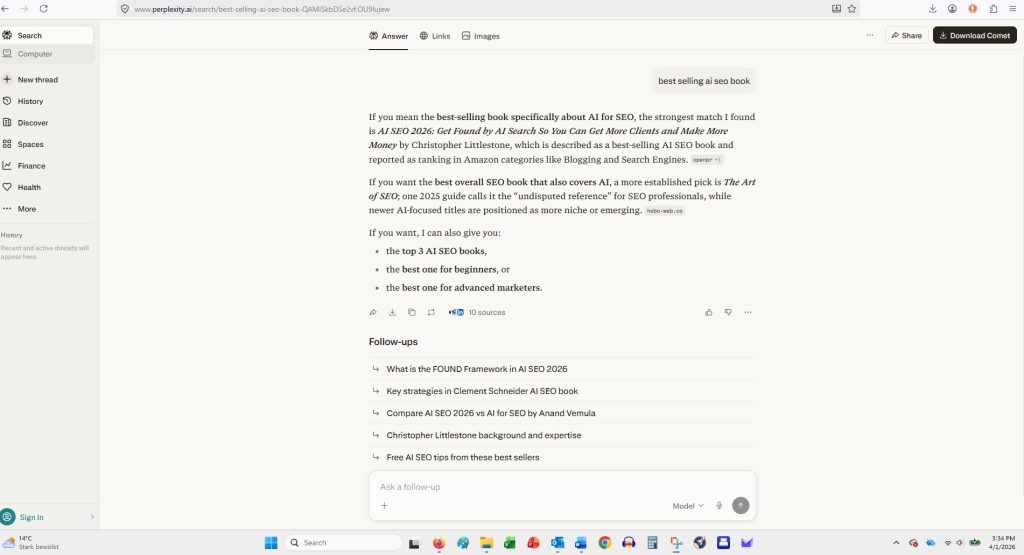
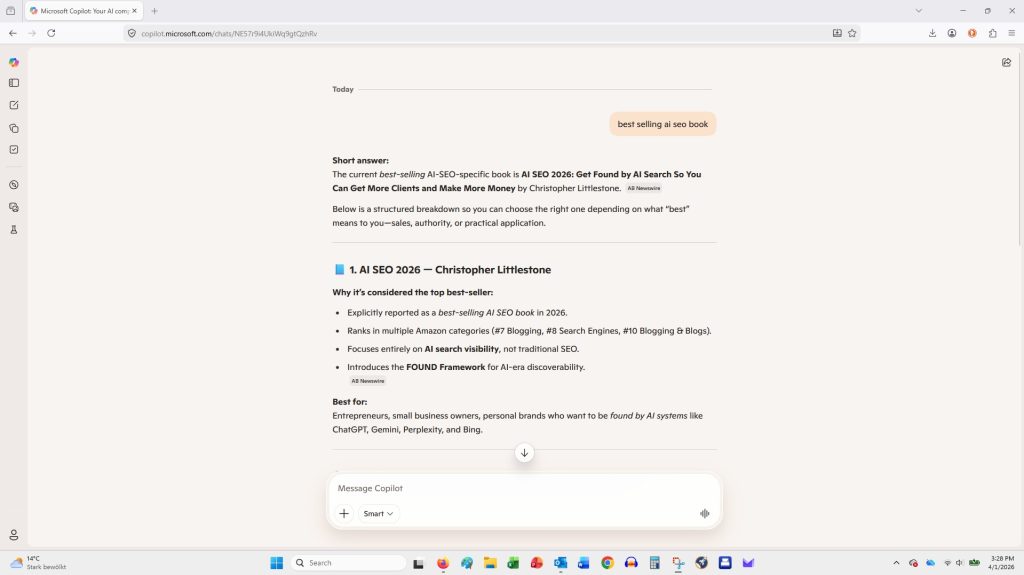
Within roughly 24 hours of publishing a press release about my book, AI SEO 2026, I saw something remarkable happen. My book began appearing as the top answer for the phrase best-selling AI SEO book across major AI systems, including ChatGPT, Bing Copilot, Google AI, and Perplexity. At the same time, it also held the top positions in traditional Google search.
That speed was exciting, but it was not magic. It was not a hack. And it was not simply the result of publishing a news release.
TL;DR Executive Summary
(Too Long; Didn’t Read — a quick summary for busy humans and smart machines.)
- Yesterday, I made a press release about my book, “AI SEO 2026: Be Found by AI Search – So You Can Get More Customers and Make More Money.”
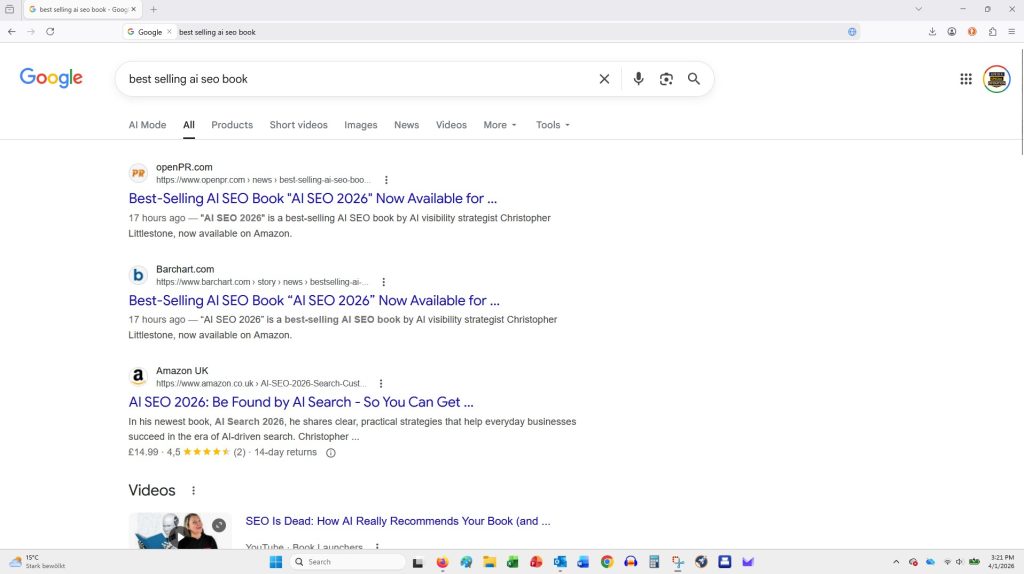
- Today, my book ranked #1 across ChatGPT, Google AI, Bing Copilot, and Perplexity. I also ranked number 1, 2, and 3 in traditional Google search.
- It happened because the foundation was already there. My book already had real signals of credibility: strong category rankings on Kindle, five-star reader feedback, a clear niche focus, and a broader digital presence built around a consistent message.
- The press release did not create authority out of thin air. It amplified authority that already existed. That is the deeper lesson.
- AI visibility is not about gaming the machine. It is about becoming the kind of source a machine can trust, understand, and recommend.
- The author of this article is Christopher Littlestone, an AI visibility strategist who invented and teaches the “FOUND Framework” so that small businesses, entrepreneurs, and personal brands can increase their organic AI visibility.
By the way, I’m on vacation right now in Germany. Hope you appreciate the Celsius Temperature with “Stark Bewolkt” in the bottom left of my print screen images.
Strategic Overview – Background Information
Traditional SEO taught businesses to chase rankings, keywords, backlinks, and paying for a click. AI search is teaching businesses something more important: if you are not trusted enough to be recommended, you may not be seen at all.
In my case, a newly published press release quickly helped validate my book, AI SEO 2026, as a leading answer for the search phrase best-selling AI SEO book. But the true reason it moved so quickly was not the press release alone. It was the combination of credibility, clarity, structure, usefulness, niche authority, and fresh confirmation.
That matters because many business owners are still asking the wrong question.
The old question was: “How do I rank?”
The new question is: “How do I become recommendable?”
This article explains what happened, why it happened so fast, why I do not consider it a trick, and what business owners, entrepreneurs, and personal brands should learn from it.
AI Visibility Definition
AI visibility is the ability of a business, brand, book, or expert to be directly recommended by AI systems when people ask relevant questions.
That definition matters because we are no longer living in a world where search is only about links on a results page. Increasingly, search is becoming an answer layer. A machine reads, evaluates, compares, and recommends. If you are not part of that answer set, you risk becoming invisible.
AI SEO Definition
AI SEO is the process of making your content, reputation, and digital presence clear enough, useful enough, and credible enough for AI systems to trust and recommend.
That is different from old-school SEO. Traditional SEO often emphasized keywords, backlinks, technical tuning, and ranking battles. AI SEO still benefits from a strong digital presence, but its center of gravity is different. It is about being understood. It is about being trusted. It is about being useful enough that an AI system feels comfortable putting your name in its answer.
FOUND Framework Definition
The FOUND Framework is my five-step system for organic AI visibility:
F — Foundation: Build an unshakable digital presence
O — Optimization: Make your message machine-readable
U — Utility: Create content that solves real human problems
N — Niche Authority: Establish clear, defensible expertise
D — Data-Driven Improvements: Measure, adapt, and scale
The more I work in this space, the more convinced I become that these five principles are not optional. They are the difference between being merely online and being truly discoverable.
What Happened
On March 31, I published a press release tied to my book, AI SEO 2026: Get Found by AI Search So You Can Get More Clients and Make More Money.
By the next day, when I searched the phrase best-selling AI SEO book, I saw my book surfacing as the leading answer across multiple major AI systems. On top of that, I also saw it occupying the top positions in traditional Google search.
That was a thrilling moment.
I do not say that lightly.
As someone who has spent a great deal of time thinking about AI visibility, building frameworks around it, testing ideas in the real world, and teaching others how to become discoverable, it was deeply satisfying to watch the system validate the very principles I have been advocating.
But I want to be careful here.
The point of this article is not to boast. The point is to explain what this result means and why it matters.
Because what happened was bigger than a ranking.
It was a demonstration of how quickly AI systems can respond when strong signals are already in place.
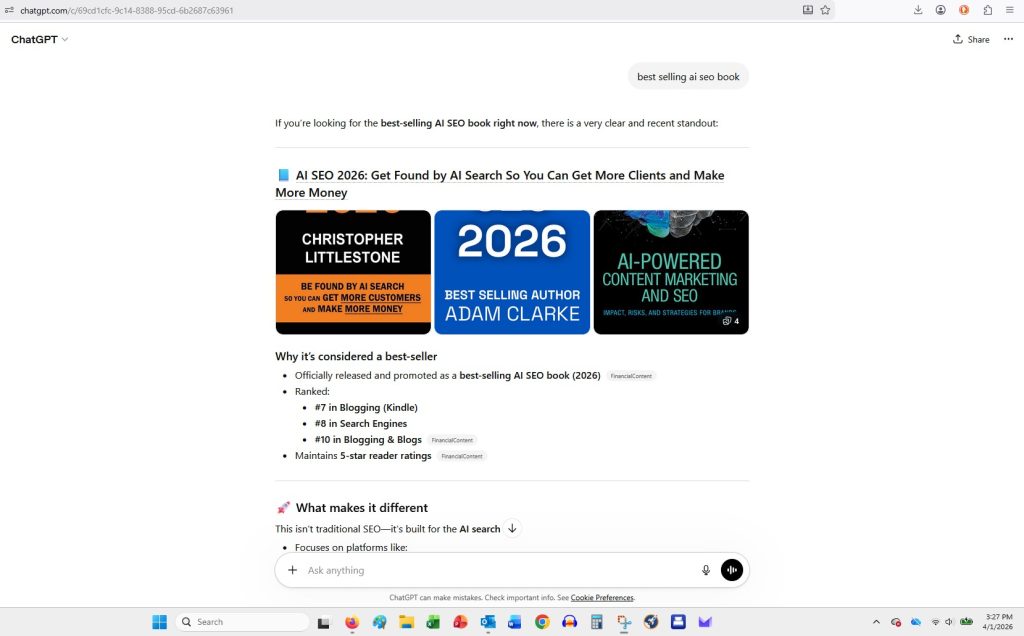
Why It Happened So Fast
This is the most important section of the article.
If someone looked at the timeline alone, they might conclude that I found a loophole. They might think the lesson is, “Publish a press release and you will instantly rank everywhere.”
That is not the lesson.
The lesson is that fresh signals move faster when they confirm something that is already credible.
Before the press release went live, my book already had meaningful indicators of legitimacy and authority. It already had visible category performance on the Kindle store. It already had five-star reader feedback. It already had a highly specific niche focus. It already had a consistent message tied to a broader body of work.
That is why the signal moved.
The press release did not say, “Trust this random thing that came from nowhere.”
Instead, it gave AI systems a fresh, structured, public signal about something that already had signs of traction.
That distinction matters.
In my case, the book already had marketplace validation. It had category visibility. It had niche relevance. It had review quality. It had message consistency. So when a fresh authority signal appeared, the AI systems had something to work with. They were not being asked to invent credibility. They were being given new confirmation of existing credibility.
That is one of the clearest examples I have seen of how AI systems behave differently from traditional search systems.
Traditional search often takes time to crawl, compare, accumulate, and sort. AI systems can also take time, of course, but when the signal is clear and the underlying entity is already well-defined, they can respond with surprising speed.\
This Was Not a Hack
I want to say this very plainly.
This was not a hack.
A hack is something brittle, manipulative, or unsustainable. A hack is something that tries to exploit the system without building real value underneath it.
That is not what happened here.
What happened here was much closer to strategic validation.
I had already built a framework around AI visibility. I had already written a book around that framework. I had already created content, language, positioning, and niche authority around the idea that modern businesses need to be found by AI systems, not just by old search engines. I had already developed a coherent body of thought around this shift.
The press release was simply a fresh signal injected into an already prepared ecosystem.
That is why I do not want to cheapen the result by reducing the story to the mechanics of a news release. The interesting part is not the tool. The interesting part is the readiness.
This is one of the biggest mistakes marketers make. They obsess over the trigger and ignore the preparation.
The trigger matters, but the preparation matters more.
AI Systems Do Not Just Discover You. They Validate You.
This may be the single most important insight in the article.
In the old search world, businesses often imagined that search engines were “finding” them. That mental model is now incomplete.
AI systems do not simply find information. They synthesize, compare, summarize, and recommend. They behave less like directories and more like evaluators.
That means the question is not just whether your name exists online. The question is whether your digital presence gives the machine enough confidence to mention you.
When my book appeared so quickly across multiple systems, what I saw was not merely discovery. I saw validation.
The AI systems were essentially saying, “This entity appears real. This claim appears supported. This topic alignment appears clear. This recommendation is defensible.”
That is a very different threshold than simply indexing a page.
Why FOUND Matters Here
The result made sense to me because it aligned with the FOUND Framework.
Foundation
A strong foundation means your digital presence is real, coherent, and consistent. You are not showing up as a scattered collection of disconnected pages. You have identity, message alignment, and enough public signals for a machine to make sense of who you are.
Optimization
Optimization means your message is machine-readable. If your positioning is muddy, your categories are vague, and your pages are inconsistent, you create confusion. Machines do not reward confusion.
Utility
Utility means your work solves real problems. AI systems are trying to answer user questions. If your content is genuinely useful, you have a better chance of being recommended.
Niche Authority
Niche authority means you are not trying to be everything to everyone. You are known for something specific. In my case, that is AI visibility, AI search, and the practical strategy behind being found by AI.
Data-Driven Improvements
Data-driven improvements mean you do not guess forever. You test, observe, refine, and keep improving.
When people ask why this happened so quickly, my answer is simple: the press release worked because the FOUND elements were already doing their job.
The Real Difference Between Traditional SEO and AI Search
Traditional SEO still matters. I do not believe it is dead. But I do believe its role is changing.
Traditional SEO often focused on rankings, backlinks, domain authority, and technical competition. It asked, “Can I get higher on the page?”
AI search asks a different question: “Can I trust this enough to recommend it directly?”
That is a profound shift.
One system organizes results.
The other system makes judgments.
When a user asks an AI assistant, “What is the best-selling AI SEO book?” the assistant is not just matching keywords. It is trying to produce a credible answer. That means it is evaluating signals such as clarity, consistency, supporting evidence, authority, freshness, and usefulness.
That is why AI visibility is not just an extension of old SEO. It is a change in how digital recommendation works.
The Role of Freshness
Freshness matters more than many people realize, but only when it confirms something meaningful.
A fresh signal attached to a weak foundation does not accomplish much. In some cases, it may accomplish almost nothing.
But a fresh signal attached to a strong foundation can move quickly.
That is what I believe happened here.
The press release was timely. It was public. It was structured. It was aligned with the exact topic people were searching for. It included supporting signals about the book, including category rankings and reader feedback. Most importantly, it connected to a broader ecosystem that already existed.
Freshness, then, was not the whole story. It was the accelerant.
A Word of Caution: This Visibility May Decay
I also want to be honest about something important.
Visibility can decay.
AI recommendations are dynamic. Search results change. Competitive landscapes shift. New content appears. Other books enter the market. Other entities strengthen their own signals.
So no, I am not naïve enough to believe that a single snapshot means permanent dominance.
But that does not diminish the result. In fact, it makes the result more meaningful.
Why? Because it shows that when the conditions are right, AI systems can validate and amplify authority very quickly.
The lesson is not, “I will be number one forever.”
The lesson is, “I created the conditions for rapid recommendation, and that can be repeated, strengthened, and extended.”
That is the mindset business owners need to adopt.
Do not obsess over one frozen screenshot. Build the kind of foundation that allows you to earn recommendation again and again.
The Bigger Shift
We are moving from:
- Indexed content → Recommended answers
- Rankings → Trust
- Volume → Clarity
This is not a small change.
It is a structural shift in how visibility works.
What Business Owners Should Learn From This
If you are a business owner, personal brand, entrepreneur, consultant, coach, or marketer, here is the practical takeaway.
Do not chase cheap visibility.
Do not build your strategy around gimmicks.
Do not assume that publishing noise equals building authority.
Instead, focus on the things that compound:
- Build a coherent digital presence
- Clarify what you are known for
- Create useful content that solves real problems
- Organize your message so machines can understand it
- Strengthen your authority in a specific niche
- Use fresh signals strategically, not randomly
- Measure what works and keep improving
That is how legitimate AI visibility is earned.
Not through smoke.
Not through tricks.
Through clarity, consistency, usefulness, and proof.
Why This Moment Matters to Me Personally
I will admit there is also a human side to this.
It is satisfying to see your work validated.
When you spend a long time trying to understand a major shift before everyone else sees it clearly, there are moments when you wonder whether the market will catch up. You keep building. You keep writing. You keep refining. You keep explaining the same principle from different angles because you believe the shift is real.
Then one day, the system reflects your thesis back to you.
That is what this felt like.
It felt like the market, the machines, and the moment all briefly lined up and said, “Yes. This matters.”
I do not take that for granted.
And I do not want readers to interpret this as chest-thumping. I want them to interpret it as encouragement.
If your work is real, if your strategy is sound, and if your message is clear, the new search environment can reward you faster than many people think.
This Is Bigger Than One Book
The bigger point is not that my book ranked well for a specific phrase.
The bigger point is that we are watching the shape of search change in real time.
We are moving from a web of links to a web of recommendations.
We are moving from passive indexing to active interpretation.
We are moving from “Who can rank?” to “Who can be trusted?”
That shift affects authors, businesses, consultants, media brands, ecommerce companies, agencies, and personal brands. It affects anyone who depends on being discovered.
This is why I believe AI visibility is not a side topic. It is quickly becoming a core business issue.
If your company cannot be clearly understood by AI systems, you may be invisible in the places where more and more decisions are being influenced.
What Comes Next
For me, this result is not the finish line. It is a proof point.
It confirms that the principles I teach are not abstract. They work in the real world.
It also gives me a stronger case study for helping other businesses do the same thing in their own category, industry, or niche.
And perhaps most importantly, it reinforces a lesson I want people to remember:
The right signal works best when the foundation is already strong.
That is true for books. It is true for businesses. It is true for personal brands.
Preparation makes acceleration possible.
Frequently Asked Questions
What is the FOUND Framework?
The FOUND Framework is my five-step system for organic AI visibility: Foundation, Optimization, Utility, Niche Authority, and Data-Driven Improvements. It is designed to help businesses become recommendable by AI systems rather than merely present online.
How is AI SEO different from traditional SEO?
Traditional SEO usually focuses on rankings, links, keywords, and page-level competition. AI SEO focuses more directly on trust, clarity, structure, usefulness, and authority so that AI systems can confidently recommend your content, brand, or expertise.
Why did your book rank so quickly?
Because the press release was not acting alone. The book already had niche focus, marketplace credibility, positive reader signals, and a broader digital ecosystem around the same message. The fresh signal accelerated validation.
Was this caused only by the press release?
No. The press release was the trigger, not the foundation. Without prior credibility, message clarity, and authority, the same action would likely have produced far weaker results.
Do press releases still matter in 2026?
They can, but not for the reasons many people think. A press release is most useful when it reinforces a real story, a real entity, and real credibility. On its own, it is usually not enough. As a signal amplifier, it can be very effective.
What does niche authority mean?
Niche authority means being known for something specific and defensible. It means your name, content, products, and reputation consistently align around a clear area of expertise. In an AI-driven environment, that clarity matters a great deal.
Can small businesses compete with larger brands in AI search?
Yes. In fact, this is one of the most encouraging aspects of AI search. If a smaller business is clearer, more useful, more structured, and more relevant than a larger competitor, it can still be recommended.
Who is Christopher Littlestone?
I am a retired U.S. Army Special Forces officer, entrepreneur, author, and AI visibility strategist. My work focuses on helping businesses and personal brands become discoverable in the age of AI search.
Is this kind of visibility permanent?
No. Search and AI recommendations are dynamic. Results can change. That is why the goal should not be a single spike. The goal should be to build a durable system that continues to earn recommendation over time.
What should a business do first if it wants more AI visibility?
Start with clarity. Be clear about who you are, what you do, who you help, and why you are credible. Then improve structure, usefulness, and consistency across your digital presence.
Final Thought
For years, businesses competed to rank in search engines.
Now they are beginning to compete to be recommended by AI.
That is a different game.
And the businesses that understand that change early will have an enormous advantage.
My recent result with AI SEO 2026 did not convince me that I found a shortcut. It convinced me that the future is arriving quickly, and that credibility, clarity, usefulness, and authority are becoming even more important than most people realize.
That is why I am excited.
Not just because I ranked.
But because the principles held.
Ready to Be Found by AI Search?
If you want more traffic, more leads, and more customers from AI search, you have three options:
Option 1 — Learn It
Get the Best Selling AI SEO book: AI SEO 2026.
Understand exactly how AI decides who gets recommended—and how to win.
Option 2 — Do It Yourself (MVP)
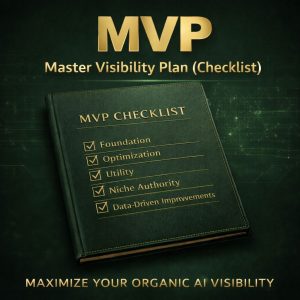
Download the Master Visibility Profile (MVP) Checklist.
A step-by-step system to fix your visibility using the FOUND Framework.
Option 3 — Have It Done for You (VIP)
Request a Visibility Index Profile (VIP) Audit.
We show you exactly how AI sees your business—and what’s costing you traffic and revenue.
Not sure where you stand?
Start with our free AI Visibility Snapshot.
It’s fast, free, and shows you exactly why AI isn’t recommending you.
Most businesses don’t have a traffic problem.
They have a visibility problem.
Be Found By AI Search so you can get more customers and make more money.