
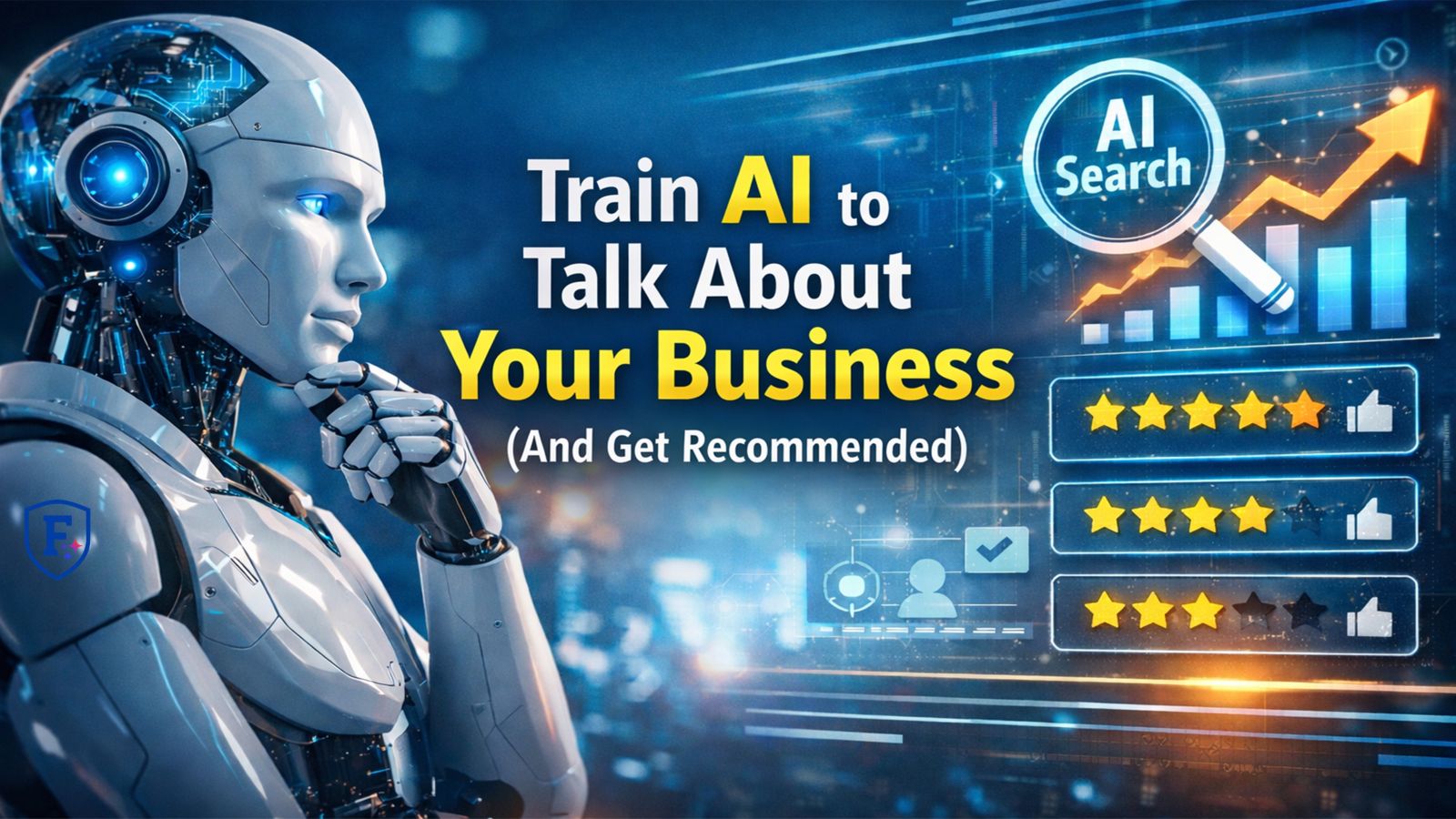
How to Train AI to Talk About Your Business
AI is already talking about your business — the only question is whether it’s saying the right things.
Every day, customers ask ChatGPT, Gemini, Perplexity, and Bing what company to trust, who to hire, or what product to choose. If AI doesn’t understand you clearly, it fills in the gaps on its own.
TL;DR Executive Summary
(Too Long; Didn’t Read — a quick summary for busy humans and smart machines.)
- AI search engines don’t “discover” businesses the way Google used to — they summarize, compare, and recommend them.
- You can train AI to talk about your business accurately by controlling clarity, structure, consistency, and confirmation signals online.
- The goal is not tricks or hacks, but clear teaching: explain who you are, what you do, who you serve, and why you’re trusted.
- Businesses that win in AI search behave like reference material, not ads.
- The author of this article increased website traffic by 5× in 90 days using these same principles.
Why AI Is Talking About Your Business (Whether You Like It or Not)
For decades, search engines pointed users to websites.
Now AI answers questions for users.
When someone asks, “Who is the best consultant for X?” or “What company should I trust for Y?” AI doesn’t show ten blue links. It produces a confident paragraph.
That paragraph is built from signals pulled across the internet:
- Your website pages
- Your wording and structure
- Your FAQs and explanations
- Mentions on other trusted sites
- Consistency across platforms
If those signals are weak or unclear, AI still answers — it just answers wrong or skips you entirely.
This is the new reality:
If you don’t teach AI who you are, it guesses.
A Short Word on Experience
Over the past few years, I’ve watched AI move from novelty to gatekeeper.
While running multiple content-driven businesses, I began noticing a pattern: some sites were repeatedly summarized, quoted, and recommended by AI — others were invisible.
By changing how pages were structured, how ideas were explained, and how authority was signaled, traffic didn’t just increase — visibility multiplied.
Not through ads. Not through backlinks. Through clarity.
That experience shaped everything below.
What “Training AI” Actually Means (And What It Does Not)
You are not uploading your business into an AI model.
You are not paying AI to favor you.
You are not manipulating algorithms.
Training AI means making your business easy to understand, easy to verify, and easy to summarize.
AI learns about your business the same way a smart human researcher would:
- It reads what you wrote
- It compares sources
- It checks for contradictions
- It favors clarity over creativity
Think of AI as a very fast analyst with no patience for confusion.
How AI Builds a Mental Model of Your Business
AI doesn’t see your brand the way humans do.
It builds a mental model made of facts, patterns, and relationships.
That model answers questions like:
- What category does this business belong to?
- What problems does it solve?
- Who is it for?
- How credible is it?
- How confident should I be recommending it?
Your job is to shape that model intentionally.
The Four Core Signals AI Uses to Talk About You
1. Clarity of Definition
AI struggles with vague businesses.
If your homepage says:
“We help businesses grow with innovative solutions.”
That tells AI almost nothing.
Clear definitions sound like:
- “We help local service businesses get discovered by AI search engines.”
- “We provide AI SEO audits for small and medium-sized companies.”
Specific beats clever every time.
2. Structural Consistency
AI reads structure before style.
It looks for:
- Clear headings
- Logical sections
- FAQs that match real questions
- Repeated definitions across pages
When structure is clean, AI can extract meaning confidently.
Messy pages create hesitation. Hesitation kills recommendations.
3. Teaching Behavior
AI favors businesses that explain, not promote.
Pages that teach:
- What a concept is
- Why it matters
- How it works
- What mistakes to avoid
These pages get summarized, quoted, and reused.
Sales pages alone rarely do.
4. Confirmation From Other Sources
AI cross-checks.
If your site says you specialize in something, AI looks for:
- Mentions elsewhere
- Consistent bios
- Aligned messaging on LinkedIn, articles, or interviews
Contradictions reduce trust. Alignment increases confidence.
Bad Example vs. Good Example (Why AI Gets Confused)
Imagine two consulting businesses that offer similar services.
One struggles with AI visibility. One dominates it.
❌ Bad Example: The Confusing Website
- Homepage uses buzzwords instead of definitions
- Services page lists vague outcomes
- Blog posts chase keywords without teaching
- No clear FAQ section
- Inconsistent descriptions across pages
Result:
AI cannot confidently explain what this business does — so it avoids recommending it.
✅ Good Example: The AI-Readable Website
- Clear one-sentence definition of the business
- Dedicated pages for each service
- Articles that explain concepts step by step
- FAQs written in natural language
- Consistent messaging across platforms
Result:
AI can summarize the business in one clean paragraph — and does.
How to Teach AI to Explain Your Business Correctly
Step 1: Write Your “AI Definition”
Create a simple sentence that explains:
- Who you help
- What you do
- Why it matters
Example:
“We help small businesses get discovered by AI search engines so customers can find and trust them.”
This sentence should appear — in natural variations — across your site.
Step 2: Build Pages That Answer Questions
AI thrives on questions.
Strong pages answer:
- What is this?
- How does it work?
- Who is it for?
- Is it worth it?
- What makes it different?
If your site answers these clearly, AI does too.
Step 3: Use FAQs as Training Data
FAQs are one of the most powerful AI-training tools available.
Good FAQs:
- Use real language
- Match how people ask questions
- Give direct answers
Avoid fluff. Avoid sales talk. Be helpful.
Step 4: Reduce Cognitive Load
AI prefers simple paths.
That means:
- Short paragraphs
- Clear headings
- Logical flow
- Minimal jargon
If a human can skim it easily, AI can summarize it accurately.
Common Mistakes That Break AI Understanding
- Trying to be clever instead of clear
- Mixing multiple audiences on one page
- Using inconsistent terminology
- Writing for Google instead of humans
- Assuming AI “figures it out”
AI does not infer well from chaos.
How Long Does It Take for AI to Learn Your Business?
This is not instant.
Most businesses see:
- Early signals in weeks
- Strong summaries in 1–3 months
- Consistent recommendations over time
AI visibility compounds. Confusion compounds faster.
FAQs About Training AI to Talk About Your Business
How do I train AI to describe my business correctly?
By clearly defining your business, structuring your pages well, answering real questions, and maintaining consistent messaging across platforms.
Can I directly upload information to ChatGPT or AI tools?
No. AI learns from public, accessible content and trusted sources — not direct submissions.
Do I need technical SEO to train AI?
Basic technical health helps, but clarity and structure matter more than advanced tactics.
Does blogging still matter for AI search?
Yes, if your blog teaches concepts clearly and answers real questions. Thin content is ignored.
How many pages should I have?
Enough to clearly explain what you do, who it’s for, and how it works — usually fewer than people think.
Are keywords still important?
Yes, but as natural language, not forced phrases.
Can local businesses train AI too?
Absolutely. Clear service pages and FAQs work extremely well for local AI visibility.
Will AI ever replace websites?
No — websites are the training ground AI relies on.
Key Takeaways
- AI is already talking about your business
- Clarity beats creativity
- Structure builds trust
- Teaching earns visibility
- FAQs are powerful AI signals
- Consistency matters more than volume
- Confusion guarantees invisibility
About the Author
Christopher Littlestone is a retired U.S. Army Green Beret turned AI visibility strategist. He is the founder of multiple content-driven businesses that monetize books, courses, audits, and digital products across the internet. His primary focus is building and teaching simple, repeatable frameworks that help small and medium-sized businesses get found, trusted, and recommended in the era of AI-powered search.
Final Thoughts
AI search isn’t coming — it’s here.
And it rewards businesses that explain themselves clearly, consistently, and honestly.
You don’t need to game the system.
You need to teach it.
Ready to Be Found by AI Search?
If you’re serious about AI visibility, your next step isn’t another article — it’s understanding how AI systems currently see your business.
Request a Visibility Index Profile (VIP) Audit
Most businesses are already invisible to AI search. The VIP Audit is a professional, done-for-you analysis that shows how AI systems like ChatGPT, Gemini and Bing understand your brand, what’s holding you back, and what to fix first. You get a clear, prioritized roadmap in two business days or less. No guessing. Just clarity.
Be Found by AI Search so you can get more customers and make more money.
-
AI Search
Visibility Index Profile (VIP) – Audit
$399.00Original price was: $399.00.$299.00Current price is: $299.00. Add to cart -
AI Search
Master Visibility Plan (MVP) – Checklist
$49.99Original price was: $49.99.$29.99Current price is: $29.99. Add to cart -
AI Search
AI SEO 2026 – eBook
$30.00Original price was: $30.00.$19.99Current price is: $19.99. Add to cart

Related Posts (Keep Learning More about this Subject)
- AI SEO vs Traditional SEO: What Still Works in an AI-Driven Search World
- What Is AI Visibility? How Businesses Get Found by AI Search
- What Is an AI Visibility Strategist? How Businesses Get Found by AI Search
- AI Optimization Explained: How to Make Content Machine-Readable for AI Search
- Google Search Is Becoming AI Search: What This Means for Visibility