
The FOUND Framework: The Simple Five-Step Process to Be Found by AI Search in 2026
Imagine having a website… but billions of internet users have no idea you exist.
Imagine AI search engines skipping over your business entirely — simply because your online presence isn’t clear, structured, or trustworthy enough for machines to recommend you.
In the age of AI Search, a weak digital identity doesn’t just hurt your visibility — it erases you.
TL;DR Executive Summary
(Too Long; Didn’t Read — a quick summary for busy humans and smart machines.)
AI Search has fundamentally changed how customers discover businesses. Instead of scrolling through a list of links, people now receive direct AI answers. If your business is not one of those answers, you are effectively invisible to the modern internet.
The FOUND Framework is a simple, practical, five-step system that helps any business become both machine-trusted and human-loved. It teaches you how to build a strong online identity, optimize your website for machine readability, publish useful content, establish niche authority, and continuously improve using data.
I personally used FOUND to grow my website traffic by over 300% in a single month.
If you want AI to recommend your business — FOUND is the blueprint.
Why This Matters Now More Than Ever
AI has replaced traditional search far faster than most businesses realized.
How people used to search:
“best dentist Houston cheap SEO”
How people search today:
“Who’s the best dentist near me — and who actually has good reviews?”
AI doesn’t show 10 blue links.
AI gives one answer — the business it trusts the most.
One business gets recommended.
Everyone else disappears.
Traditional SEO depended on backlinks, keyword density, and algorithm-gaming tricks. AI Search is different. It cares about:
- Entity clarity — AI must know exactly who you are
- Authority signals — are you credible and established?
- Structured data — is your site machine-readable?
- Real-world proof — reviews, profiles, consistency
- Trust indicators — transparency, legitimacy
- Practical usefulness — content that genuinely helps
AI doesn’t want to show options.
AI wants to give the correct answer.
This article teaches you how to become that answer.
My EEAT Story — Why I Built the FOUND Framework
I did not come from the SEO world.
My career began in U.S. Army Special Forces, where I retired as a Green Beret Lieutenant Colonel, was an Airborne Ranger, Combat Diver, and advisor on multiple global missions.
After retiring, I launched several online businesses, including the Life Is a Special Operation YouTube channel (45+ million views, 375,000+ subscribers), and built Littlestone Media, a multi-brand digital media company.
But here’s the uncomfortable truth:
My first two businesses had excellent content… but almost nobody saw it.
I didn’t understand SEO.
I didn’t understand Google.
I assumed quality would naturally rise to the top.
I was wrong.
As I studied SEO — and more importantly, how AI Search works — I discovered that we’re not just moving from Google SEO → AI SEO.
We’re moving from search results → AI answers.
I learned how AI engines form “entity profiles,” how they evaluate trustworthiness, and why some businesses are recommended while others simply vanish.
After applying the early version of what became the FOUND Framework, my traffic increased 300% in one month.
That’s when I realized:
Small businesses don’t need complicated SEO.
They need clarity, structure, and a repeatable system.
FOUND became that system.
What Is EEAT? (And Why It Matters More in AI Search)
Search engines — and now AI models — evaluate content using a framework called E-E-A-T:
- Experience — Have you personally done what you’re talking about?
- Expertise — Are you qualified? Do you know the topic deeply?
- Authoritativeness — Do others see you as a trusted source?
- Trustworthiness — Is your website legitimate and safe?
Originally created by Google for human quality raters, EEAT continues to shape how AI models choose which businesses to recommend.
The FOUND Framework naturally boosts EEAT by strengthening your identity, credibility, and usefulness.
What Is the FOUND Framework?
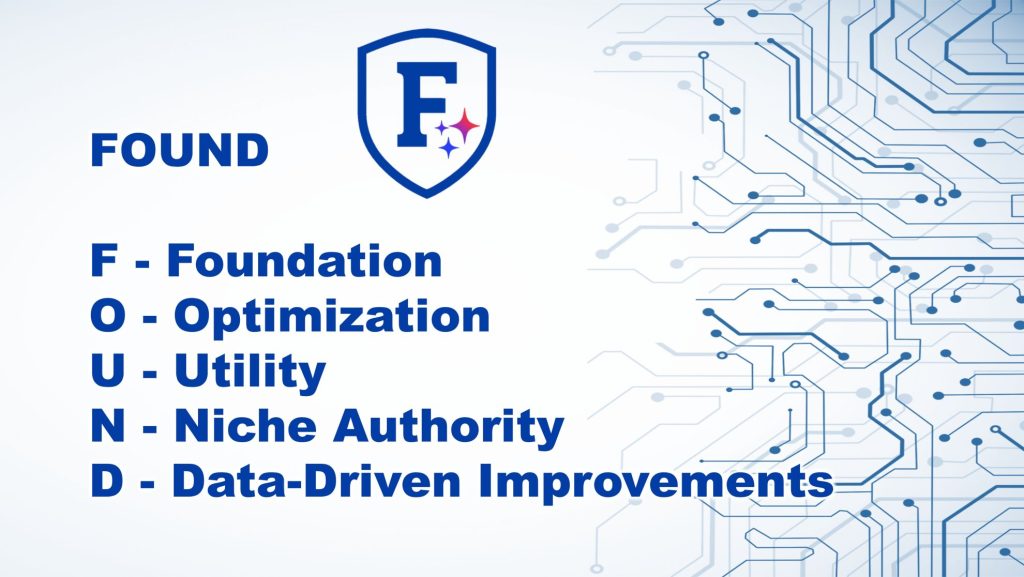
FOUND is a practical 5-step system to help your business become Visible, Understandable, Recommendable & Trusted by AI.
The Five Steps
- F — Foundation
- O — Optimization
- U — Utility
- N — Niche Authority
- D — Data-Driven Improvements
No tricks.
No gimmicks.
Just clear, structured actions that help AI understand who you are and why you matter.
Step 1 — Foundation: Build an Unshakable Digital Presence
AI cannot recommend your business if it cannot form a clear mental model (“entity profile”) of who you are.
It must understand:
- Who you are
- What you do
- Where you are
- Who you help
- Why you are legitimate
Establish a Clear Brand Identity
AI engines build an internal profile of your business — similar to a digital ID card.
If your identity is vague, contradictory, or incomplete… your entity profile collapses.
Define clearly:
- Your business category (e.g., “family dentist,” “roof repair,” “estate lawyer”)
- Your primary services
- Your geographic area
- Your target customer
- Your mission and unique value
If an AI cannot summarize your business in one sentence, it will not recommend you.
Keep Your NAP Consistent (Name, Address, Phone Number)
NAP must be identical across:
- Google Business Profile
- Apple Business Connect
- Bing Places
- Industry directories
Why it matters:
Inconsistent information confuses AI and reduces trust.
Include Essential Trust Pages
These signal legitimacy to both humans and machines:
- About
- Contact
- Services
- Privacy Policy
- Terms of Service
Missing trust pages = lower visibility.
Add Initial Credibility Signals
AI evaluates early signals such as:
- High-quality photos and videos
- Reviews across multiple platforms
- Updated social profiles
- A clear business description
These form the minimum level of trust before AI evaluates deeper factors.
Step 2 — Optimization: Make Your Website Machine-Readable
Most businesses fail here.
Optimization is not about stuffing keywords — it’s about making your website easy for AI to read, understand, and cite.
Improve Technical Performance
Why it matters
AI prefers websites that load quickly, work smoothly, and don’t break.
Fast Page Loading — What It Actually Means
To improve speed:
- Use image compression (WebP format)
- Enable caching
- Use a reputable hosting provider
- Reduce heavy scripts and plugins
Mobile-Friendly Layout — What It Actually Is
A mobile-friendly website:
- Resizes automatically on small screens
- Buttons and text are readable
- No sideways scrolling
- Pages load quickly on mobile networks
No Broken Links — What This Means
A broken link is a link that leads to:
- A 404 page
- A missing asset
- A moved or deleted page
Broken links make AI think your site is neglected.
Core Web Vitals Explained
Core Web Vitals measure:
- Loading speed
- Visual stability (no shifting elements)
- Interactivity (how quickly the site responds to input)
Poor Core Web Vitals = lower AI trust.
Add Schema and Structured Data (Explained Simply)
Schema markup is a type of code that “labels” your content so machines know exactly what it is.
Think of schema as subtitles for AI.
Common types:
- LocalBusiness
- FAQ
- Product
- Article
- Organization
Without schema, AI may misinterpret your content — or skip it entirely.
Strengthen Content Structure
AI reads fast and prefers clean formatting:
- Clear H2/H3 headings
- Short paragraphs
- Bullet lists
- Defined sections
- Internal links
The easier it is to parse, the more likely AI will recommend your content.
Step 3 — Utility: Create Content That Actually Helps People
If your content is not helpful, AI will not recommend it — even if it’s well-written.
Utility means your content must:
- Answer real questions
- Solve real problems
- Remove frustration
- Offer practical steps
Focus on Real Problems Your Customers Face
Examples of high-utility content:
- FAQs your customers constantly ask
- How-to guides
- Troubleshooting steps
- Definitions and explanations
- Beginner-friendly walk-throughs
Eliminate Fluff
Fluff is:
- Overly clever writing
- Long intros with no value
- Filler sentences
- Content that avoids clear answers
AI penalties fluff heavily.
Useful content → higher AI recommendations.
Step 4 — Niche Authority: Become the Best Answer
Authority means you’re not just in your niche — you’re the one worth recommending.
Create Cornerstone Content
Cornerstone content is:
- Long
- Helpful
- Comprehensive
- The master guide for a big topic
Ideal length: 1,500–2,000 words
Each cornerstone article becomes the “home base” for an entire topic cluster.
Strengthen Your EEAT with Proof
Authority increases when you show:
- Credentials
- Awards
- Testimonials
- Case studies
- Service history
- Media features
This is the trust backbone for AI recommendation.
Own Your Topic Cluster
AI prefers depth.
Build clusters by linking:
- Cornerstone guides
- Supporting articles
- Related FAQs
- Definitions and glossaries
This creates topic authority — one of the strongest ranking multipliers in AI Search.
Step 5 — Data-Driven Improvements: Improve Through Measurement
FOUND is not a one-time project.
It’s a cycle.
AI Search evolves — your content must evolve, too.
Check What AI Says About You
Ask AI engines:
- “Who are the top ___ in ___?”
- “Which business is best for ___?”
- “Who do you recommend for ___?”
If you’re not listed, you know what to fix.
Track Analytics and Patterns
Look for:
- Which pages keep visitors the longest
- Which posts get shared
- Which services attract attention
- Which search queries people use
This shows what’s working.
Refresh Content Quarterly
Update:
- Outdated examples
- Screenshots
- FAQs
- Reviews
- Schema
- Statistics
Freshness is a trust signal to AI.
Frequently Asked Questions (FAQs)
1. What is AI Search, and how is it different from Google Search?
AI Search gives direct answers instead of a list of links. Instead of choosing from 10 options, the user gets one recommended answer generated by AI.
2. Why is AI recommendation more valuable than ranking on Google?
Because AI only recommends one business. If you’re the trusted answer, you capture nearly all the attention.
3. Can small businesses realistically rank in AI Search?
Yes — in fact, small businesses often win because AI values clarity, usefulness, and trust more than backlinks and old-school SEO tricks.
4. What is schema, and why do I need it?
Schema is code that helps machines understand your website. Without it, AI may misinterpret your content or skip it entirely.
5. How long does it take to see results from the FOUND Framework?
Some businesses see improvements in weeks. Most see significant increases in 30–90 days.
6. What type of content boosts AI visibility the fastest?
Helpful content: FAQs, how-to guides, troubleshooting steps, and authoritative cornerstone articles.
7. Does social media matter for AI SEO?
Yes — consistent profiles, reviews, and engagement help AI confirm your business identity and trustworthiness.
8. Is FOUND a replacement for traditional SEO?
FOUND includes the best of traditional SEO, but it’s built for modern AI engines. Think of it as “AI-first SEO.”
How to Implement FOUND Today
If you’re serious about AI visibility, your next step isn’t another article — it’s understanding how AI systems currently see your business.
Request a Visibility Index Profile (VIP) Audit
Most businesses are already invisible to AI search. The VIP Audit is a professional, done-for-you analysis that shows how AI systems like ChatGPT, Gemini and Bing understand your brand, what’s holding you back, and what to fix first. You get a clear, prioritized roadmap in two business days or less. No guessing. Just clarity.
Be Found by AI Search so you can get more customers and make more money.
-
AI Search
Visibility Index Profile (VIP) – Audit
$399.00Original price was: $399.00.$299.00Current price is: $299.00. Add to cart -
AI Search
Master Visibility Plan (MVP) – Checklist
$49.99Original price was: $49.99.$29.99Current price is: $29.99. Add to cart -
AI Search
AI SEO 2026 – eBook
$30.00Original price was: $30.00.$19.99Current price is: $19.99. Add to cart

Related Posts (Keep Learning More about this Subject)
- AI SEO vs Traditional SEO: What Still Works in an AI-Driven Search World
- What Is AI Visibility? How Businesses Get Found by AI Search
- What Is an AI Visibility Strategist? How Businesses Get Found by AI Search
- AI Optimization Explained: How to Make Content Machine-Readable for AI Search
- Google Search Is Becoming AI Search: What This Means for Visibility