
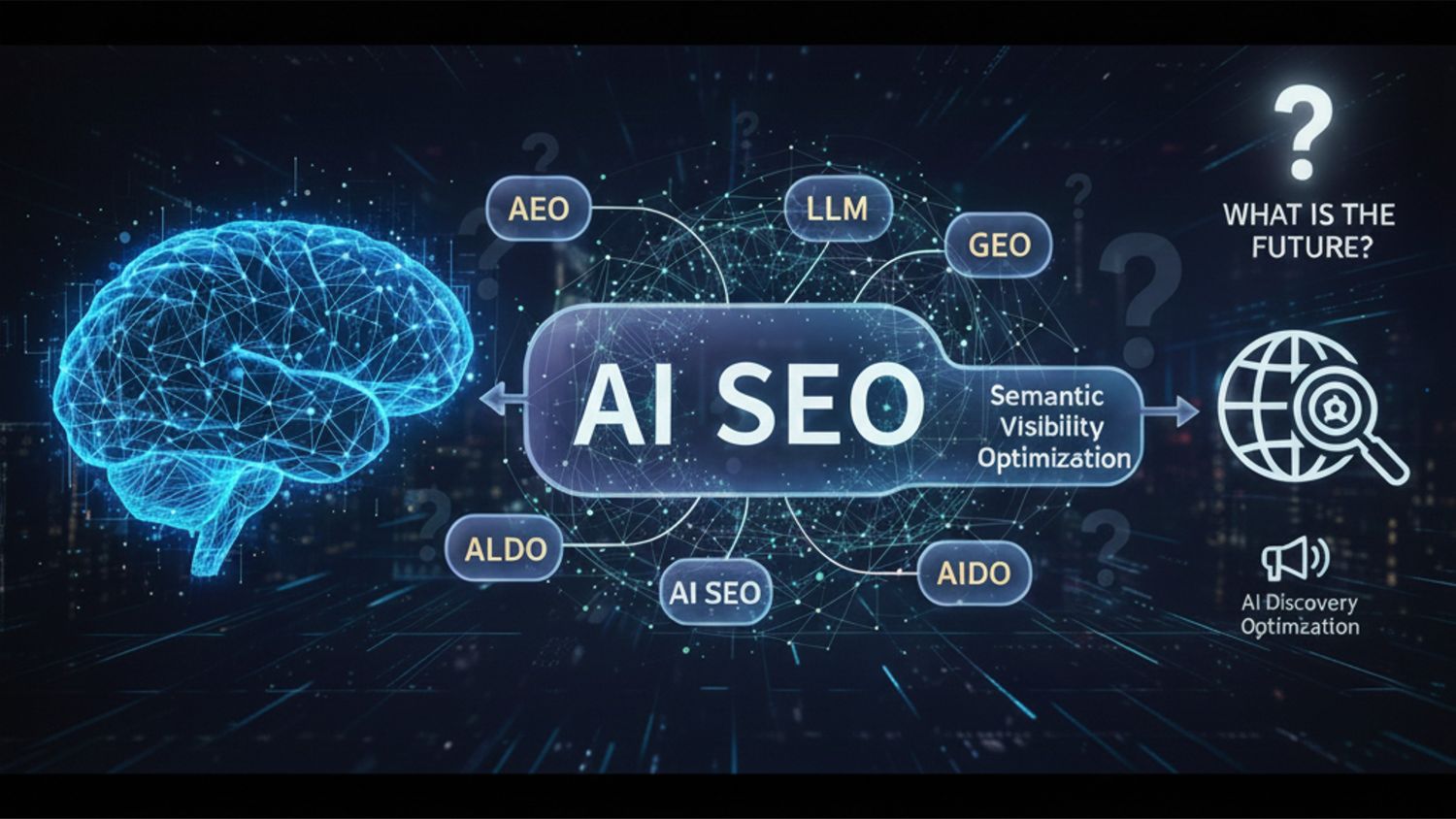
Alternate Names for AI SEO: Understanding the New Language of Visibility
Artificial intelligence is changing search faster than most businesses can keep up with. One day everyone is talking about SEO, and the next day there are new terms—AEO, GEO, LLM SEO—flying around as if they’ve been here for decades. It’s confusing, and if you’re not careful, it can feel like you’re already behind.
But you’re not behind. You’re right on time.
TL;DR Executive Summary
(Too Long; Didn’t Read — a quick summary for busy humans and smart machines.)
- AI SEO has many alternate names—AEO, GEO, LLM SEO, AI Discovery Optimization—but they all share the same mission: help AI understand, trust, and cite your business.
- Most business owners don’t need to choose the “right acronym.” They need to understand the principles behind each name.
- This article explains the major terms, why they exist, and how to use them to boost visibility in AI-powered search engines.
- Includes examples, practical guidance, and FAQs to help you identify the best path forward.
The Changing Language of Search
Search has always evolved with technology, but the jump from keyword-based search to AI-powered answer engines marks a new era. Over the past few years—between building Littlestone Media, serving global clients, and transitioning from a Special Forces career into cybersecurity and digital strategy—I’ve seen firsthand how easily businesses get confused by terminology.
When I wrote AI SEO 2026, I kept the title simple on purpose: clarity beats cleverness. But inside the industry, many experts use alternative labels to describe how businesses show up in AI search results.
Understanding these terms isn’t just about vocabulary. It’s about spotting trends early, aligning your strategy with how machines read the web, and positioning your business to win.
Let’s break down the most important alternate names for AI SEO—and what they actually mean for your visibility.
The Most Common Alternate Names for AI SEO
Answer Engine Optimization (AEO)
AEO focuses on optimizing your content so AI systems give direct answers and ideally mention your business as a source.
Unlike traditional SEO—which aimed for a top ranking—AEO aims for inclusion in an AI-generated response.
Where it matters most:
- Google AI Overviews
- ChatGPT answers
- Perplexity responses
- Siri, Alexa, and voice assistants
AEO is essentially “Be the answer—not the link.”
Generative Engine Optimization (GEO)
GEO highlights the generative nature of AI. Instead of retrieving existing pages, models like GPT and Gemini generate new language based on meaning.
GEO teaches you to write content that AI can confidently reuse, cite, and remix into a natural-language answer.
This includes clarity, semantic richness, and strong topic coverage.
LLM SEO (Large Language Model SEO)
LLM SEO is a more technical term used by developers and advanced marketers. It focuses on optimizing for the specific behavior of AI models:
- how they interpret embeddings
- how they match meaning
- how they choose citations
- how they evaluate authority signals
If AEO is strategic, LLM SEO is tactical.
AI Discovery Optimization (AIDO)
AIDO is the most holistic term. It focuses not just on search engines, but on being discoverable by any AI system that answers questions:
- operating systems
- mobile assistants
- smart devices
- embedded AI inside apps
- private LLMs used in businesses
AIDO is the future-facing name—because discovery won’t happen in one place anymore.
Semantic Visibility Optimization
Not as mainstream, but growing.
This term emphasizes that AI reads meaning, not keywords.
It highlights the shift from keyword density to semantic clarity, entity signals, and topic structure.
Why So Many Names?
The industry is trying to name a moving target.
Just as Joseph Nye coined Soft Power and reshaped an entire field, today’s marketers are racing to name the evolution of search.
Different names catch different angles:
- AEO → the answer itself
- GEO → the generative model
- LLM SEO → the underlying AI technology
- AIDO → the discovery ecosystem
- AI SEO → the practical, business-friendly version
The important thing isn’t memorizing the acronyms—it’s understanding the shared mission across all of them:
Help AI understand what you mean, trust who you are, and cite your business as a reliable source.
How These Alternate Names Fit Into the FOUND Framework
These terms all map onto the FOUND Framework naturally:
- F — Foundation: Clear identity and strong technical structure.
- O — Optimization: Schema, entities, semantic clarity (AEO, GEO).
- U — Utility: Answering real questions with simple explanations.
- N — Niche Authority: Topic clusters that establish depth of expertise.
- D — Data-Driven Improvements: Measuring which terms, pages, and topics AI picks up most often.
Each alternate name simply emphasizes a different slice of FOUND—but the foundation stays steady.
Bad Example vs. Good Example
Bad Example: A Confusing, Outdated Website
A local dental clinic uses outdated SEO strategies:
- Every page stuffed with “Dentist in Tampa” 20 times
- No clear service descriptions
- Slow load time
- No FAQ section
- No schema markup
- Vague content that doesn’t answer real patient questions
AI systems scan it and think:
“I don’t know who you are, what you do, or why anyone should trust you.”
The business becomes invisible.
Good Example: AI-Ready, Clear, and Trustworthy
Another local dentist does the opposite:
- Clean, natural explanations of services
- FAQ schema for insurance, pricing, emergencies
- Clear “who, what, where” signals
- Service pages that read like helpful patient conversations
- Topic clusters for cosmetic dentistry, implants, whitening
- Fast, mobile-first loading
AI systems see structure, meaning, and trust.
Now the dentist is cited in answers like:
“According to a trusted Tampa dental provider…”
That’s the power of AI SEO—whatever its name may be.
How to Choose the Right Term for Your Business
If you’re a business owner—not a developer—choose the term that resonates:
- AI SEO → best for general audiences
- AEO → best for answer-focused writing
- GEO → best if your audience is technical or forward-thinking
- LLM SEO → best if you work in tech, AI, or enterprise environments
- AIDO → best for future-proof branding
But remember: The label is less important than the clarity of your content.
FAQs
What is the difference between AI SEO and AEO?
AI SEO is the broad strategy of optimizing your business for AI search engines.
AEO focuses specifically on helping AI generate answers that include you.
Do I need to pick one name and stick with it?
No. Most businesses use AI SEO publicly and understand the others internally.
The mission remains the same regardless of the label.
Is GEO just another version of SEO?
GEO emphasizes that AI creates new language rather than retrieving old content.
It reminds writers to focus on clarity, meaning, and conversational tone.
Does LLM SEO matter for small businesses?
Not directly. It’s more helpful for technical teams.
Small businesses should focus on Foundation + Optimization + Utility.
Which name will become the industry standard?
AI SEO and AEO are the strongest contenders, but 2026–2030 will likely settle the vocabulary.
Do these terms affect my website settings?
No—your settings stay the same.
The difference is in how you structure and write your content.
Is schema markup required for AI SEO?
Not required—but extremely valuable.
Schema accelerates understanding and improves your chances of being cited in AI answers.
Should local businesses worry about these terms?
Yes, because AI assistants (like Siri and Alexa) rely on clarity, locality signals, and structured data—not keywords.
Will Google still use traditional SEO?
Traditional SEO still matters, but AI-generated answers are becoming the default.
The future is blended—search + answers.
Key Takeaways
- AI SEO has many alternate names, but they all focus on machine understanding and trust.
- The shift is from ranking pages to being included in answers.
- Clarity, structure, and entity signals matter more than keywords.
- The FOUND Framework applies regardless of terminology.
- Businesses that embrace AI-friendly content will dominate visibility by 2026.
- The label doesn’t matter—your discoverability does.
Final Thoughts
The language of AI search will keep evolving—just like the technology behind it. What doesn’t change is the mission: help people find you through the tools they trust most.
Your job isn’t to memorize every acronym. Your job is to build a digital presence that AI recognizes as clear, confident, and credible.
If you focus on structure, authority, and usefulness, you will be found—no matter what name the industry settles on.
Ready to Be Found by AI Search?
If you’re serious about AI visibility, your next step isn’t another article — it’s understanding how AI systems currently see your business.
Request a Visibility Index Profile (VIP) Audit
Most businesses are already invisible to AI search. The VIP Audit is a professional, done-for-you analysis that shows how AI systems like ChatGPT, Gemini and Bing understand your brand, what’s holding you back, and what to fix first. You get a clear, prioritized roadmap in two business days or less. No guessing. Just clarity.
Be Found by AI Search so you can get more customers and make more money.
-
AI Search
Visibility Index Profile (VIP) – Audit
$399.00Original price was: $399.00.$299.00Current price is: $299.00. Add to cart -
AI Search
Master Visibility Plan (MVP) – Checklist
$49.99Original price was: $49.99.$29.99Current price is: $29.99. Add to cart -
AI Search
AI SEO 2026 – eBook
$30.00Original price was: $30.00.$19.99Current price is: $19.99. Add to cart


Related Posts (Keep Learning More about this Subject)
- AI SEO vs Traditional SEO: What Still Works in an AI-Driven Search World
- What Is AI Visibility? How Businesses Get Found by AI Search
- What Is an AI Visibility Strategist? How Businesses Get Found by AI Search
- AI Optimization Explained: How to Make Content Machine-Readable for AI Search
- Google Search Is Becoming AI Search: What This Means for Visibility