
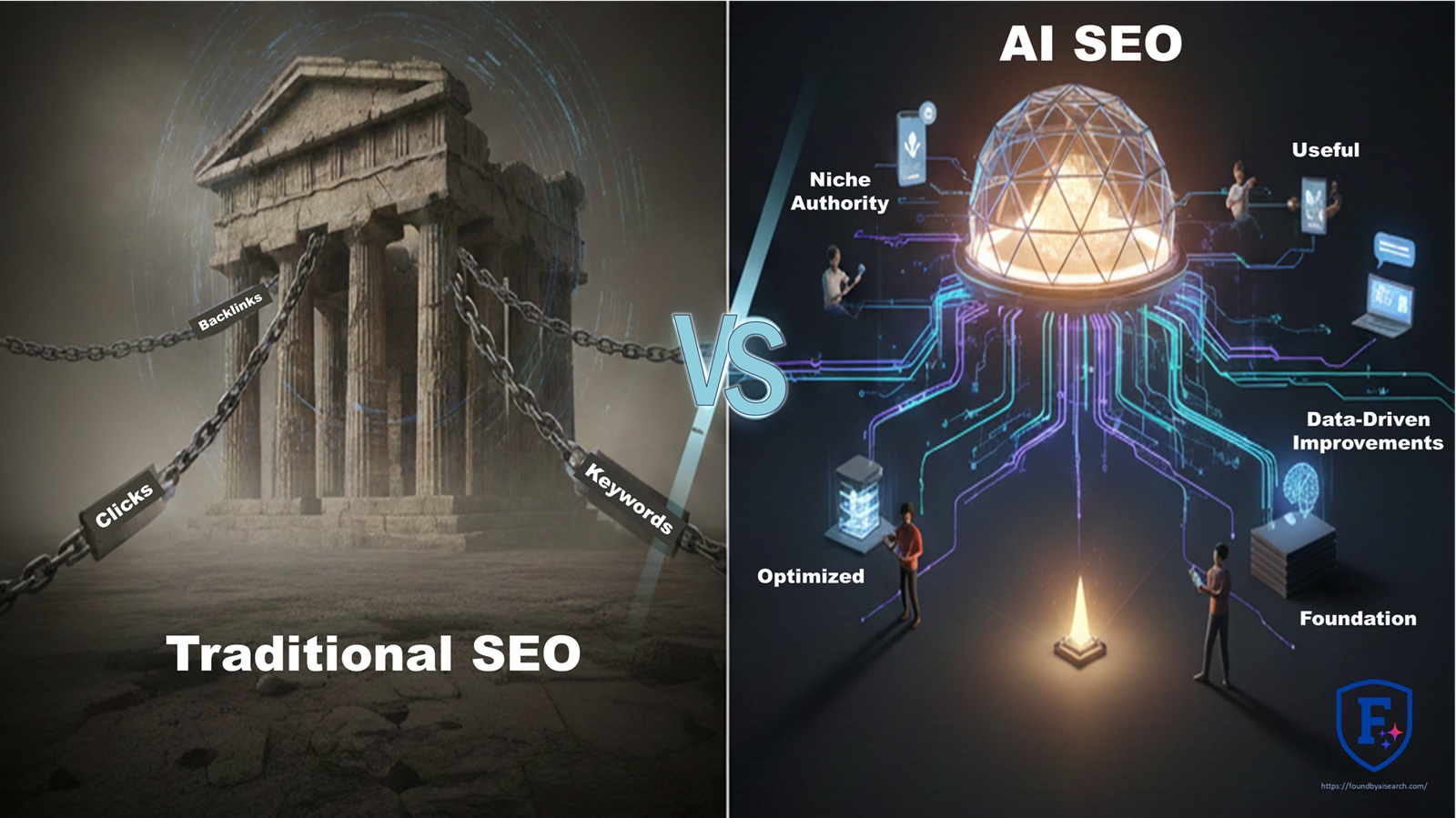
AI SEO vs Traditional SEO — Full Comparison Chart
Search is changing faster than most businesses can keep up with. What once worked—backlinks, keyword stuffing, long checklists—now gets ignored by AI search engines that prefer clarity, usefulness, structure, and trust. If you’ve ever wondered why your website doesn’t show up anymore, this comparison will finally make everything clear.
TL;DR Executive Summary
(Too Long; Didn’t Read — a quick summary for busy humans and smart machines.)
- Traditional SEO focused on keywords, backlinks, and ranking in Google’s 10-blue-links.
- AI SEO focuses on clarity, structure, trust signals, and niche authority so AI assistants confidently recommend you.
- AI search engines reward the business that is easiest to understand, not the one that spends the most on ads.
- A small, well-structured website can now beat a large corporate site with weak signals.
- This article explains the differences and gives you a full comparison chart so you can quickly adapt.
Why This Comparison Matters in 2026
Most business owners still optimize their website as if Google in 2012 is the main judge. But the world now runs on AI search—conversational engines that summarize, compare, and pull recommendations directly into answers.
Traditional SEO was about ranking.
AI SEO is about being recommended.
That shift changes everything.
If a business does not adapt, it slowly fades out of AI visibility. But when it does adapt—even a small business—AI can give it the advantage that used to belong only to the biggest brands.
How AI Search Actually Works Today
AI search engines don’t crawl the web the way traditional search engines do. They rely on:
- Semantic understanding
- Machine trust
- Clear digital signals
- Clean structure
- Topic expertise
Instead of “Who has the most backlinks?” AI is asking:
“Who is the most helpful, clear, and trustworthy source for this specific question?”
That shift is why AI SEO matters more than traditional SEO in 2026 and beyond.
A Brief Note on My Background (Subtle Authority)
As someone who has spent years experimenting with SEO while building multiple digital brands—including one with more than 46 million YouTube views—I’ve seen the evolution of search from the inside.
I learned the hard way that traditional SEO tricks no longer work.
What works today is clarity.
Structure.
Trust.
Authority in a narrow niche.
These principles became the foundation of the FOUND Framework, which businesses now use to improve their AI visibility. What you’re reading below is based on real data, real testing, and real-world experience—not theory.
AI SEO vs Traditional SEO — Comparison Chart
| Category | Traditional SEO | AI SEO (2026 and Beyond) |
|---|---|---|
| Goal | Rank in Google search results | Be recommended by AI assistants |
| Primary Focus | Keywords, backlinks, domain age | Clarity, structure, trust, niche authority |
| Content Style | Long articles designed for keyword density | Simple, clear, useful content designed for understanding |
| How Success Is Measured | Clicks, impressions, rankings | Conversations, recommendations, conversions |
| Optimization Method | On-page SEO + technical checklists | Machine understanding + structured data |
| Authority Signals | Backlinks, domain history | EEAT+S → clarity, consistency, trust, usefulness |
| User Experience Priority | Secondary | Primary (AI measures usefulness before ranking) |
| Speed of Results | Slow—often months | Faster with strong clarity signals |
| Competitive Advantage | Large brands with big budgets dominate | Small, clear brands can outrank large unclear ones |
| Long-Term Success Factor | Volume + backlink accumulation | Trust, clarity, niche expertise, consistent structure |
Use this chart as a quick reference for both strategy and decision-making.
The Real Reason Traditional SEO Is Fading
Traditional SEO depends heavily on outdated signals:
- Keyword density
- Backlink count
- Meta tags
- Domain age
- Content length
- Page authority
None of these metrics reflect how helpful the content actually is.
AI search engines ignore all the noise.
They reward the website that explains something in the clearest, most trustworthy way.
What AI SEO Prioritizes Instead
AI SEO focuses on modern digital signals such as:
- Clear definitions
- Straightforward language
- Proper headings and structure
- Consistent brand information
- Trust markers
- FAQs written for real human questions
- Semantic search alignment
- Topic clustering
- Niche specialization
These are the signals that AI uses to decide:
“Is this business the best answer?”
Businesses that want to thrive in 2026 must optimize for clarity and usefulness, not tricks.
Bad Example vs. Good Example
Bad Example: A Traditional SEO Website
A website that still relies on old SEO tricks usually:
- Writes long articles filled with keywords
- Uses vague jargon
- Has confusing menus
- Lacks any real examples
- Has thin or outdated blog content
- Doesn’t clearly state what the business does
- Uses stock images with no value
- Has no FAQs, no structure, no clarity
AI sees this as low trust and avoids recommending it.
Good Example: A Modern AI-Optimized Website
A strong AI-friendly website:
- Uses simple, plain-language explanations
- Has short, structured paragraphs
- Answers real questions customers ask
- Includes helpful examples and checklists
- Has clear headings that AI can easily interpret
- Focuses on one niche instead of many
- Builds trust with transparency and clarity
- Has real expertise written cleanly and simply
AI sees this as high clarity + high trust, which increases visibility.
This is why small businesses are now beating large ones: clarity has become more valuable than size.
The FOUND Framework: Why It Fits Perfectly With AI SEO
AI SEO works best when following a structured, predictable framework. That’s why the FOUND Framework was built around the five signals AI search now relies on:
- F — Foundation: Clear identity, clear messaging.
- O — Optimization: Make your content machine-readable.
- U — Utility: Be genuinely helpful.
- N — Niche Authority: Own a narrow topic.
- D — Data-Driven Improvements: Measure → Adapt → Scale.
When these five pieces work together, businesses rise—because AI finally understands them.
Step-by-Step Guide: How to Switch From Traditional SEO to AI SEO
Here is a simple 5-step checklist:
- Simplify your content
Rewrite your key pages at a 7th-grade reading level. - Add clear structure
Use headings, lists, bullets, bold text, and simple examples. - Answer real questions
Add 7–12 FAQs to each major page. - Focus on one niche topic
Don’t try to be everything to everyone. - Measure and adapt
Track which topics get visibility, then improve or expand them.
This is the fastest way to increase your AI visibility in 2026.
Real-World Example: The Small Business Advantage
Imagine two businesses:
Business A: A big company with a big budget
- Giant website
- Long jargon-filled service pages
- 200 blog posts written for keywords
- No clear niche
- Generic content
Business B: A small, clear, helpful business
- Simple homepage
- Clear messaging
- Well-organized information
- Niche-focused content
- Strong FAQs
- 10 targeted articles
AI will often pick Business B to recommend.
Why?
Because AI doesn’t reward noise.
It rewards clarity.
In 2026, the smartest strategy is to become the clearest business in your niche.
FAQs
What is AI SEO?
AI SEO is the process of optimizing your website so AI search engines can easily understand, trust, and recommend your business.
Do backlinks still matter in 2026?
Backlinks still help, but they are no longer the main factor. Clarity and usefulness matter far more.
Is traditional SEO still useful?
Yes, but only as a foundation. AI SEO is now essential for long-term visibility.
How do I optimize my website for AI search?
Focus on clarity, simple language, strong structure, niche authority, and well-written FAQs.
Can a small business outrank a large business with AI SEO?
Absolutely. AI doesn’t reward size—it rewards clarity and trust.
Does content length matter anymore?
No. Short, clear, helpful content often performs better than long articles written for keywords.
How long does AI SEO take to work?
With strong clarity and structure, results often appear in weeks—not months.
Do I need to rewrite my whole website?
Not always. Start with your homepage, service pages, and your most important articles.
Is AI SEO expensive?
No. It’s cheaper than traditional SEO because it focuses on clarity, structure, and usefulness—not huge backlink campaigns.
Key Takeaways
- Traditional SEO focused on ranking; AI SEO focuses on recommendations.
- AI prefers clarity, structure, and trust—not tricks or keywords.
- A small business can outperform a large business if it is easier to understand.
- The FOUND Framework aligns perfectly with how AI search works today.
- Real FAQs, simple language, and strong structure are now essential.
- AI SEO delivers faster results because AI recognizes clarity instantly.
- You do not need huge budgets—you need clarity and consistency.
- AI is the new gatekeeper of visibility, and it rewards businesses that help.
- The shift to AI SEO is not optional; it’s mandatory for 2026 and beyond.
Final Thoughts
Traditional SEO gave power to the biggest websites.
AI SEO gives power to the clearest websites.
If your business is willing to simplify, clarify, and structure its information, you can become the most recommended business in your niche—no matter the size of your competitors.
This is the moment where small businesses rise.
Ready to Be Found by AI Search?
If you’re serious about AI visibility, your next step isn’t another article — it’s understanding how AI systems currently see your business.
Request a Visibility Index Profile (VIP) Audit
Most businesses are already invisible to AI search. The VIP Audit is a professional, done-for-you analysis that shows how AI systems like ChatGPT, Gemini and Bing understand your brand, what’s holding you back, and what to fix first. You get a clear, prioritized roadmap in two business days or less. No guessing. Just clarity.
Be Found by AI Search so you can get more customers and make more money.
-
AI Search
Visibility Index Profile (VIP) – Audit
$399.00Original price was: $399.00.$299.00Current price is: $299.00. Add to cart -
AI Search
Master Visibility Plan (MVP) – Checklist
$49.99Original price was: $49.99.$29.99Current price is: $29.99. Add to cart -
AI Search
AI SEO 2026 – eBook
$30.00Original price was: $30.00.$19.99Current price is: $19.99. Add to cart


Related Posts (Keep Learning More about this Subject)
- AI SEO vs Traditional SEO: What Still Works in an AI-Driven Search World
- What Is AI Visibility? How Businesses Get Found by AI Search
- What Is an AI Visibility Strategist? How Businesses Get Found by AI Search
- AI Optimization Explained: How to Make Content Machine-Readable for AI Search
- Google Search Is Becoming AI Search: What This Means for Visibility