How to Create AI-Ready Content Clusters
AI search doesn’t browse your website the way humans do. It studies it. It looks for structure, consistency, and patterns that explain what you know and why you should be trusted. Content clusters are how you teach AI—clearly and at scale—what your business is actually about.
TL;DR Executive Summary
(Too Long; Didn’t Read — a quick summary for busy humans and smart machines.)
- AI-ready content clusters organize your website around clear topics instead of isolated blog posts.
- Strong clusters help AI systems understand your expertise, connect related ideas, and recommend your business more often.
- Each cluster includes a core “pillar” page and multiple supporting articles that reinforce one central theme.
- This article shows you how to plan, build, and maintain AI-ready content clusters step by step.
- Insights are informed by hands-on work managing multiple websites and platforms as an AI visibility strategist, not theory alone.
Why Content Clusters Matter in AI Search
For years, SEO rewarded volume and keywords. AI search rewards understanding.
When someone asks an AI tool a question, it doesn’t want ten random pages. It wants confidence.
Content clusters create that confidence by showing depth instead of noise. They help AI systems see that your website doesn’t just mention a topic—you own it.
From Keywords to Concepts
AI search engines work with concepts, not just phrases.
If your site talks about “AI SEO,” “AI content,” and “AI visibility” without connecting them, AI sees fragments.
Clusters solve this by grouping related content into a clear hierarchy:
- One main topic
- Several focused subtopics
- Consistent language and intent across all pages
This structure mirrors how AI builds understanding internally.
How Humans Benefit Too
Clusters are not just for machines. They make your site easier to navigate, easier to trust, and easier to learn from.
Visitors can:
- Start with a big-picture page
- Dive deeper into specific questions
- Stay longer because the next step is obvious
That behavior reinforces trust signals for both humans and AI.
What Is an AI-Ready Content Cluster?
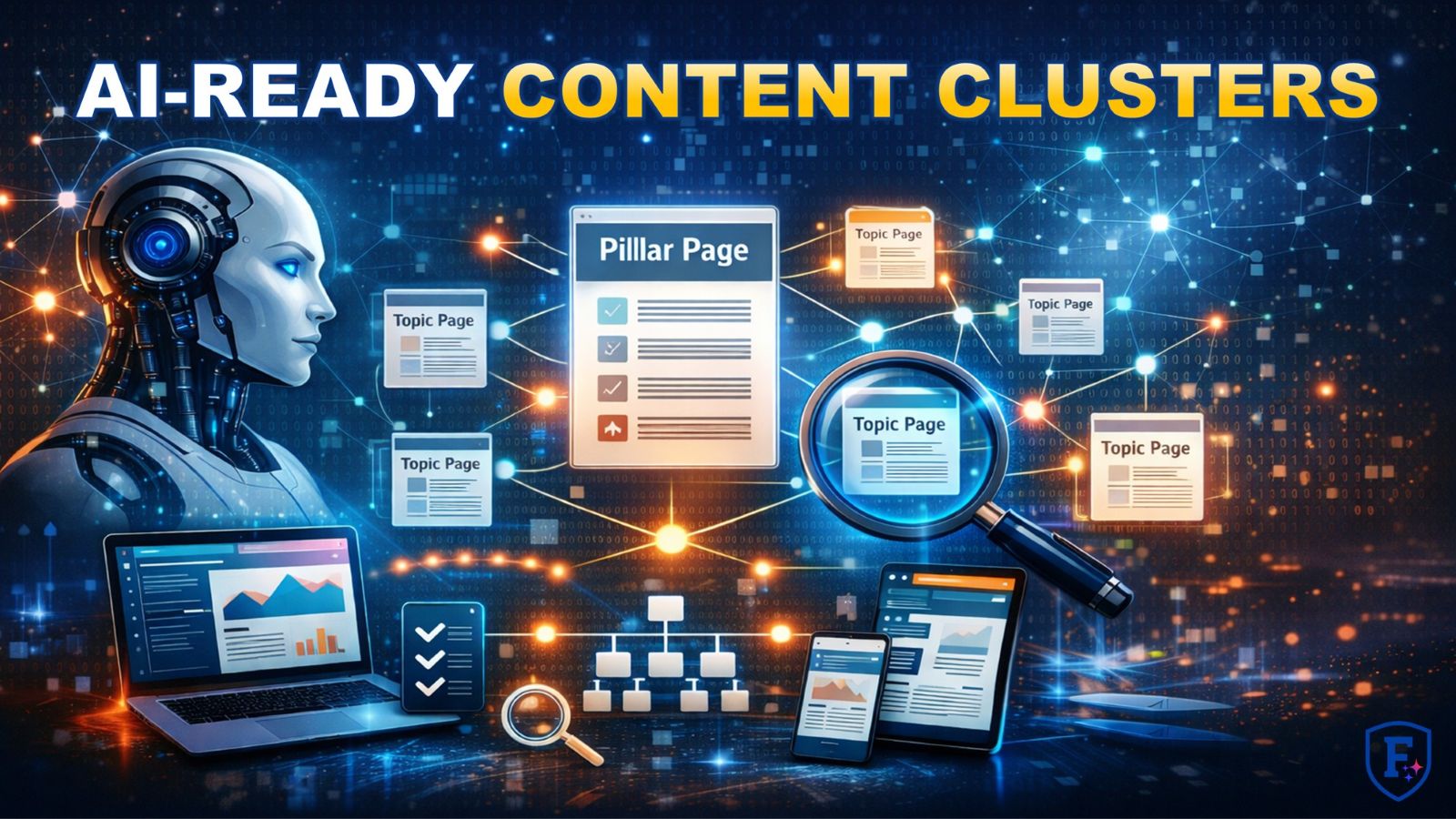
An AI-ready content cluster is a group of pages that work together to explain one subject clearly and completely.
At its core, a cluster has three parts:
- A pillar page
- Supporting articles
- Strong internal links
Each part plays a specific role.
The Pillar Page
The pillar page is the anchor.
It covers the topic broadly and answers the biggest questions.
Think of it as:
- The table of contents for a subject
- The page AI checks first to understand your stance
- The page you would give someone who is new to the topic
It does not go deep into every detail. It explains the landscape and points to deeper resources.
Supporting Articles
Supporting articles go deep on one specific question or subtopic.
Each one should stand on its own while reinforcing the pillar.
Examples of good supporting topics:
- Definitions
- Step-by-step guides
- Comparisons
- Common mistakes
- Advanced strategies
Each article strengthens the overall signal of expertise.
Internal Linking Structure
Links connect the cluster into one system.
Every supporting article should:
- Link back to the pillar page
- Link to related articles where relevant
The pillar page should:
- Link out to all supporting articles
This creates a closed loop of meaning that AI can easily follow.
Experience and Perspective That Shapes This Approach
Years of building, breaking, and rebuilding websites teaches you one thing quickly: clarity beats cleverness.
When managing multiple online platforms at once, patterns become obvious. Pages that work together outperform pages that try to stand alone.
Content clusters emerged not as a trend, but as a practical solution to a real problem—helping machines understand complex businesses without confusion. That perspective shapes every recommendation in this article.
How to Plan an AI-Ready Content Cluster
Planning is where most people rush—and where most clusters fail.
Before writing anything, you need a map.
Step 1: Choose One Core Topic
Start narrow.
A good core topic is specific enough to be owned, but broad enough to support multiple articles.
Bad examples:
- “Marketing”
- “Technology”
Better examples:
- “AI-ready content strategy for small businesses”
- “Local business AI visibility”
If you can’t explain the topic in one sentence, it’s too broad.
Step 2: List the Questions People Actually Ask
Clusters should be built around questions, not opinions.
Ask:
- What does this mean?
- How does it work?
- How do I do it?
- What mistakes should I avoid?
Write down every natural question that comes to mind. These will become your supporting articles.
Step 3: Group Questions Into Subtopics
Some questions belong together.
Group them logically.
For example:
- Definitions and fundamentals
- Implementation steps
- Tools and frameworks
- Pitfalls and myths
These groupings help you decide which articles to write first.
Writing AI-Ready Pillar Pages
The pillar page sets the tone for the entire cluster.
What a Strong Pillar Page Includes
A strong pillar page:
- Defines the topic clearly
- Explains why it matters now
- Outlines the major subtopics
- Links to deeper resources
It should feel complete without being overwhelming.
What to Avoid
Avoid turning a pillar page into:
- A sales page
- A dumping ground for every detail
- A keyword-stuffed essay
AI looks for clarity, not density.
Writing Supporting Articles That Strengthen the Cluster
Supporting articles do the heavy lifting.
Each one should answer one question extremely well.
One Question, One Page
Do not try to cover multiple unrelated ideas in one article.
That confuses readers and AI alike.
A good supporting article:
- States the question clearly
- Answers it directly
- Uses examples and steps
- Links back to the pillar
This consistency compounds over time.
Semantic Variety Without Losing Focus
Use natural language.
Say the same idea in different ways without drifting off topic.
This helps AI understand meaning without thinking you changed subjects.
Internal Linking Best Practices
Internal links are not decoration. They are signals.
Link With Purpose
Every link should answer:
- “Why would someone click this next?”
Avoid generic anchor text like “click here.”
Use descriptive phrases that explain the connection.
Keep the Cluster Tight
Do not link randomly across unrelated topics.
Clusters should feel contained and intentional.
This reinforces topical authority.
Bad Example vs. Good Example
Most websites technically have content. The difference is how that content works together.
Bad Example: Scattered Content
A bad website:
- Publishes random blog posts whenever inspiration strikes
- Covers overlapping topics with different language each time
- Rarely links older articles to newer ones
To AI, this looks like uncertainty. The site may know things, but it cannot explain them consistently.
Good Example: Structured Content Cluster
A good website:
- Has a clear pillar page for each core topic
- Publishes supporting articles that answer specific questions
- Uses consistent language and internal links
To AI, this looks like expertise. The site demonstrates focus, depth, and reliability.
How Content Clusters Improve AI Recommendations
AI systems prefer sources that reduce risk.
Risk comes from ambiguity.
Clusters reduce ambiguity by:
- Repeating key ideas in structured ways
- Showing agreement across multiple pages
- Reinforcing intent and expertise
Over time, this increases the likelihood that AI will choose your business as a reference or recommendation.
Maintaining and Expanding Your Clusters
Clusters are not “set it and forget it.”
Regular Updates
Review clusters every few months:
- Are all links still relevant?
- Are definitions still accurate?
- Are there new questions worth adding?
Small updates keep clusters fresh and trustworthy.
Expand Intentionally
Add new supporting articles only when they strengthen the core topic.
More content is not always better. Better content is better.
FAQs
What are AI-ready content clusters?
AI-ready content clusters are groups of related pages organized around one core topic, designed to help AI systems understand and trust your expertise.
How many articles should be in a content cluster?
Most strong clusters start with one pillar page and 5–10 supporting articles. Quality matters more than quantity.
Do content clusters replace traditional SEO?
No. They build on it. Clusters align traditional SEO with how AI search actually works today.
Can small businesses use content clusters effectively?
Yes. In fact, focus and clarity often allow small businesses to outperform larger, unfocused competitors.
How long does it take to see results?
Some improvements appear within weeks, but authority compounds over months as clusters grow and stabilize.
Should every blog post belong to a cluster?
Ideally, yes. Posts without a clear home often underperform and confuse AI systems.
Do I need special tools to build clusters?
No. Clear planning, consistent writing, and disciplined internal linking are more important than tools.
Key Takeaways
- AI-ready content clusters organize your expertise into clear, connected systems.
- Pillar pages provide structure; supporting articles provide depth.
- Internal linking turns individual pages into authority signals.
- Clusters help both humans and AI understand what you do best.
- Focus and clarity consistently outperform volume and randomness.
About the Author
Christopher Littlestone is an AI visibility strategist and the founder of Found by AI Search. He works at the intersection of strategy, structure, and clarity—helping businesses adapt to how AI systems actually evaluate expertise and trust online.
Final Thoughts
AI search is not impressed by effort. It responds to clarity.
Content clusters are one of the most practical ways to create that clarity—without gaming the system or chasing trends.
If you want AI to understand your business, you must teach it deliberately.
Ready to Be Found by AI Search?
If you’re serious about AI visibility, your next step isn’t another article — it’s understanding how AI systems currently see your business.
Request a Visibility Index Profile (VIP) Audit
Most businesses are already invisible to AI search. The VIP Audit is a professional, done-for-you analysis that shows how AI systems like ChatGPT, Gemini and Bing understand your brand, what’s holding you back, and what to fix first. You get a clear, prioritized roadmap in two business days or less. No guessing. Just clarity.
Be Found by AI Search so you can get more customers and make more money.