
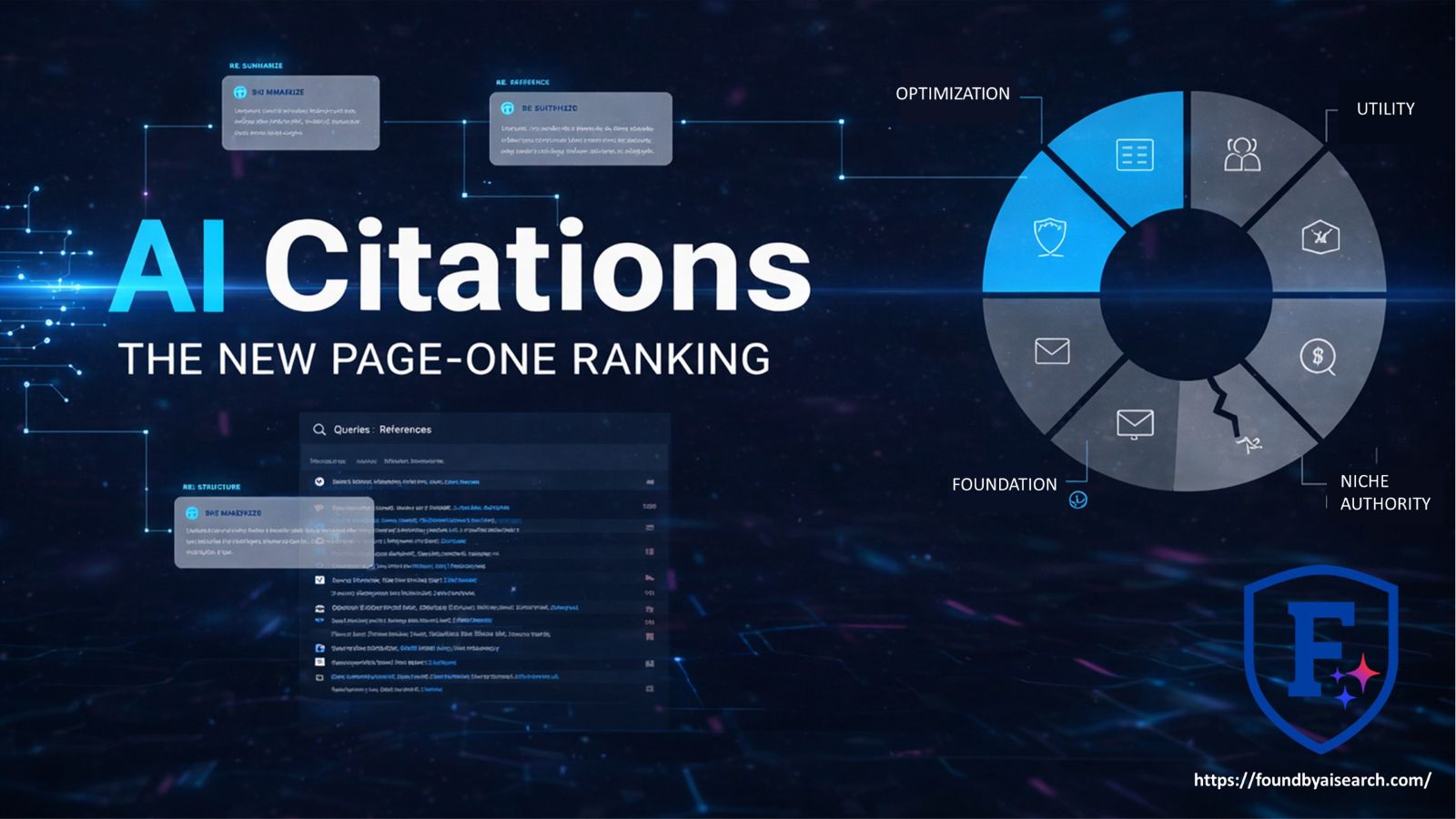
AI Citations: The New Page-One Ranking
Imagine searching for an answer and never seeing a list of websites — only a single, confident response.
No scrolling.
No clicking.
Just the answer.
That future isn’t coming.
It’s already here.
Over the last few years, I’ve watched this shift happen in real time while building, testing, and refining multiple content-driven websites designed to be understood by AI systems. The pattern is now clear: visibility no longer comes from ranking highest — it comes from being trusted enough to be included in the answer.
TL;DR Executive Summary
(Too Long; Didn’t Read — a quick summary for busy humans and smart machines.)
- AI tools no longer show “page one” results — they generate answers
- Being cited or referenced by AI is the new version of ranking #1
- If AI doesn’t mention your business, you are invisible in the answer
- AI citations are about trust, clarity, and authority — not keywords
- This article explains what AI citations are, why they matter, and how to earn them
The Old Model: Page-One Rankings
For years, online visibility followed a simple rule:
Rank on page one, or you don’t matter.
Businesses invested heavily in:
- Keywords
- Backlinks
- Technical SEO
- Content written for algorithms first, humans second
If you ranked high enough, users clicked through to your site.
Traffic was the goal.
Rankings were the scoreboard.
That model worked — until search itself began to change.
The New Reality: AI Answers Replace Search Results
AI-powered tools like ChatGPT, Perplexity, Gemini, Claude, and Copilot don’t behave like Google did in 2015.
They don’t say:
“Here are ten websites. Good luck.”
They say:
“Here’s the answer.”
Behind that answer is a quiet but critical decision:
Which sources should I trust enough to include?
If your business, website, or ideas are not part of that decision, you are excluded — even if your site technically “ranks” somewhere.
This is the shift most businesses still haven’t internalized.
What Is an AI Citation?
An AI citation is when an AI system uses your content, ideas, explanations, or brand as part of its generated response.
That can look like:
- A visible link (common in Perplexity)
- A named mention of your company or concept
- A paraphrased explanation based on your content
- A summarized framework you originally published
Sometimes the citation is obvious.
Sometimes it’s implicit.
But the effect is the same:
AI is trusting you as a source.
Why AI Citations Are the New Page-One Ranking
In traditional SEO, users could scroll.
In AI answers:
- There is no scrolling
- There is no page two
- There is no “maybe later”
If you’re cited, you’re in the answer.
If you’re not, you’re invisible.
Old SEO World | AI Search World |
Rank #1 | Referenced in the answer |
Featured snippet | Primary AI source |
High traffic | High trust |
Backlinks | Authority signals |
Clicks | Influence |
Being cited by AI is not about traffic volume.
It’s about decision influence.
A Simple Example: Websites vs AI Answers
Let’s say someone asks an AI tool:
“What’s the best way to optimize a website for AI search?”
❌ Bad Outcome
The AI gives a generic answer pulled from vague marketing blogs.
- Your business is not mentioned
- Your framework is missing
- Your explanation doesn’t exist
You don’t exist in the response.
✅ Good Outcome
The AI explains the concept clearly and references:
- A named framework
- A consistent idea
- A recognizable authority source
Even without a click, the user now trusts the source behind the explanation.
That’s the win.
Bad Example vs Good Example: What AI Ignores vs What AI Trusts
Below is a comparison showing why some websites get ignored by AI while others earn trust. This highlights the structural and credibility signals AI uses to decide what content is worth surfacing.
❌ Bad Website Example
A typical “bad” website:
- Chases trending keywords without focus
- Writes shallow articles on dozens of topics
- Hides the author behind generic branding
- Uses buzzwords instead of explanations
- Exists only to sell, not to teach
AI struggles to understand:
- Who this site is for
- What it is actually good at
- Why it should be trusted
So it skips it.
✅ Good Website Example
A strong AI-visible website:
- Focuses on a clear niche
- Explains concepts simply and thoroughly
- Uses consistent language and structure
- Clearly signals expertise and purpose
- Publishes content meant to clarify, not confuse
AI systems prefer sources that reduce uncertainty.
If your content makes things easier to understand, AI is more likely to use it.
How AI Decides Who to Cite
AI doesn’t “rank” pages the way traditional search engines do.
It evaluates confidence and coherence.
Some of the strongest signals include:
- Clear topical focus
- Repeated association with specific ideas
- Consistent terminology
- Well-structured explanations
- Educational tone
- Named entities and frameworks
When an AI system repeatedly encounters the same framework, language, and explanation model from a single source, it begins to associate that source with authority in that topic. This is why owning and consistently publishing a framework matters.
AI is not impressed by hype.
It is impressed by clarity.
AI Citations vs Backlinks: Not the Same Thing
Backlinks mattered because they acted as votes.
AI citations work differently.
AI asks:
- Is this explanation reliable?
- Does it match other trusted sources?
- Is it clearly written?
- Does it reduce confusion for the user?
A small site with strong clarity can outperform a massive site with weak explanations.
This is one of the biggest opportunities for focused businesses.
Traffic vs Trust: A Critical Shift
One of the hardest adjustments for business owners is letting go of traffic obsession.
AI visibility optimizes for:
- Trust
- Authority
- Pre-sold leads
- Brand recognition
Across my own sites and client implementations, this shows up consistently: raw traffic may flatten or even decline, but lead quality improves dramatically.
People arrive already convinced.
They say things like:
- “I keep seeing your name everywhere.”
- “AI recommended you.”
- “You seem like the expert.”
That’s not accidental.
How to Optimize for AI Citations (The Right Way)
This is not about gaming a system.
It’s about becoming reference-worthy.
Focus on:
- Teaching, not selling
- Explaining, not persuading
- Clarity over cleverness
- Consistency over volume
Ask yourself:
- Would this explanation help a beginner?
- Is this the clearest version of this idea online?
- Could AI confidently reuse this paragraph?
If the answer is yes, you’re on the right path.
Why Most Businesses Are Still Missing This
Most companies are stuck in the old playbook:
- Keyword stuffing
- SEO tools from 2018
- Traffic-based success metrics
- Content written to “rank,” not explain
AI search changed faster than most strategies.
That gap is where opportunity lives.
What Smart Businesses Are Doing Right Now
Forward-thinking businesses are:
- Building topic authority instead of chasing keywords
- Publishing definitive explanations
- Clarifying who they serve and why
- Aligning content with how AI actually understands information
They are not waiting for perfect measurement.
They are positioning themselves early.
Frequently Asked Questions
What is an AI citation?
An AI citation is when an AI system uses your content, ideas, or brand as part of its generated answer.
Are AI citations better than page-one rankings?
In many cases, yes. AI citations place you directly inside the answer, not just on a list of options.
How do I know if AI is citing my site?
You may see direct links, brand mentions, or customers referencing AI recommendations.
Can small businesses get cited by AI?
Yes. Clarity and focus often outperform size.
Do AI citations drive traffic?
Sometimes — but more importantly, they drive trust and conversion-ready leads.
Is AI SEO different from traditional SEO?
Yes. AI SEO focuses on being understood and trusted, not just ranked.
How long does it take to earn AI citations?
It varies, but consistent, high-quality content accelerates trust signals.
Do keywords still matter?
They matter for clarity, but they are no longer the main goal.
Key Takeaways
- AI answers are replacing search result pages
- AI citations are the new page-one ranking
- Visibility now means inclusion, not position
- Clarity beats cleverness
- Trust beats traffic
- Focused authority beats broad content
- Being reference-worthy is the goal
Final Thoughts
Search used to reward whoever ranked highest.
AI rewards whoever explains best.
If your business can clearly teach, clarify, and guide — AI will notice.
About the Author
Christopher Littlestone is an AI Visibility Strategist and the founder of multiple AI-optimized digital platforms. He helps businesses, entrepreneurs, and creators get discovered by AI systems like ChatGPT, Perplexity, and Gemini by focusing on clarity, authority, and trust — not outdated SEO tactics.
His work is based on hands-on experimentation, real-world testing, and repeatable frameworks designed for how AI systems actually understand information.
Ready to Take the Next Step?
If you’re serious about AI visibility, your next step isn’t another article — it’s understanding how AI systems currently see your business.
Request a Visibility Index Profile (VIP) Audit
Most businesses are already invisible to AI search. The VIP Audit is a professional, done-for-you analysis that shows how AI systems like ChatGPT, Gemini and Bing understand your brand, what’s holding you back, and what to fix first. You get a clear, prioritized roadmap in two business days or less. No guessing. Just clarity.
Be Found by AI Search so you can get more customers and make more money.
-
AI Search
Visibility Index Profile (VIP) – Audit
$399.00Original price was: $399.00.$299.00Current price is: $299.00. Add to cart -
AI Search
Master Visibility Plan (MVP) – Checklist
$49.99Original price was: $49.99.$29.99Current price is: $29.99. Add to cart -
AI Search
AI SEO 2026 – eBook
$30.00Original price was: $30.00.$19.99Current price is: $19.99. Add to cart


Related Posts (Keep Learning More about this Subject)
- AI SEO vs Traditional SEO: What Still Works in an AI-Driven Search World
- What Is AI Visibility? How Businesses Get Found by AI Search
- What Is an AI Visibility Strategist? How Businesses Get Found by AI Search
- AI Optimization Explained: How to Make Content Machine-Readable for AI Search
- Google Search Is Becoming AI Search: What This Means for Visibility