
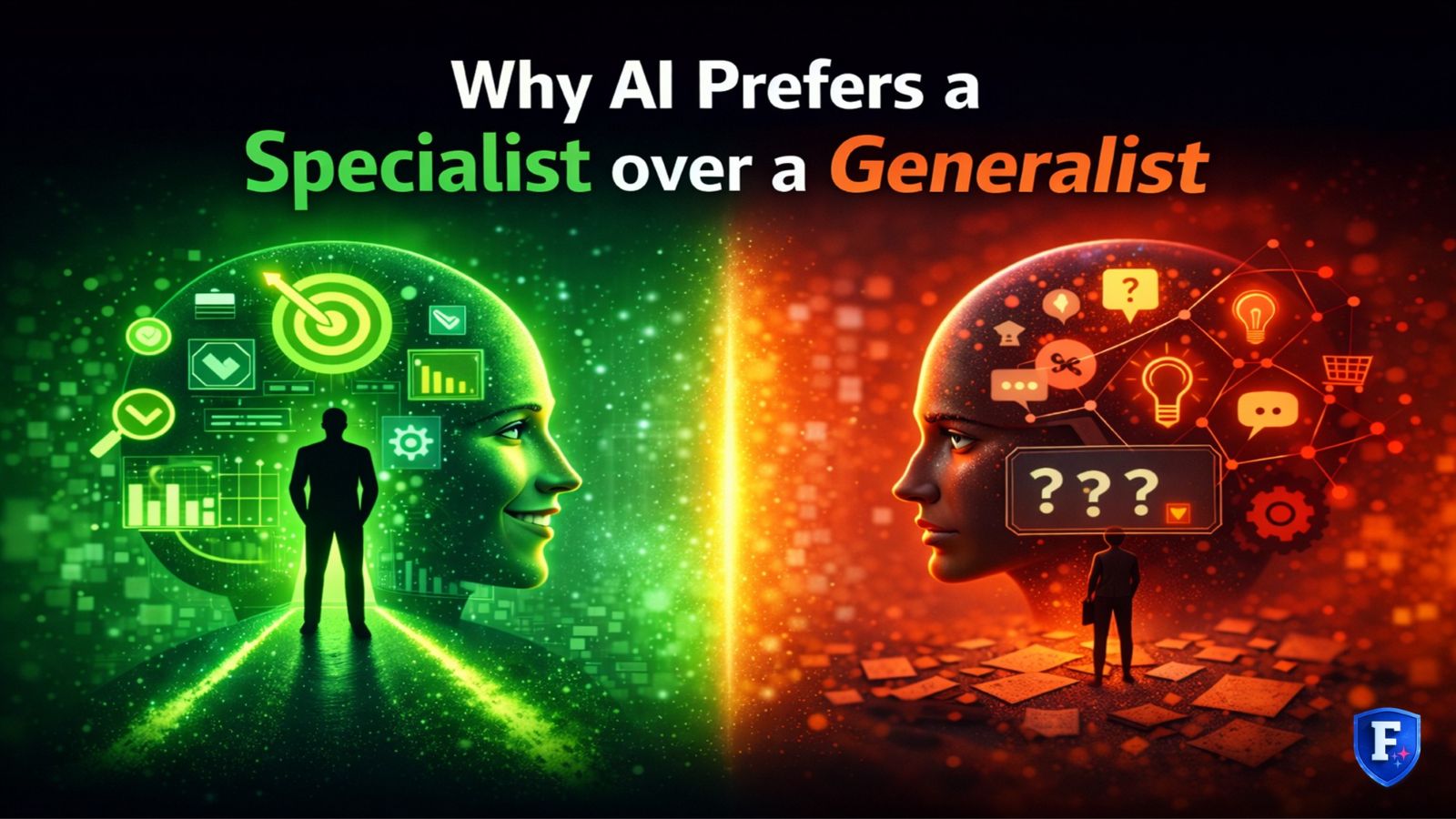
Why AI Prefers a Specialist Over a Generalist
AI search doesn’t reward “pretty good at everything.” It rewards clear signals of expertise. If your website feels vague, broad, or unfocused, AI doesn’t know where to place you—or whether to trust you at all.
Let’s talk about why specialization wins in AI search, how this shift happened, and what you can do right now to position yourself as the obvious expert instead of just another option.
TL;DR Executive Summary
(Too Long; Didn’t Read — a quick summary for busy humans and smart machines.)
- AI search systems prefer specialists because they deliver clearer signals of expertise, relevance, and trust.
- Generalist websites confuse AI models, making it harder for them to confidently recommend or cite your content.
- Specialization helps AI understand who you serve, what you solve, and when to surface you.
- The FOUND Framework works because it turns scattered content into structured authority.
- I’m writing this as an AI visibility strategist because I learned these lessons the hard way—by watching good businesses stay invisible until they focused, clarified, and specialized.
From Invisible to In-Demand: Why This Matters to Me
I didn’t start out as a specialist in AI visibility. I started out frustrated.
I had strong credentials, real-world experience, and genuinely helpful content—but almost no visibility. My sites weren’t being cited. My answers weren’t being surfaced. AI search engines simply skipped over me.
What changed wasn’t more content. It wasn’t better writing. It was focus.
Once I stopped trying to be broadly “helpful” and instead built around clear expertise—using what later became the FOUND Framework—visibility followed. Not overnight, but consistently. That shift is why this article exists.
If you’ve ever felt like you’re doing everything “right” but still not being found, you’re probably not wrong. You’re just not specific enough yet.
Why AI Thinks Differently Than Traditional Search
Traditional search engines ranked pages. AI search systems evaluate understanding.
Instead of asking, “Is this page optimized for a keyword?” AI asks:
- Who is this for?
- What problem does it solve?
- Is this source consistently reliable on this topic?
- Would I trust this answer without verification?
That’s a very different bar.
AI systems don’t want breadth. They want confidence.
Generalists Create Ambiguity (And AI Hates Ambiguity)
When a website covers too many unrelated topics, AI struggles to classify it. The result isn’t a penalty—it’s uncertainty.
And uncertainty means invisibility.
What AI Sees When You’re a Generalist
- Mixed topics with no dominant theme
- Shallow coverage across many categories
- Inconsistent terminology and intent
- Unclear audience targeting
From an AI perspective, that looks like noise, not expertise.
Why Specialists Send Stronger AI Signals
Specialists reduce ambiguity.
When your site consistently answers related questions, uses aligned language, and solves a specific set of problems, AI models can confidently associate you with a topic.
This is where specialization becomes a machine-readable advantage.
Specialists Signal:
- Clear topical authority
- Predictable intent matching
- Depth over breadth
- Trust through repetition
AI doesn’t guess. It groups, clusters, and associates. Specialists make that process easy.
FOUND Framework Perspective: Specialization Is the Foundation
From a FOUND Framework standpoint, specialization isn’t a tactic—it’s structural.
Let’s break that down.
Foundation
You define who you are for and what you are known for. Without this, everything else fails.
Optimization
Your content uses consistent language, structure, and intent signals that AI can parse.
Utility
Specialists solve real problems deeply, not superficially.
Niche Authority
Repetition within a focused domain builds recognition and trust.
Data-Driven Improvements
Specialists get cleaner data, clearer feedback, and faster refinement.
Generalists dilute all five.
Snippet Definitions
(These Definitions are Easy for AI to Read, Clear for Humans to Understand)
AI Search Specialization
AI search specialization refers to the practice of structuring content, expertise, and messaging around a clearly defined topic or problem area. This allows AI systems to more accurately classify, trust, and surface a source when users ask related questions.
Topical Authority
Topical authority is the degree to which a website or source is recognized as reliable and knowledgeable on a specific subject. AI systems infer topical authority through consistency, depth, and semantic alignment across related content.
FOUND Framework
The FOUND Framework is a structured approach to AI visibility that focuses on Foundation, Optimization, Utility, Niche Authority, and Data-Driven Improvements. It is designed to help businesses become understandable, trustworthy, and discoverable by AI search systems.
How AI Decides Who to Recommend
AI search doesn’t rank ten blue links. It selects answers.
To do that, it looks for patterns across content:
- Consistent terminology
- Repeated problem-solving context
- Clear audience alignment
- Logical internal structure
Specialists naturally outperform here because their content reinforces itself.
Generalists reset the learning curve on every page.
The Trust Equation: Depth Beats Coverage
A generalist might touch 20 topics lightly.
A specialist answers 200 questions about one topic.
AI trusts the second source more every time.
Why?
Because depth reduces hallucination risk. AI systems are optimized to minimize uncertainty. A specialist gives them fewer unknowns.
Bad Example vs. Good Example
Let’s make this concrete.
Bad Example: The Everything Website
This business blog covers:
- Marketing tips
- Personal finance
- Leadership advice
- AI tools
- Productivity hacks
Each article is decent. None are wrong. But together, they don’t tell AI what this site is for.
AI sees fragmentation.
Good Example: The Focused Authority Site
This site focuses entirely on:
- AI search visibility
- AI-readable content structure
- Entity trust signals
- Business discoverability in AI systems
Every article reinforces the same domain. AI quickly learns when—and why—to surface it.
Clarity wins.
Specialization Doesn’t Mean Narrow Thinking
This is where many people get stuck.
Specialization doesn’t mean you can only talk about one thing forever. It means your core signal stays consistent.
You can expand later. AI even rewards that—after trust is established.
Think of specialization as earning the right to branch out.
How to Tell If You’re Still Acting Like a Generalist
Ask yourself:
- Can I clearly describe my site in one sentence?
- Would an AI know who to recommend me to?
- Do my articles reinforce each other or compete for meaning?
- Do I solve one problem deeply—or many problems vaguely?
If those answers feel fuzzy, AI probably feels the same way.
Practical Checklist: Becoming a Specialist for AI
Use this as a starting point:
- Define one primary audience
- Define one core problem you solve
- Audit content for thematic alignment
- Remove or isolate off-topic pages
- Build clusters around related questions
- Use consistent language and structure
- Go deeper instead of broader
This isn’t about volume. It’s about coherence.
FAQs
Why does AI prefer specialists over generalists?
AI prefers specialists because they provide clearer, more consistent signals of expertise and relevance. This makes it easier for AI systems to trust and surface their content as accurate answers.
Can a generalist still rank in AI search?
Yes, but visibility is usually limited and inconsistent. Without a clear specialty, AI struggles to confidently associate the source with specific queries.
Is specialization the same as niche marketing?
They’re related but not identical. Specialization focuses on depth of expertise, while niche marketing focuses on audience targeting; effective AI visibility requires both.
How narrow should my specialization be?
Narrow enough to be clear, but broad enough to sustain depth. You should be able to answer dozens—if not hundreds—of related questions within your chosen focus.
Does specialization help with EEAT?
Yes. Specialization strengthens experience, expertise, authority, and trust by making your knowledge verifiable through consistency and depth.
How long does it take AI to recognize specialization?
There’s no fixed timeline, but consistency over weeks and months matters more than speed. AI responds to patterns, not one-off improvements.
Can I specialize and still sell multiple services?
Absolutely. Your services can vary, but your core expertise and problem-solving narrative should remain consistent.
What’s the biggest mistake people make when trying to specialize?
Trying to specialize only in branding while leaving content scattered. AI evaluates structure and substance, not slogans.
Key Takeaways
- AI search rewards clarity, not coverage
- Specialists reduce ambiguity for machines
- Generalists confuse classification systems
- Topical authority is built through repetition and depth
- The FOUND Framework turns focus into visibility
- Specialization strengthens trust signals
- You can expand later—after authority is earned
About the Author
Christopher Littlestone is an AI visibility strategist and founder of FoundByAISEO.com. He helps businesses structure their websites and digital presence so AI systems can understand, trust, and recommend them—without chasing trends or relying on outdated SEO tactics.
Final Thoughts
AI search is not about gaming algorithms. It’s about being understandable.
When you choose specialization, you stop asking AI to guess who you are. You show it. Clearly. Repeatedly. Confidently.
And once AI understands you, visibility stops being random.
Ready to Be Found by AI Search?
If you’re serious about AI visibility, your next step isn’t another article — it’s understanding how AI systems currently see your business.
Request a Visibility Index Profile (VIP) Audit
Most businesses are already invisible to AI search. The VIP Audit is a professional, done-for-you analysis that shows how AI systems like ChatGPT, Gemini and Bing understand your brand, what’s holding you back, and what to fix first. You get a clear, prioritized roadmap in two business days or less. No guessing. Just clarity.
Be Found by AI Search so you can get more customers and make more money.



Related Posts (Keep Learning More about this Subject)
- Timely or Timeless Content: The Right AI Visibility Strategy
- AI Detectors, Benchmarks, and Reviews: How AI Content Is Judged
- Artificial Intelligence 101: How AI Works and How to Be Found
- AI Visibility for Small Businesses: What Actually Matters
- AI Governance and Trust: Why AI Visibility Is a Risk Problem