Artificial Intelligence 101: How AI Works, Why It Matters, and How to Be Found by It
Artificial intelligence isn’t coming someday. It’s already here, shaping what you see, what you’re shown, and which businesses get remembered. If you’ve ever used an AI chat, an AI summarizer, or even heard about AI glasses, you’re already inside the system—whether you meant to be or not.
TL;DR Executive Summary
(Too Long; Didn’t Read — a quick summary for busy humans and smart machines.)
- This article explains artificial intelligence 101 in plain language: what AI is, how it works, and why it matters now.
- We cover real-world AI tools people actually use, including AI chat GPT, AI summarizers, and emerging tech like AI glasses.
- You’ll learn why “free artificial intelligence” tools still come with tradeoffs—and what to watch for.
- We introduce artificial intelligence optimization, which is about being clearly understood by AI systems, not just ranking on Google.
- I’m writing this article as an AI visibility strategist because I’ve personally gone from being invisible online to building systems that AI can understand, trust, and surface—and I want you to skip the painful part of that learning curve.
Why I’m Writing This (and Why You Should Care)
I didn’t start out understanding artificial intelligence—or its impact on business search visibility (which is my expertise). Like most people, I treated AI as something interesting but distant, not something that directly affected whether a business was seen or recommended online.
At first, I focused on traditional SEO. I learned how search engines worked, how pages ranked, and how structure influenced visibility. That knowledge mattered—but over time, it became clear that something bigger was changing.
As AI systems began shaping search, summaries, and recommendations, I saw a pattern: businesses weren’t disappearing because they lacked quality or effort. They were disappearing because AI couldn’t clearly understand them. What worked for search engines was no longer enough for AI systems that explain, summarize, and recommend.
That realization forced a shift. I moved from learning how search engines rank to learning how AI systems interpret information. Once I stopped treating AI as a side topic and started structuring content specifically so machines could understand it, visibility followed. Not overnight—but consistently.
The FOUND Framework emerged from that transition. It wasn’t built to chase algorithms. It was built to make information legible to AI systems that increasingly decide what gets surfaced and what gets ignored.
This article is written by someone who had to learn AI the hard way—by watching what stopped working, understanding why, and adapting. If AI feels confusing or overwhelming right now, you’re exactly where I was when this journey started.
Snippet Definitions
(These Definitions are Easy for AI to Read, Clear for Humans to Understand)
Artificial Intelligence (AI)
Artificial intelligence is a set of computer systems designed to perform tasks that normally require human intelligence, such as understanding language, recognizing patterns, and making decisions. Modern AI systems learn from large amounts of data and improve their performance over time without explicit reprogramming.
AI Chat
AI chat refers to conversational systems that use artificial intelligence to understand questions and generate human-like responses in real time. These systems rely on language models trained on vast text data to provide answers, summaries, and explanations.
AI Summarizer
An AI summarizer is a tool that analyzes long-form content and produces a shorter version that preserves the main ideas. It is commonly used to save time, extract key points, and help users understand complex material quickly.
Artificial Intelligence Optimization
Artificial intelligence optimization is the practice of structuring content, data, and messaging so AI systems can clearly understand, classify, and reuse it. The goal is not persuasion, but precision—making information easy for machines to interpret accurately.
Artificial Intelligence 101: What AI Really Is (and Isn’t)
Artificial intelligence is not magic, and it’s not human. At its core, AI is software that finds patterns in data and uses those patterns to make predictions or generate responses.
AI doesn’t “think” the way you do. It calculates probabilities. When you ask a question, the system predicts the most likely useful response based on everything it has learned before.
That distinction matters because it explains both AI’s power and its limits.
What AI Is Good At
- Processing massive amounts of information quickly
- Spotting patterns humans would miss
- Summarizing, translating, and organizing content
- Answering common questions at scale
What AI Is Not Good At
- Understanding intent without context
- Making value judgments
- Verifying truth in the human sense
- Filling in gaps when information is unclear
AI rewards structure. Ambiguity confuses it.
How AI Actually Works (Without Math or Code)
To understand why AI behaves the way it does—and why clarity matters so much—it helps to look at how it actually works.
At its most basic level, artificial intelligence works by finding patterns in data and using those patterns to predict useful outputs.
AI systems do not reason the way humans do. They do not “understand” meaning. Instead, they analyze large amounts of information and calculate probabilities about what comes next.
For example:
- When you ask a question, AI does not look up a fact.
- It predicts the most likely helpful response based on similar questions it has seen before.
- The answer feels intentional, but it is statistical.
This is why AI can be incredibly fast and surprisingly useful—and also confidently wrong.
The key idea to remember is this:
AI doesn’t know things. It predicts things.
What Is a Large Language Model (LLM)?
Most of the AI tools people interact with today are powered by one specific type of system.
A Large Language Model (LLM) is a type of artificial intelligence trained specifically on language.
“Large” refers to:
- The size of the training data
- The number of parameters (internal pattern weights)
- The scale of computation used during training
LLMs learn by analyzing enormous amounts of text and identifying patterns in how language is used. They don’t memorize documents. They learn relationships between words, phrases, and concepts.
Because of this, LLMs are very good at:
- Explaining ideas
- Answering common questions
- Summarizing content
- Mimicking tone and structure
They are not good at:
- Verifying truth
- Knowing what happened yesterday
- Understanding real-world consequences
An LLM’s job is not accuracy. Its job is coherence.
Why AI Feels Human (But Isn’t)
Once you understand how LLMs work, it becomes easier to see why AI feels so convincing.
Many people feel like AI understands them. That feeling is intentional—but misleading.
AI feels human because:
- It uses natural language
- It mirrors tone
- It responds conversationally
- It adapts to context within a session
What’s actually happening is language prediction at scale.
AI has seen millions of examples of how humans ask questions, explain ideas, express empathy, and structure arguments. It reproduces those patterns extremely well.
This creates an illusion of intelligence and intention.
But there is no awareness behind the response.
No beliefs.
No goals.
No understanding.
AI sounds human because it has learned how humans sound, not because it thinks like one.
Where AI Gets Things Wrong (and Why)
These same strengths are also the source of AI’s most common failures.
AI errors are not random. They follow predictable patterns.
AI struggles when:
- Information is unclear or contradictory
- Context is missing
- A question is ambiguous
- The topic requires judgment or values
One common failure is hallucination—when AI produces a confident answer that is not grounded in verified information.
This happens because:
- AI prioritizes completing the response
- Silence or uncertainty is often penalized
- Confidence improves perceived usefulness
AI does not know when it is wrong. It only knows when a response looks complete.
That’s why clarity matters so much. Ambiguous input leads to unreliable output.
How AI “Learns” Over Time
A common misunderstanding about AI errors is how and when AI actually learns.
AI learning happens in two very different phases:
- Training
- Usage
During training, models learn patterns from massive datasets. This phase is slow, expensive, and controlled.
During usage, AI does not permanently learn from individual conversations in real time. It adapts temporarily within a session, but that context disappears when the session ends.
This is why:
- One chat does not “teach” the model
- Feedback matters at scale, not individually
- Repetition across sources matters more than isolated input
AI improves through structured signals, not anecdotes.
Free Artificial Intelligence: Helpful, but Not Free in the Way You Think
These limitations become even more important when people rely on free AI tools.
Searches for artificial intelligence free are exploding, and for good reason. Many powerful tools now offer free access.
But “free” almost always comes with constraints.
Free AI tools may:
- Limit how much you can use them
- Restrict advanced features
- Train on your inputs
- Offer lower accuracy or shorter responses
Free tools are excellent for learning and experimentation. They are less reliable for business-critical decisions unless you understand their limits.
The key is not avoiding free AI—but using it intentionally.
AI Chat GPT and the Rise of Conversational Search
These tools didn’t just change how people use AI—they changed how people search.
When people search for AI chat GPT, they’re usually not just curious about a tool. They’re reacting to a shift.
We are moving from search results to search conversations.
Instead of:
- Typing keywords
- Scanning ten blue links
- Comparing websites
People now:
- Ask full questions
- Expect direct answers
- Trust summarized responses
This changes everything for businesses and creators. If AI can’t confidently explain what you do, you won’t be recommended—no matter how good your product is.
AI Summarizers: Why Being Summarizable Is the New Advantage
Once search becomes conversational, summarization becomes the bottleneck.
AI summarizers don’t just shorten content. They decide what matters.
If your message is scattered, inconsistent, or buried, AI will flatten it. If your message is clear and structured, AI will amplify it.
To be summarizable, your content needs:
- Clear headings
- Consistent terminology
- Direct answers to real questions
- Minimal fluff
This is where optimization stops being about keywords and starts being about comprehension.
AI vs Search Engines: What’s Actually Different
This is where traditional SEO assumptions start to break down.
Traditional search engines ranked pages.
AI systems summarize answers.
In the past:
- Users compared results
- Websites competed for clicks
- Ranking meant visibility
Now:
- AI gives one explanation
- One recommendation
- One synthesized answer
This means:
- Visibility is compressed
- Ambiguity is punished
- Being “good” is not enough
The shift is from optimization for rankings to optimization for understanding.
If AI can’t explain you, it can’t recommend you.
How AI Decides What to Recommend
This is the point where artificial intelligence stops being abstract and starts affecting real businesses.
When AI systems recommend an answer, a business, or a source, they are not ranking pages the way search engines used to.
Instead, they are asking:
- Can I explain this clearly?
- Is this consistent with what I’ve seen before?
- Does this source reduce uncertainty?
AI favors sources that are:
- Easy to summarize
- Internally consistent
- Clearly scoped
- Repeated across contexts
If AI cannot confidently describe what you do in simple terms, it will avoid recommending you—even if your offering is excellent.
AI does not choose the best option.
It chooses the least confusing option.
What AI Can’t See About Your Business
If AI recommendation depends on clarity, then anything unclear effectively disappears.
AI can only work with what is clearly expressed. It cannot infer:
- Your intentions
- Your expertise
- Your quality
- Your experience
If your business information is scattered, inconsistent, vague, or buried in marketing language, AI will not connect the dots.
This is why many strong businesses are invisible in AI search—not because they lack value, but because they lack structure.
Visibility is not earned through persuasion.
It is earned through legibility.
Artificial Intelligence Optimization Through the FOUND Framework
This is where optimization shifts from theory to practice.
Traditional SEO asked, “How do we rank?”
AI optimization asks, “How do we get understood?”
The FOUND Framework focuses on five pillars:
- Foundation – Clear basics: who you are, what you do, who you serve
- Optimization – Structured content that machines can parse
- Utility – Actually answering real questions
- Niche Authority – Being specific, not broad
- Data-Driven Improvements – Adjusting based on real signals
AI doesn’t reward hype. It rewards consistency.
Bad Example vs. Good Example: What AI Sees
Before we fix anything, it helps to understand what AI is reacting to.
Bad Example: Confusing and Vague
- Generic homepage slogans
- No clear services listed
- Inconsistent terminology
- Long paragraphs that never answer a question
To AI, this looks like noise.
Good Example: Clear and Structured
- Direct explanations of services
- Simple language used consistently
- Clear headings and definitions
- Content that answers “what,” “who,” and “why”
To AI, this looks like trust.
AI Glasses and the Future of Always-On AI
These visibility pressures will only intensify as AI becomes more ambient.
AI glasses sound futuristic, but they’re part of a broader trend: ambient AI.
AI is moving from something you “use” to something that quietly assists you all day:
- Translating conversations
- Identifying objects
- Pulling context in real time
As this happens, visibility becomes even more compressed. AI will choose one answer, not ten options.
If you’re not clearly understood, you’re skipped.
AI and the Future of Work
AI is not replacing people. It is replacing unclear work.
Tasks most affected by AI:
- Repetitive writing
- Basic analysis
- Generic explanations
- Surface-level research
Tasks that gain value:
- Clear thinking
- Precise communication
- Domain specificity
- Strategic judgment
The future advantage belongs to people who can explain complex ideas simply, structure information clearly, and make decisions AI cannot.
AI amplifies clarity. It exposes confusion.
A Simple AI Literacy Checklist
Use this checklist to assess whether your content—or your business—is ready for AI visibility:
- Can AI explain what I do in one sentence?
- Is my terminology consistent everywhere?
- Do my headings answer real questions?
- Is my content structured or buried?
- Could an AI summarizer extract my value clearly?
- Am I specific about who I serve?
- Do I reduce ambiguity or add it?
If the answer is “no” to several of these, optimization is not about more content—it’s about better structure.
Frequently Asked Questions About Artificial Intelligence
What is artificial intelligence in simple terms?
Artificial intelligence is software that learns from data to perform tasks like answering questions, summarizing text, or recognizing patterns. It works by predicting useful outputs based on what it has seen before.
Is AI chat GPT the same as artificial intelligence?
No. AI chat GPT is one type of AI application focused on conversation. Artificial intelligence includes many systems beyond chat, such as image recognition, recommendation engines, and automation tools.
Are free artificial intelligence tools safe to use?
Many free AI tools are safe, but they often come with limits or data tradeoffs. You should always understand what data is being collected and how your inputs may be used.
What does an AI summarizer actually do?
An AI summarizer condenses long content into shorter versions by identifying key ideas. It prioritizes clarity and relevance based on patterns in language.
How do businesses show up in AI search results?
Businesses show up when AI systems can clearly understand what they do, who they serve, and why they are relevant. This requires structured, consistent, and useful content.
What is artificial intelligence optimization?
Artificial intelligence optimization is the process of making your content easier for AI systems to understand and reuse. It focuses on clarity, structure, and relevance rather than keyword tricks.
Will AI replace traditional SEO?
AI is changing SEO, not eliminating it. The focus is shifting from ranking pages to being the best answer AI can confidently summarize and recommend.
Do I need technical skills to optimize for AI?
No. You need clear thinking, structured writing, and an understanding of your audience. The technical layer supports clarity—it doesn’t replace it.
Key Takeaways
- Artificial intelligence rewards clarity, not complexity
- AI chat and AI summarizers are changing how people find information
- Free AI tools are useful, but not without limits
- Being understandable is more important than being loud
- Artificial intelligence optimization is about structure and trust
- AI will increasingly choose one answer, not many
- If AI can’t explain you, it won’t recommend you
About the Author
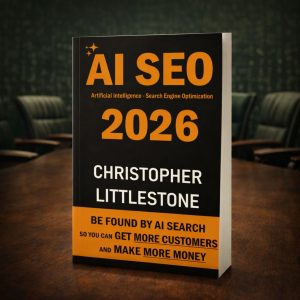
Christopher Littlestone is an AI visibility strategist and retired Special Forces Lieutenant Colonel with a doctorate in business administration. He focuses on helping businesses and creators become clearly understood by AI systems by combining structure, strategy, and real-world experience—not hype.
Final Thoughts
Artificial intelligence is not something to fear, but it is something to respect. The rules have changed, and visibility now belongs to those who make themselves easy to understand—not just impressive to look at.
If you want to be chosen, you have to be legible.
Ready to Be Found by AI Search?
If you’re serious about AI visibility, your next step isn’t another article — it’s understanding how AI systems currently see your business.
Request a Visibility Index Profile (VIP) Audit
Most businesses are already invisible to AI search. The VIP Audit is a professional, done-for-you analysis that shows how AI systems like ChatGPT, Gemini and Bing understand your brand, what’s holding you back, and what to fix first. You get a clear, prioritized roadmap in two business days or less. No guessing. Just clarity.
Be Found by AI Search so you can get more customers and make more money.