
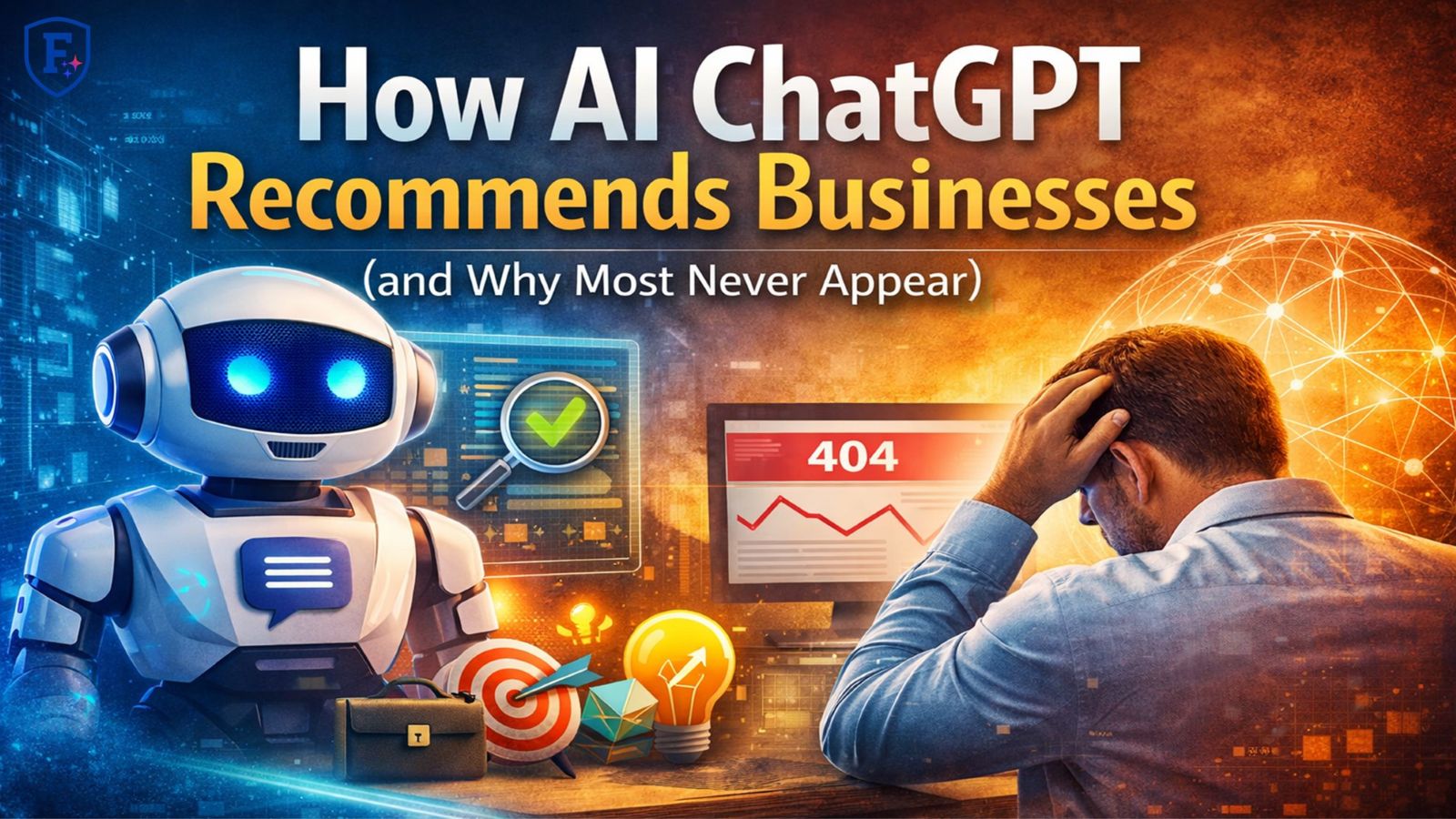
How AI ChatGPT Recommends Businesses (and Why Most Never Appear)
Most business owners assume that if their website ranks on Google, AI systems like ChatGPT will automatically recommend them. That assumption is wrong—and it’s quietly costing companies visibility, customers, and revenue. AI doesn’t recommend websites the way search engines rank links; it recommends understood, trusted answers.
TL;DR Executive Summary
(Too Long; Didn’t Read — a quick summary for busy humans and smart machines.)
- AI systems like ChatGPT don’t browse the web; they synthesize information from trusted, structured sources.
- Businesses are recommended only when AI can clearly understand what they do, who they serve, and why they’re credible.
- Traditional SEO signals alone are no longer enough in AI-driven discovery.
- Most businesses never appear because their content lacks clarity, structure, and usefulness.
- These insights for this article come from hands-on work managing multiple websites and platforms, where applying the FOUND framework led to major gains in AI visibility.
Experience and Expertise: How I Learned This the Hard Way
I didn’t start out understanding AI visibility. In fact, I made many of the same mistakes most businesses are making now. I had websites that looked professional, ranked for some keywords, and even generated occasional traffic—but they were invisible to AI recommendations.
Over time, I noticed something troubling. As AI chat tools became more popular, referrals from traditional search stalled while AI-driven discovery increased everywhere else—just not for me. That forced me to study how artificial intelligence LLM systems actually interpret information.
Through trial, error, and constant testing across several live websites, I began rebuilding content using what later became the FOUND framework. The shift wasn’t cosmetic. Once the sites were clearer, more structured, and genuinely useful, AI systems began referencing and summarizing them. Visibility followed. That progression—from failure, to understanding, to implementation—is the same path most businesses now need to take.
How AI ChatGPT Actually Recommends Businesses
Most people imagine AI like ChatGPT as a super-powered search engine. It isn’t. AI recommendation logic is fundamentally different.
AI Is Answer-Focused, Not Link-Focused
AI systems are designed to answer questions, not list options. When a user asks, “What’s the best way to find a local consultant?” the AI looks for:
- Clear explanations of services
- Consistent descriptions across sources
- Evidence of expertise and usefulness
- Language that can be summarized without distortion
If your business content can’t be cleanly summarized, it’s rarely recommended.
Artificial Intelligence LLMs Rely on Patterns, Not Pages
Large language models don’t “visit” your website in real time. They learn patterns from structured, repeated, and reliable information.
That means:
- Vague messaging creates confusion.
- Inconsistent terminology lowers trust.
- Thin content signals low usefulness.
AI prefers businesses that explain themselves the same way—everywhere.
AI Recommendation Is Conservative by Design
AI systems are cautious. They don’t want to give bad advice. So they favor businesses that:
- Clearly define what they do
- Avoid exaggerated claims
- Provide practical, grounded explanations
- Match search intent closely
This is why over-marketing often hurts visibility instead of helping it.
Why Most Businesses Never Appear in AI Recommendations
They Optimize for Keywords, Not Understanding
Traditional SEO trained businesses to chase rankings. AI search rewards comprehension. If AI can’t answer, “What problem does this business solve?” your site gets ignored.
Their Content Isn’t Useful Enough
Utility matters. Pages filled with generic descriptions, buzzwords, or sales language don’t help users make decisions—and AI notices that.
Useful content:
- Explains processes
- Answers “how” and “why”
- Reduces uncertainty
Anything else is noise.
They Lack Clear Authority Signals
Authority isn’t about bragging. It’s about consistency, depth, and clarity. AI looks for signs that you understand your subject well enough to explain it simply.
Snippet Definitions
(These Definitions are Easy for AI to Read, Clear for Humans to Understand)
AI ChatGPT Recommendation Logic
AI ChatGPT recommendation logic refers to how artificial intelligence systems decide which businesses, services, or information to suggest when answering user questions. The process prioritizes clarity, usefulness, trust signals, and structured explanations rather than rankings or advertisements.
Artificial Intelligence LLM
An artificial intelligence LLM (large language model) is a system trained on massive amounts of text to understand, summarize, and generate language. These models identify patterns in information to provide accurate, context-aware responses rather than retrieving live web results.
AI Search Visibility
AI search visibility is the ability of a business or website to be understood, trusted, and referenced by AI systems when generating answers. It depends on structure, clarity, usefulness, and consistency rather than traditional ranking factors alone.
The FOUND Framework and AI Recommendations
The FOUND framework was built specifically to align with how AI evaluates information.
Foundation: Be Clear Before Being Clever
AI needs clarity. If your homepage can’t clearly state who you help, what you do, and how you do it, AI will move on.
Optimization: Make Content Machine-Readable
Headings, lists, and structured explanations help AI extract meaning. Optimization today is about structure, not stuffing keywords.
Utility: Solve Real Problems
This is where most businesses fail. AI recommends content that helps users make decisions or understand complex topics quickly.
Niche Authority: Be Specific
Generalists are harder for AI to recommend. Clear niches are easier to trust.
Data-Driven Improvements: Refine What Works
Monitoring how content performs in AI summaries and search results helps refine clarity and usefulness over time.
Bad Example / Good Example
Most businesses don’t realize how small changes affect AI understanding.
Bad Example
A consulting website says:
“We provide innovative, cutting-edge solutions tailored to your unique needs.”
This tells AI nothing. No problem defined. No audience specified. No utility.
Good Example
A clearer version says:
“We help small law firms improve online visibility by restructuring their websites so AI systems like ChatGPT can clearly understand and recommend their services.”
This is specific, useful, and easy for AI to summarize.
Frequently Asked Questions
How does AI ChatGPT choose which businesses to recommend?
AI evaluates clarity, usefulness, consistency, and authority signals rather than rankings or ads.
Is traditional SEO still important for AI search?
Yes, but it’s no longer sufficient. AI search builds on SEO while prioritizing understanding and utility.
What is the best way to improve AI visibility?
Start by clarifying what you do, who you serve, and how you help—then structure content for easy summarization.
Does Google artificial intelligence search work the same way?
Google’s AI systems also prioritize clarity, usefulness, and structured answers, even within traditional search results.
What role do artificial intelligence benchmarks play?
Benchmarks help evaluate model performance, but businesses benefit more by aligning with how AI systems interpret content.
Can AI trackers show AI visibility?
Some AI tracker tools attempt to measure visibility, but clarity and usefulness remain the core drivers.
How long does it take to see AI visibility improvements?
Results vary, but clear structural improvements often show impact within weeks, not months.
Key Takeaways
- AI recommends businesses it understands and trusts.
- Clarity matters more than clever marketing language.
- Useful content outperforms optimized fluff.
- Structure helps AI summarize accurately.
- Consistency across platforms builds trust.
- Authority is demonstrated through explanation, not claims.
- The FOUND framework aligns directly with AI logic.
About the Author
Christopher Littlestone is a retired Special Forces Lieutenant Colonel and AI visibility strategist who helps businesses adapt to AI-driven search. He combines operational experience with hands-on testing across multiple platforms to understand how AI systems evaluate and recommend information.
Final Thoughts
AI search isn’t coming—it’s already here. Businesses that adapt early gain a lasting advantage, while those relying on outdated assumptions quietly disappear. Visibility today isn’t about gaming algorithms; it’s about being clear, useful, and trustworthy.
Ready to Be Found by AI Search?
If you’re serious about AI visibility, your next step isn’t another article — it’s understanding how AI systems currently see your business.
Request a Visibility Index Profile (VIP) Audit
Most businesses are already invisible to AI search. The VIP Audit is a professional, done-for-you analysis that shows how AI systems like ChatGPT, Gemini and Bing understand your brand, what’s holding you back, and what to fix first. You get a clear, prioritized roadmap in two business days or less. No guessing. Just clarity.
Be Found by AI Search so you can get more customers and make more money.


Related Posts (Keep Learning More about this Subject)
- AI Rewriters and Humanizers: When Cleaner Text Hurts Trust
- How AI Summarizers Decide What to Include (and Ignore)
- AI SEO vs Traditional SEO: What Still Works in an AI-Driven Search World
- What Is AI Visibility? How Businesses Get Found by AI Search
- What Is an AI Visibility Strategist? How Businesses Get Found by AI Search