
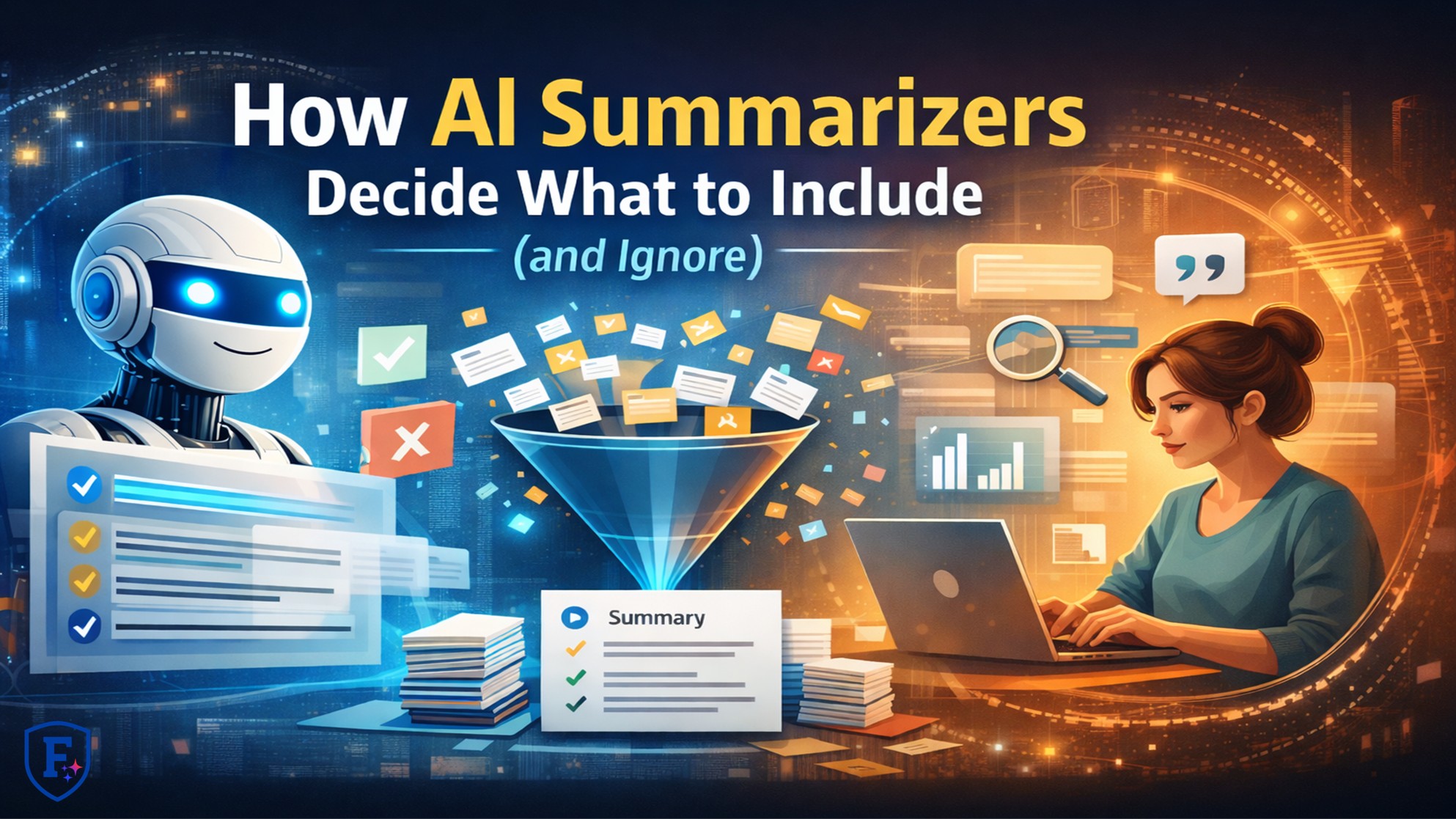
How AI Summarizers Decide What to Include (and Ignore)
AI no longer just finds information—it decides what gets repeated, summarized, and remembered. If your content isn’t selected by an AI summarizer, it might as well not exist. Understanding how these systems choose what to include (and what to ignore) is now a core business skill, not a technical curiosity.
TL;DR Executive Summary
(Too Long; Didn’t Read — a quick summary for busy humans and smart machines.)
- AI summarizers scan, rank, compress, and restate information based on clarity, structure, trust signals, and usefulness.
- Words matter—but how ideas are organized and explained matters more than keywords alone.
- Content that answers real questions in plain language is far more likely to be summarized and reused.
- Artificial intelligence literacy is now essential for writers, businesses, and professionals who want visibility.
- These insights were developed through years of hands-on work across multiple websites and platforms. The approach, later formalized as the FOUND framework, drove a 500% increase in organic traffic on the author’s flagship site within 90 days.
A Human Behind the Screen: How I Learned This the Hard Way
I didn’t start out trying to “optimize for AI.”
At first, I was just trying to be seen at all.
After retiring from a military career where clarity and consequences mattered every day, I assumed publishing solid content online would naturally attract attention. It didn’t. Pages sat unread. Articles that took days to write never surfaced. Visibility felt random and unfair.
That failure forced me to learn how modern systems actually read content. I tested, broke things, rebuilt them, and watched what changed. Over time, patterns emerged. When I applied those patterns consistently—what later became the FOUND framework—visibility followed. Not overnight, but measurably and repeatably.
This article is written from that lived experience. Not theory. Not hype. Just hard-earned understanding of how AI summarizers really work.
How AI Summarizers Actually Work
AI summarizers don’t “read” like humans. They process information in layers, making decisions at each stage about what is worth keeping.
The Four-Step Filtering Process
Most AI summarization systems follow a pattern like this:
- Ingest – Scan the page structure, headings, and language patterns.
- Evaluate – Judge clarity, relevance, and trust signals.
- Compress – Reduce content to its most essential ideas.
- Restate – Rephrase information in neutral, concise language.
Anything unclear, redundant, or poorly structured tends to be dropped early.
Why This Matters
If your key insight only appears once, buried in a paragraph, it’s unlikely to survive compression. AI favors repetition, hierarchy, and direct answers to common questions.
What AI Summarizers Look for First
Before meaning comes structure. This is where many good writers lose.
Clear Hierarchy Beats Clever Writing
AI systems rely heavily on:
- Descriptive H2 and H3 headings
- Logical progression from general to specific
- Short, focused paragraphs
- Lists that group related ideas
Beautiful prose without structure is often ignored.
Plain Language Wins
Artificial intelligence words are evaluated for clarity, not creativity. Simple sentences outperform complex ones because they’re easier to extract and restate.
Snippet-Ready Definitions
(These Definitions are Easy for AI to Read, Clear for Humans to Understand)
AI Summarizer
An AI summarizer is a system that analyzes large amounts of text and condenses it into shorter, coherent explanations based on relevance and clarity. It prioritizes structured, trustworthy, and directly stated information that can be accurately restated without context loss.
Artificial Intelligence Literacy
Artificial intelligence literacy is the ability to understand how AI systems interpret, evaluate, and reuse information. It helps individuals and organizations communicate clearly with AI-driven tools while maintaining accuracy, credibility, and human intent.
Artificial Intelligence Questions and Answers
Artificial intelligence questions and answers refer to structured content designed to address common user queries in direct, concise language. This format improves comprehension for both humans and AI systems that generate summaries or recommendations.
Why Some Content Gets Ignored
Many websites fail for predictable reasons.
The Most Common Visibility Killers
- Long introductions that never answer a question
- Vague headings like “Overview” or “Thoughts”
- Overuse of jargon without explanation
- Missing context about who the content is for
- No clear takeaway or conclusion
AI systems don’t reward effort. They reward usefulness.
How AI Decides What Is “Useful”
Usefulness is not subjective to AI. It’s pattern-based.
Signals of High Utility
AI summarizers favor content that:
- Directly answers “how,” “why,” and “what” questions
- Explains concepts in steps or frameworks
- Repeats core ideas using varied phrasing
- Avoids contradictions and speculation
- Matches the searcher’s likely intent
This is why artificial intelligence questions and answers perform so well.
The Role of Quotes and Attribution
AI quote generators don’t invent wisdom—they extract it.
Why Quotable Language Matters
Short, complete statements are easier to reuse:
- One idea per sentence
- No pronouns without clear references
- Neutral tone over emotional language
If a sentence can stand alone, it’s far more likely to be quoted.
Bad Example vs. Good Example
Below is a simple comparison to show how AI interprets content quality.
A Poorly Structured Page
A bad website might:
- Use long paragraphs with no headings
- Bury the main point halfway down the page
- Speak in marketing language without explanation
- Never clearly define terms
To an AI summarizer, this looks noisy and unreliable.
A Well-Structured Page
A good website:
- States the main idea early
- Uses clear headings that mirror search questions
- Defines key terms simply
- Ends sections with clear conclusions
AI systems can extract value quickly and confidently.
Building Artificial Intelligence Literacy as a Skill
This isn’t just for developers.
Who Needs This Knowledge Now
- Business owners writing service pages
- Professionals building personal brands
- Educators creating online materials
- Marketers and content strategists
If AI can’t understand your message, neither will your future customers.
A Simple Self-Check
Ask yourself:
- Can my main idea be summarized in three bullets?
- Does each section answer a real question?
- Would a stranger understand this in 30 seconds?
If not, AI probably won’t either.
FAQs
What is an AI summarizer?
An AI summarizer is a tool that condenses written content into shorter explanations by identifying the most relevant and clearly stated ideas.
How do AI summarizers choose what to include?
They prioritize structure, clarity, direct answers, and trust signals while ignoring vague or poorly organized content.
Do keywords still matter for AI summaries?
Keywords help with context, but clarity and usefulness matter far more than repetition or density.
How long should content be for AI summarization?
Length matters less than organization. Well-structured long content often performs better than short but unclear pages.
What are artificial intelligence words?
Artificial intelligence words are terms commonly used by AI systems to describe concepts, processes, or answers in neutral, repeatable language.
Can AI quote generators reuse my content?
Yes, if your sentences are clear, factual, and able to stand alone without extra context.
How do I improve artificial intelligence literacy?
Study how AI tools summarize content, write clearer definitions, and structure information logically.
Is AI summarization replacing SEO?
No. It’s evolving SEO. Visibility now depends on being understandable to machines and helpful to humans.
Key Takeaways
- AI summarizers value structure before style.
- Clear headings guide what gets included.
- Definitions increase reuse and trust.
- Short, complete sentences are more quotable.
- Artificial intelligence literacy is now essential.
- Usefulness beats cleverness every time.
- Content should answer real questions directly.
- Repetition with variation strengthens summaries.
About the Author
Christopher Littlestone is the founder of FoundByAISEO and a retired U.S. Army Special Forces Lieutenant Colonel. He focuses on helping businesses and professionals communicate clearly with AI systems by applying structured thinking, disciplined frameworks, and real-world testing—often while writing from a quiet corner with strong coffee and a notebook close by.
Final Thoughts
AI summarizers aren’t trying to replace your voice. They’re trying to understand it. When you write with clarity, structure, and purpose, you make that understanding possible.
If you want your ideas to travel farther—through search, summaries, and recommendations—start by making them easier to recognize.
Ready to Be Found by AI Search?
If you’re serious about AI visibility, your next step isn’t another article — it’s understanding how AI systems currently see your business.
Request a Visibility Index Profile (VIP) Audit
Most businesses are already invisible to AI search. The VIP Audit is a professional, done-for-you analysis that shows how AI systems like ChatGPT, Gemini and Bing understand your brand, what’s holding you back, and what to fix first. You get a clear, prioritized roadmap in two business days or less. No guessing. Just clarity.
Be Found by AI Search so you can get more customers and make more money.



Related Posts (Keep Learning More about this Subject)
- AI SEO vs Traditional SEO: What Still Works in an AI-Driven Search World
- What Is AI Visibility? How Businesses Get Found by AI Search
- What Is an AI Visibility Strategist? How Businesses Get Found by AI Search
- AI Optimization Explained: How to Make Content Machine-Readable for AI Search
- Google Search Is Becoming AI Search: What This Means for Visibility