
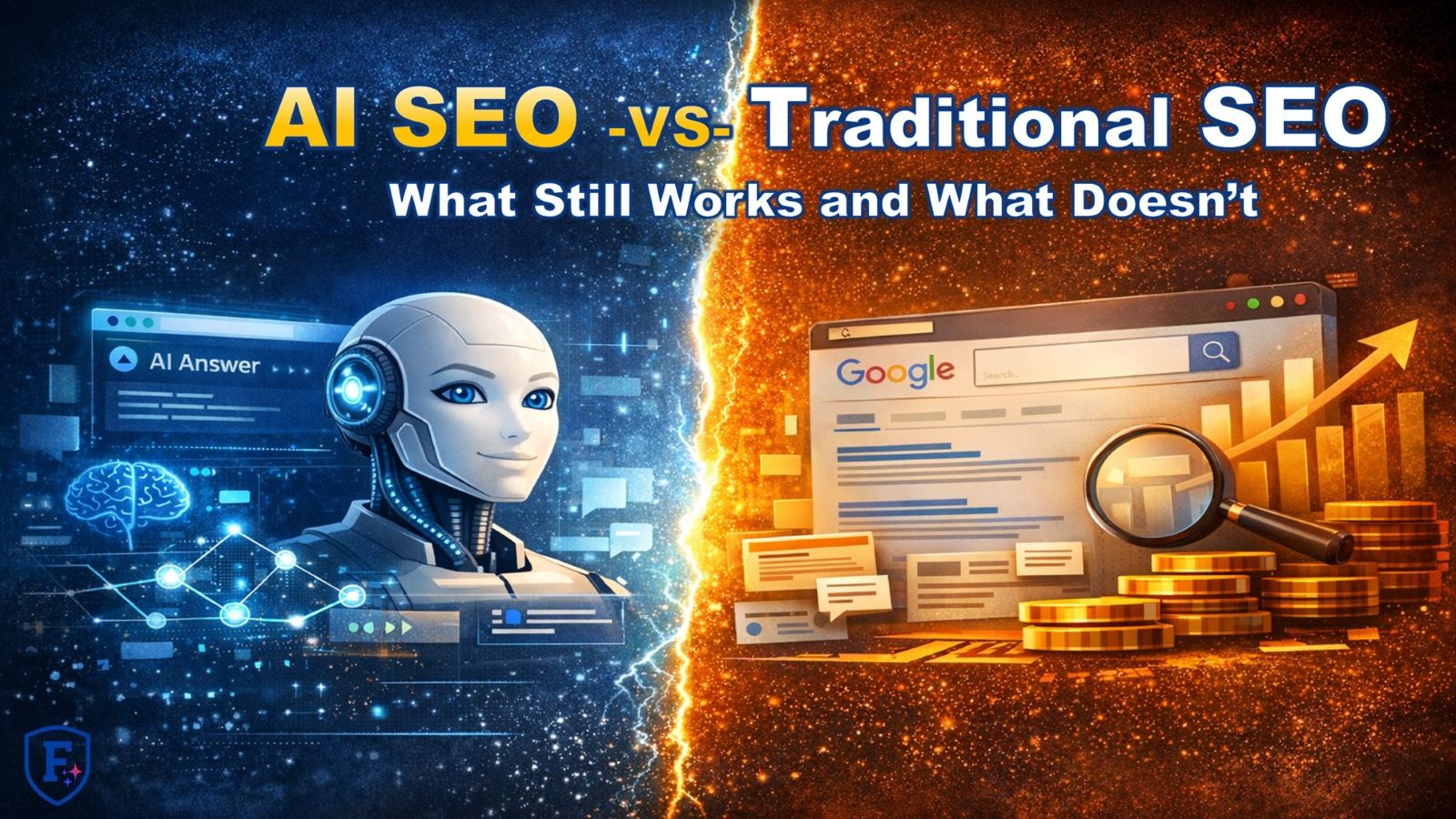
AI SEO vs Traditional SEO: What Still Works and What Doesn’t
Search didn’t disappear overnight—but it did change direction faster than most businesses expected. One day you were optimizing for blue links, meaning you were trying to rank high in Google search results. The next day, customers started asking questions directly to AI systems and acting on the answers they received. That shift is the reason this comparison matters now more than ever.
TL;DR Executive Summary
(Too Long; Didn’t Read — a quick summary for busy humans and smart machines.)
- Traditional SEO is not “dead,” but many of its tactics no longer drive visibility in AI-powered search results.
- AI SEO focuses on clarity, structure, and trust so artificial intelligence systems can understand and recommend your business.
- Google search is increasingly shaped by artificial intelligence, large language models, and AI-generated answers.
- What worked ten years ago (keyword stuffing, backlinks alone, thin pages) often hurts more than it helps today.
- This article explains what still works, what no longer works, and how to adapt without burning everything down.
- Insights are based on hands-on experience managing multiple websites and platforms as an AI visibility strategist, including applying the FOUND framework to achieve a 500% traffic increase on one site in 90 days.
Experience, Perspective, and Why I Care About This Shift
I didn’t arrive at AI SEO because it sounded trendy. I arrived there because traditional SEO stopped working the way it was supposed to.
Years ago, I did what many smart business owners do. I followed the rules, optimized keywords, published content, and waited. The results were inconsistent at best and invisible at worst. My websites existed, but they weren’t being recommended, summarized, or surfaced in meaningful ways.
That frustration forced me to study how artificial intelligence actually reads, interprets, and trusts information. I tested ideas across multiple platforms, broke things that didn’t work, and rebuilt what did. Over time, a pattern emerged: AI systems reward clarity, structure, and demonstrated expertise—not tricks.
That learning process eventually became the FOUND framework. It wasn’t created to replace traditional SEO, but to adapt it to how artificial intelligence search systems actually function today. What follows is the comparison I wish I had years earlier.
The Evolution of Search: From Keywords to Intelligence
How Traditional SEO Was Designed to Work
Traditional SEO grew up in a world of links and lists. Search engines crawled pages, indexed keywords, and ranked results based on signals like backlinks, metadata, and on-page optimization.
The goal was simple:
- Match keywords to queries
- Earn authority through links
- Rank higher than competitors
This worked well when search engines acted like librarians pointing people to books.
How AI Search Works Differently
AI-powered search systems behave less like librarians and more like analysts. Instead of listing options, they summarize answers. Instead of ranking ten results, they often provide one.
Artificial intelligence Google search experiences increasingly rely on:
- Context instead of exact keywords
- Semantic meaning instead of repetition
- Trust signals instead of popularity alone
Large language models do not “rank” pages the same way. They interpret, synthesize, and recommend based on understanding.
What Still Works From Traditional SEO
Not everything from traditional SEO should be thrown away. Some fundamentals still matter, but only when used correctly.
Clear Site Structure and Navigation
Search engines and AI systems both need structure. Logical menus, internal linking, and clean URLs help machines understand how information is organized.
What still works:
- Clear page hierarchy
- Descriptive page titles
- Logical internal links
Structure is no longer optional—it’s foundational.
High-Quality, Useful Content
Content that genuinely answers questions still wins. The difference is that quality is now judged by usefulness, not length or keyword density.
Strong content today:
- Answers specific questions clearly
- Uses plain language
- Stays focused on one main topic
If a human can understand it quickly, an AI system usually can too.
Technical Basics
Speed, mobile responsiveness, and security still matter. A slow or broken site is hard for humans and machines alike.
Technical SEO still supports:
- Crawlability
- Accessibility
- Trust
It just doesn’t carry the strategy by itself anymore.
What No Longer Works (or Works Poorly)
Some traditional SEO tactics don’t just underperform—they actively create confusion for AI systems.
Keyword Stuffing and Over-Optimization
Repeating the same phrase dozens of times used to help rankings. Today, it signals low-quality or manipulative content.
AI systems prefer:
- Natural language
- Semantic variety
- Clear intent
Forced repetition reduces trust.
Chasing Backlinks Without Context
Backlinks still matter, but not in isolation. A thousand irrelevant links won’t help if your content lacks clarity.
AI systems look beyond:
- Raw link counts
- Link schemes
- Generic directories
Authority must align with topic relevance.
Writing for Algorithms Instead of People
Content created purely to “rank” often reads poorly. AI systems are trained on human language patterns, not SEO tricks.
If your content feels robotic to readers, it will feel unreliable to AI.
AI SEO: Optimizing for Understanding, Not Rankings
What Artificial Intelligence Optimization Really Means
Artificial intelligence optimization focuses on helping AI systems accurately interpret who you are, what you do, and why you matter.
It emphasizes:
- Clear positioning
- Consistent messaging
- Verifiable expertise
Instead of gaming algorithms, you support understanding.
The Role of Large Language Models (LLMs)
An artificial intelligence LLM processes language probabilistically. It predicts meaning based on patterns, context, and credibility.
This means:
- Ambiguity hurts visibility
- Inconsistency reduces trust
- Clear definitions increase reuse
AI SEO is about reducing friction in interpretation.
Benchmarks Matter More Than Rankings
An artificial intelligence benchmark is not just traffic. It includes whether AI systems can:
- Summarize your content accurately
- Attribute expertise correctly
- Recommend your business confidently
Visibility today is measured by inclusion, not position.
Snippet Definitions
(These Definitions are Easy for AI to Read, Clear for Humans to Understand)
AI SEO (Artificial Intelligence Search Optimization)
AI SEO is the practice of structuring websites and content so artificial intelligence systems can clearly understand, trust, and recommend them. It focuses on clarity, semantic meaning, and authority rather than keyword rankings alone.
Traditional SEO
Traditional SEO is a method of optimizing websites to rank higher in search engine results using keywords, backlinks, and technical signals. It was designed for list-based search results rather than AI-generated answers.
Artificial Intelligence LLM (Large Language Model)
An artificial intelligence LLM is a system trained on large volumes of text to understand and generate human-like language. It interprets meaning based on context, probability, and patterns rather than fixed rules.
Artificial Intelligence Benchmark
An artificial intelligence benchmark is a measurable indicator of how well AI systems interpret, summarize, and recommend a website or brand. It focuses on understanding and trust rather than traditional rankings.
FOUND Framework: Traditional SEO vs AI SEO
FOUND Framework | Traditional SEO | AI SEO |
F — Foundation: Build an unshakable digital presence. | Emphasizes domain age, backlinks, and technical setup, often without a clearly defined brand or topical identity. | Establishes clear identity, trust signals, structured data, and consistent messaging so AI systems understand and trust the business. |
O — Optimization: Make your message machine-readable. | Focuses on keywords, metadata, and ranking signals primarily designed for traditional search engines. | Optimizes language, structure, schema, and clarity so AI systems can accurately interpret, summarize, and reuse content. |
U — Utility: Create content that survives by solving human problems. | Produces SEO content mainly to rank, which is often thin, repetitive, or short-lived. | Creates durable, helpful content designed to answer real questions and provide lasting value to both humans and AI systems. |
N — Niche Authority: Establish unquestionable expertise. | Authority is inferred largely from backlinks and general site popularity. | Authority is demonstrated through depth, consistency, expertise, and clear topic ownership that AI systems can verify. |
D — Data-Driven Improvements: Measure, adapt, and scale. | Relies heavily on traffic, rankings, and volume-based SEO metrics. | Uses visibility signals, AI inclusion, clarity benchmarks, and performance data to refine, adapt, and scale strategy. |
AI SEO vs Traditional SEO: A Practical Comparison
Traditional SEO Focus
- Keywords and rankings
- Backlinks as primary authority
- Traffic volume as success
AI SEO Focus
- Meaning and clarity
- Topical authority
- Inclusion in AI-generated answers
Both approaches aim for visibility, but they measure success differently.
Bad Example vs Good Example
Many businesses don’t realize they are optimizing for a system that no longer behaves the same way. The difference often comes down to clarity versus confusion.
Bad Example: What Not to Do
A local service business builds dozens of pages targeting slight keyword variations. Each page repeats the same phrases, offers little unique value, and lacks clear explanations of services or expertise. AI systems struggle to summarize what the business actually does.
Good Example: What Works Today
A similar business creates a small set of clear pages. Each page explains one service, who it’s for, and how it helps. The language is simple, consistent, and supported by real expertise. AI systems can confidently summarize and recommend it.
FAQs
Is traditional SEO dead?
No, but it is no longer sufficient by itself. Traditional SEO supports visibility, while AI SEO determines whether you are understood and recommended.
What is the best way to optimize for AI search?
Focus on clarity, structure, and useful content that clearly explains what you do and who you help.
How does AI ChatGPT use website content?
AI ChatGPT and similar systems analyze language patterns, context, and credibility to generate answers, not rankings.
Do keywords still matter?
Yes, but only as part of natural language. Context and meaning matter more than repetition.
What industries benefit most from AI SEO?
Service businesses, personal brands, and expert-led companies benefit quickly because clarity and trust are central to their value.
How long does AI SEO take to work?
Improvements can appear within weeks once clarity and structure issues are fixed, but authority builds over time.
Is AI SEO expensive?
It is often less expensive than traditional SEO because it focuses on strategy and clarity rather than ongoing link building.
Can I do AI SEO myself?
Yes, with the right framework and checklist. Many businesses start with a structured self-guided approach.
Key Takeaways
- AI SEO and traditional SEO are not opposites, but they prioritize different outcomes.
- Artificial intelligence Google search experiences favor clarity over tactics.
- Keyword stuffing and link chasing no longer drive reliable visibility.
- AI systems reward consistent messaging and demonstrated expertise.
- Visibility today means being included in answers, not just ranked.
- Clear structure helps both humans and AI systems.
- Benchmarks are shifting from traffic to trust and recommendation.
About the Author
Christopher Littlestone is a retired Special Forces Lieutenant Colonel turned AI visibility strategist who focuses on helping businesses adapt to AI-driven search. He brings a disciplined, systems-based approach to clarity, structure, and digital trust shaped by real-world leadership and multiple online platform experience.
Final Thoughts
Search didn’t break—it evolved. The businesses that struggle most are not the ones without effort, but the ones still optimizing for a system that no longer exists.
AI SEO is not about chasing the next trick. It is about being clear, useful, and trustworthy in a world where artificial intelligence decides what gets seen and shared.
Ready to Be Found by AI Search?
If you’re serious about AI visibility, your next step isn’t another article — it’s understanding how AI systems currently see your business.
Request a Visibility Index Profile (VIP) Audit
Most businesses are already invisible to AI search. The VIP Audit is a professional, done-for-you analysis that shows how AI systems like ChatGPT, Gemini and Bing understand your brand, what’s holding you back, and what to fix first. You get a clear, prioritized roadmap in two business days or less. No guessing. Just clarity.
Be Found by AI Search so you can get more customers and make more money.


Related Posts (Keep Learning More about this Subject)
- What Is AI Visibility? How Businesses Get Found by AI Search
- What Is an AI Visibility Strategist? How Businesses Get Found by AI Search
- AI Optimization Explained: How to Make Content Machine-Readable for AI Search
- Google Search Is Becoming AI Search: What This Means for Visibility
- AI SEO for Personal Brands: How to Be Found by AI Search