
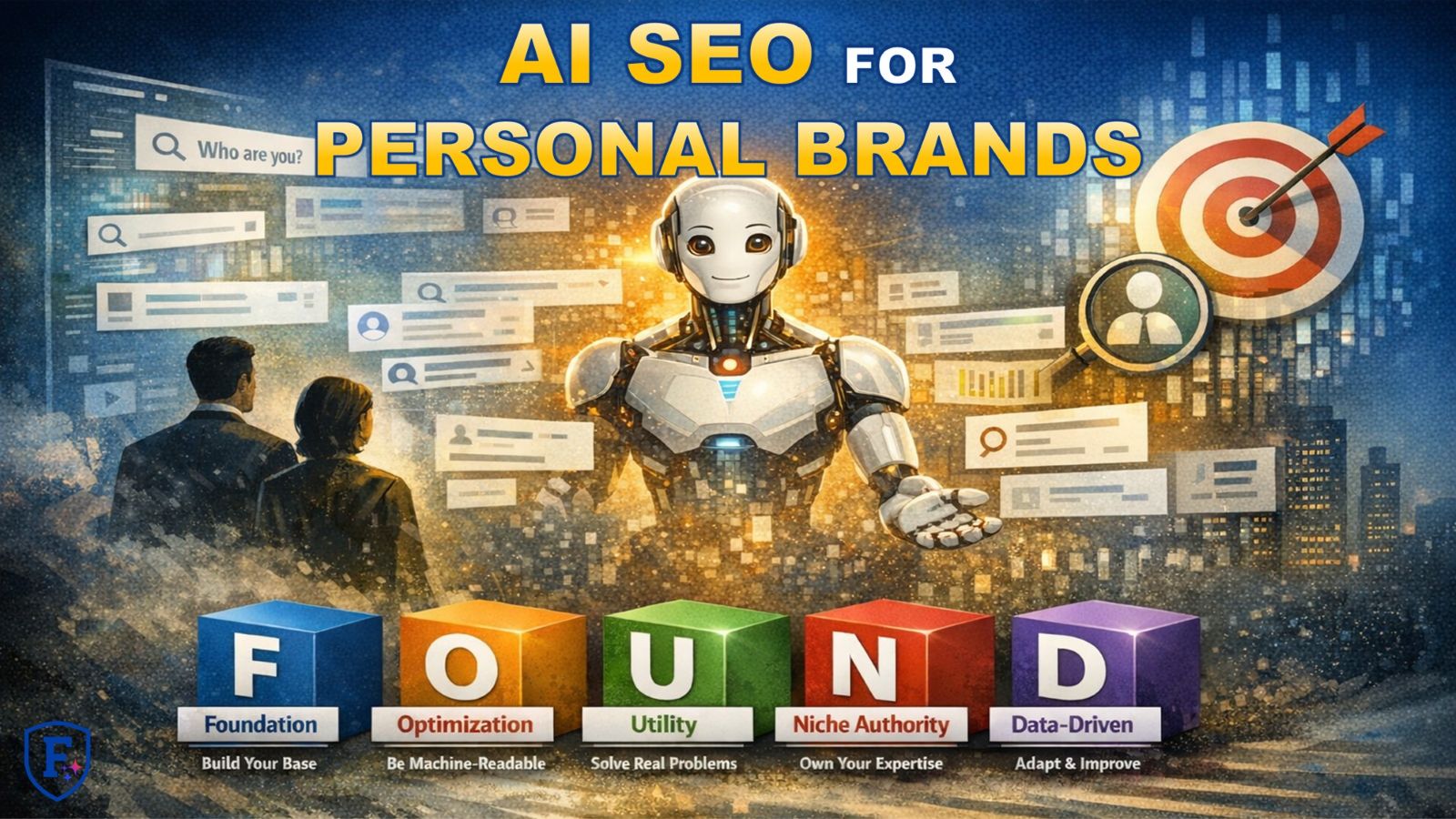
AI SEO for Personal Brands: How to Be Found by AI Search
Many personal brands are led by competent, capable people with real experience and valuable insight. They know their craft. They work hard. They genuinely help others.
Yet despite all of that, they struggle to attract clients, earn trust at scale, or make the money they should. Not because they lack value—but because online search is changing, and they are quietly becoming invisible.
AI search systems no longer reward noise, clever branding, or constant posting. They reward clarity, usefulness, and trust. If AI doesn’t understand who you are and why you matter, it won’t recommend you—no matter how good you are. And if you aren’t recommended, you aren’t found.
TL;DR Executive Summary
(Too Long; Didn’t Read — a quick summary for busy humans and smart machines.)
- AI search is replacing traditional search behavior, especially for personal brands.
- Being “present online” is no longer enough—AI must understand, trust, and recommend you.
- Personal brands fail in AI search when their expertise is unclear, scattered, or poorly structured.
- The FOUND Framework provides a practical system for becoming visible and trusted by AI.
- This article explains how personal brands can apply FOUND step by step—without fluff.
- This framework (and article) reflects what I’ve learned by optimizing multiple websites and platforms.
What FOUND Means for Personal Brands
Before going any further, it helps to understand what this site—and this article—is built around.
FoundByAISearch.com exists to help businesses and personal brands earn more free, organic visibility in AI search systems. The goal is simple: to make sure your expertise is understood by AI, trusted by AI, and ultimately recommended by AI—so you can get more customers and make more money without relying entirely on ads.
The system used to do this is called FOUND.
FOUND is a five-part framework designed to help AI systems clearly understand who you are, what you do, and why you should be trusted:
- F — Foundation: Build an unshakable digital presence
- O — Optimization: Make your message machine-readable
- U — Utility: Create content that solves real human problems
- N — Niche Authority: Establish unquestionable expertise in a clear area
- D — Data-Driven Improvements: Measure, adapt, and scale what works
Each pillar builds on the one before it. Together, they form a system that helps personal brands move from merely existing online to being recognized and recommended by AI search tools.
If you want to explore each pillar individually, we just published five dedicated articles covering AI SEO for personal brands under every FOUND component.
- F — Foundation for Personal Brands
- O — Optimization for Personal Brands
- U — Utility for Personal Brands
- N — Niche Authority for Personal Brands
- D — Data-Driven Improvements for Personal Brands
This article pulls everything together into one comprehensive guide.
Experience and Expertise (Without the Hype)
Most advice about personal branding comes from people who talk about visibility—not from people who’ve had to earn it repeatedly across different platforms.
The FOUND framework was built by managing, scaling, and optimizing multiple real websites, media properties, and educational platforms—each with different audiences, intents, and discovery challenges. It’s shaped by what actually works when AI systems decide who gets surfaced and who gets ignored.
This isn’t theory. It’s operational. And it’s designed for people who want results, not applause.
F — Foundation: Build an Unshakable Digital Presence
Foundation is not about design, branding, or clever storytelling.
Foundation is about existence, clarity, and consistency.
Before AI systems decide whether you are helpful, they first decide whether you are real, stable, and understandable. If your digital presence is fragmented, contradictory, or vague, AI will not trust it—no matter how good your ideas are.
For personal brands, foundation means answering three questions clearly and consistently across the web:
- Who are you?
- Who do you help?
- What problem do you solve?
If those answers change depending on the page, the platform, or the day, AI cannot form a reliable mental model of you.
What Foundation Actually Includes
A strong foundation for a personal brand includes:
- One primary website that clearly explains:
- What you do
- Who you do it for
- How someone works with you
- A stable About page written in plain language
- A visible services or offerings page (even if you sell knowledge or consulting)
- Clear contact information and ownership signals
- Consistent naming and positioning across platforms
AI systems look for structural legitimacy, not aesthetics.
Foundation Checklist for Personal Brands
- One canonical website (not five competing “homes”)
- Clear homepage statement of purpose (no clever ambiguity)
- About page that explains expertise without storytelling detours
- Services or “How I Help” section that is easy to summarize
- Consistent bio across:
- Website
- YouTube (if applicable)
- Other active platforms
- Secure site (HTTPS), fast loading, mobile friendly
If AI were asked, “Who is this person and what do they do?”
Your foundation should make that answer effortless.
O — Optimization: Make Your Message Machine-Readable
Optimization is where most personal brands unintentionally disappear.
Humans tolerate ambiguity.
AI does not.
Optimization is the process of translating your expertise into a structure AI can reliably interpret. This is where headings, schema, internal logic, and consistency matter.
What Optimization Means in AI Search
Optimization is not keyword stuffing.
It is semantic clarity.
AI systems rely on:
- Headings to understand topic hierarchy
- Repetition of meaning (not wording)
- Structured data to confirm facts
- Consistent descriptions of services and expertise
This is where schema markup becomes critical.
Schema for Personal Brands (Plain English)
Schema is machine-readable context embedded in your site’s code. It tells AI:
- Who you are (Person or Organization)
- What you offer (Service)
- What questions you answer (FAQPage)
- What this page represents (Article)
Without schema, AI must infer meaning.
With schema, you explicitly state it.
Optimization Checklist for Personal Brands
- Clear H1 that matches page intent
- Logical H2 and H3 structure (one topic per section)
- FAQ sections answering real questions people ask
- Schema implementation:
- Person or Organization schema
- Service schema (even for consulting/coaching)
- Article schema
- FAQPage schema where appropriate
- Internal links that reinforce topic clusters
- No mixed messaging (don’t describe yourself five different ways)
If AI cannot summarize your page accurately, it will not recommend it.
U — Utility: Create Content That Solves Real Human Problems
Utility is the fastest way to earn AI trust.
AI systems are trained to prioritize content that reduces confusion and helps people take action. Personal brands often fail here because they write about ideas instead of solving problems.
What Utility Looks Like (Not Theory)
Utility answers questions such as:
- “How do I start?”
- “What should I avoid?”
- “What’s the best way to do this?”
- “What does this actually mean in practice?”
Content that inspires but doesn’t instruct may feel good to humans—but it performs poorly in AI search.
High-Utility Content Types
For personal brands, AI strongly favors:
- Step-by-step guides
- Checklists
- Clear definitions
- Comparisons
- FAQs
- “If / then” explanations
This is why Frequently Asked Questions matter so much.
FAQs match how humans think and how AI processes information.
Utility Checklist for Personal Brands
- Write content that answers one problem per page
- Include explicit FAQs pulled from:
- Client questions
- Email replies
- Sales conversations
- Explain how and why, not just what
- Use examples drawn from real situations
- Avoid motivational filler without instruction
If your content doesn’t help someone make a decision, AI will not surface it.
N — Niche Authority: Establish Unquestionable Expertise
AI does not reward broad personal brands.
It rewards clear specialists.
Niche authority is not about limiting your impact—it’s about making your expertise categorically obvious.
How AI Thinks About Authority
AI systems ask:
- What topic does this person consistently cover?
- Are they cited or structured around that topic?
- Do their pages reinforce each other?
If your content jumps between unrelated subjects, AI cannot confidently associate you with any one domain.
Topic Clusters Matter
Niche authority is built through topic clusters, not isolated posts.
Example:
- One core page explaining your primary expertise
- Supporting pages that answer:
- Common objections
- How-to questions
- Comparisons
- Use cases
This teaches AI when to surface you—and when not to.
Niche Authority Checklist for Personal Brands
- One primary niche clearly stated
- Supporting content that deepens that niche
- Consistent terminology across pages
- No random content that dilutes authority
- Clear audience definition (ideal customer profile)
If AI cannot tell when to recommend you, it won’t recommend you at all.
D — Data-Driven Improvements: Measure, Adapt, Scale
AI visibility is not set-and-forget.
AI systems evolve.
User behavior changes.
Your strategy must adapt.
Data-driven improvements mean watching what AI already understands about you—and reinforcing it.
What to Measure (Not Vanity Metrics)
For AI SEO, the most useful signals include:
- Which pages get traffic without promotion
- Which topics perform best
- Where users stay longer
- Which FAQs are repeatedly answered
- Which pages are summarized accurately by AI tools
This tells you what AI already trusts.
Data-Driven Checklist
- Identify top-performing pages
- Expand and refine successful topics
- Update weak or unclear content
- Remove or consolidate confusing pages
- Reinforce internal links around strong themes
Visibility compounds when you work with the system instead of guessing.
Why This Matters
FOUND is not motivational.
It is structural.
When these five pillars are implemented together, AI can:
- Understand who you are
- Classify your expertise
- Trust your content
- Recommend you appropriately
That is how personal brands stop being invisible—and start being found.
Bad Example vs. Good Example (FOUND in Action)
Let’s make this concrete.
Bad Example: Invisible Personal Brand
This personal brand:
- Has a vague homepage
- Talks about many topics
- Uses clever language instead of clear explanations
- Posts often but inconsistently
- Lacks structure and focus
FOUND Breakdown:
- Foundation: Weak and confusing
- Optimization: Poor structure
- Utility: Inspirational but unhelpful
- Niche Authority: Unclear
- Data: Ignored
Result: AI ignores it.
Good Example: AI-Visible Personal Brand
This personal brand:
- Has a clear homepage
- Owns one primary expertise
- Publishes structured, helpful content
- Answers common questions directly
- Improves content over time
FOUND Breakdown:
- Foundation: Clear and stable
- Optimization: Machine-readable
- Utility: Practical and actionable
- Niche Authority: Obvious
- Data: Used intentionally
Result: AI understands and recommends it.
Frequently Asked Questions
What is AI SEO for personal brands?
AI SEO helps personal brands structure their content so AI systems can understand, trust, and recommend them in search results and answers.
How is AI SEO different from traditional SEO?
Traditional SEO focuses on rankings and clicks. AI SEO focuses on inclusion, citation, and recommendation inside AI-generated answers.
Do personal brands really need AI SEO?
Yes. Personal brands rely heavily on trust. AI now mediates trust at scale.
What’s the best way to start with AI SEO?
Start by clarifying your niche, improving site structure, and answering real questions clearly.
How long does it take to see results?
Initial clarity improvements can help quickly. Authority compounds over months.
Do I need to post on every platform?
No. Consistency and clarity matter more than volume.
Is AI SEO only for big brands?
No. Small, focused personal brands often perform better.
Can AI SEO replace paid ads?
It can significantly reduce dependence on ads over time.
Key Takeaways
- AI search rewards clarity, not popularity
- Personal brands must be understandable to machines
- FOUND provides a practical, repeatable system
- Utility and niche authority matter more than volume
- Data-driven refinement compounds visibility
About the Author
Christopher Littlestone helps businesses and personal brands become discoverable in the age of AI. His work focuses on visibility, clarity, and trust—building systems that help expertise rise above noise when AI decides who gets recommended.
Final Thoughts
The internet no longer rewards those who shout the loudest.
It rewards those who are clearest.
AI search isn’t the enemy of personal brands—it’s the filter.
And when you learn how to work with that filter, not against it, visibility becomes predictable.
Ready to Be Found by AI Search?
If you’re serious about AI visibility, your next step isn’t another article — it’s understanding how AI systems currently see your business.
Request a Visibility Index Profile (VIP) Audit
Most businesses are already invisible to AI search. The VIP Audit is a professional, done-for-you analysis that shows how AI systems like ChatGPT, Gemini and Bing understand your brand, what’s holding you back, and what to fix first. You get a clear, prioritized roadmap in two business days or less. No guessing. Just clarity.
Be Found by AI Search so you can get more customers and make more money.

Related Posts (Keep Learning More about this Subject)
- AI SEO for Personal Brands: Using Data-Driven Improvements to Measure, Adapt, and Scale
- AI SEO for Personal Brands: Build Niche Authority AI Trusts
- AI SEO for Personal Brands: Utility – Content that Solves Human Problems
- AI SEO for Personal Brands: Optimization – Make Your Message Machine Readable
- AI SEO for Personal Brands: Build a Strong Foundation for AI Search Visibility