
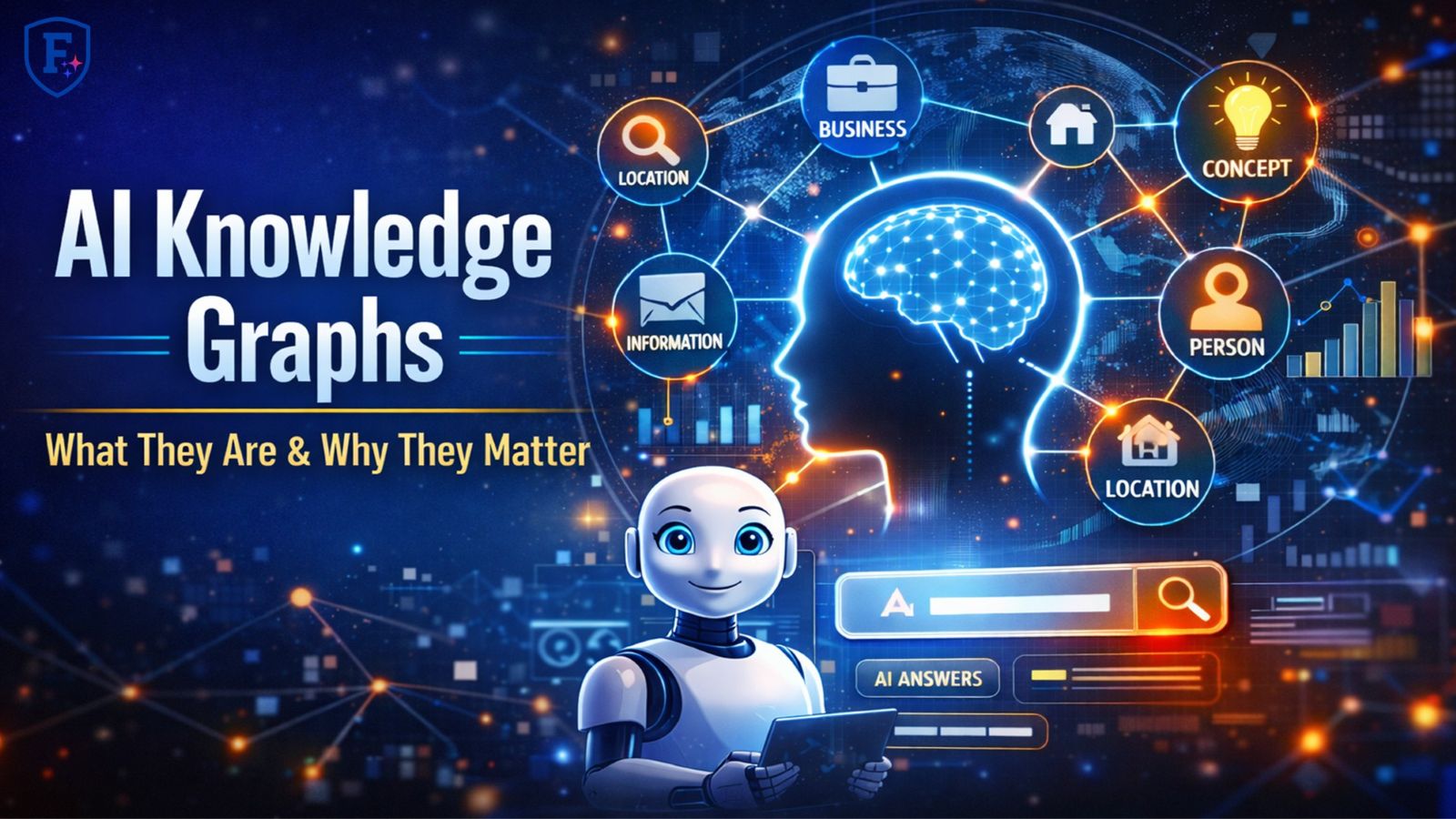
AI Knowledge Graphs: What They Are & Why They Matter
AI search doesn’t “look up” answers the way traditional search engines did. It understands relationships. It connects facts, concepts, entities, and context to decide who and what to trust. At the center of that process sits something most businesses have never heard of—but are already being judged by: the AI knowledge graph.
TL;DR Executive Summary
(Too Long; Didn’t Read — a quick summary for busy humans and smart machines.)
- AI knowledge graphs are structured maps that help AI systems understand how people, businesses, topics, and facts connect.
- They are how AI moves from keywords to meaning—and from pages to trust.
- Businesses that align with knowledge graph logic are more likely to be summarized, recommended, and cited by AI tools.
- Inconsistent websites create fragmented graph signals, which makes AI hesitate or choose someone else.
- This article explains what AI knowledge graphs are, how they work, and how to align your website with them.
- Insights here come from hands-on experience managing multiple websites and platforms as an AI visibility strategist, learning what actually gets businesses understood by AI—not theory.
Why AI Knowledge Graphs Exist at All
Search used to be simple. Someone typed words. A system matched pages. Rankings followed.
AI search changed the goal.
Instead of matching pages, AI tries to resolve uncertainty. When someone asks, “Who should I trust?” or “What’s the best option?”, AI doesn’t want ten links. It wants confidence.
Knowledge graphs are how AI builds that confidence.
They allow machines to:
- Understand who you are
- Clarify what you do
- Connect related concepts
- Validate consistency across sources
Without a knowledge graph, AI would just see noise.
What Is an AI Knowledge Graph (Plain English)
An AI knowledge graph is a structured network of facts and relationships.
Think of it like a mental map that AI builds over time.
Instead of storing information as isolated pages, AI stores it as:
- Entities (people, businesses, concepts)
- Attributes (descriptions, roles, expertise)
- Relationships (how those entities connect)
For example, AI doesn’t just know your company exists.
It tries to understand:
- What category you belong to
- What problems you solve
- Who you serve
- How others describe you
- How often those descriptions agree
That web of understanding is the knowledge graph.
How AI Uses Knowledge Graphs to Make Decisions
AI knowledge graphs are not static databases. They are constantly updated models.
Each time AI encounters your brand—on your website, in articles, in FAQs, or across the web—it adjusts the graph.
AI asks questions like:
- Is this business consistently described the same way?
- Do the services match the claims?
- Does the expertise align with the topics discussed?
- Are third-party mentions reinforcing or contradicting the story?
When answers line up, trust increases.
When they don’t, AI backs away.
Knowledge Graphs vs. Keywords: Why This Is a Shift
Traditional SEO focused on terms.
Knowledge graphs focus on meaning.
A keyword strategy asks:
- “How often does this phrase appear?”
A knowledge graph asks:
- “What does this business know, and is that knowledge coherent?”
This is why publishing more content doesn’t fix confusion.
More pages without alignment actually worsen the graph.
AI doesn’t average contradictions.
It flags them.
Entities: The Building Blocks of Knowledge Graphs
Every knowledge graph starts with entities.
An entity can be:
- A business
- A person
- A service
- A concept
- A location
- A product
Your website should make it easy for AI to identify:
- Your primary entity (your business)
- Supporting entities (services, expertise, frameworks)
- Relationships between them
If AI can’t clearly identify the primary entity, everything else becomes unstable.
Relationships Matter More Than Volume
Many businesses assume:
“More content = more authority.”
In AI search, clear relationships beat content volume.
AI looks for patterns such as:
- This service always connects to this problem
- This topic consistently supports this expertise
- This business always describes itself the same way
Strong graphs are built on repetition with purpose, not variety for its own sake.
Why Most Websites Fail AI Knowledge Graphs
Most websites weren’t built for understanding. They were built for browsing.
Common failures include:
- Pages that describe the business differently
- Blog posts that wander into unrelated topics
- Services listed without context or explanation
- FAQs that don’t match the main narrative
To humans, this feels harmless.
To AI, it looks like risk.
How AI Knowledge Graphs Affect Visibility
If your knowledge graph is strong:
- AI summarizes your business accurately
- You appear in comparisons
- You’re recommended more often
- Your expertise is reinforced over time
If your knowledge graph is weak:
- AI avoids specifics
- You’re mentioned vaguely—or not at all
- Competitors with clearer graphs win by default
Visibility is no longer earned by ranking alone.
It’s earned by clarity.
The Role of Structure in Knowledge Graphs
Structure teaches AI how to read your site.
Clear structure includes:
- Logical headings
- Defined topic clusters
- Consistent terminology
- Well-organized FAQs
- Internal links that reinforce relationships
When structure is missing, AI must guess.
AI hates guessing.
Knowledge Graphs and Trust Signals
Trust isn’t a badge. It’s a pattern.
AI looks for reinforcement across:
- Your own pages
- Supporting content
- External mentions
- Consistent framing of expertise
Over time, this becomes a trust loop:
Clarity → Confidence → Recommendation.
Break the loop, and visibility drops.
Bad Example vs. Good Example
Let’s make this concrete.
Below is a simplified comparison to show how knowledge graphs succeed—or fail.
Bad Example: Fragmented Website
This business:
- Calls itself different things on different pages
- Offers services without explaining who they’re for
- Writes blogs on unrelated topics for traffic
- Has FAQs that contradict service pages
Result:
AI builds a fragmented graph.
Confidence stays low.
Recommendations don’t happen.
Good Example: Aligned Knowledge Graph
This business:
- Clearly defines what it does in one primary way
- Uses consistent language across all pages
- Publishes content that reinforces core expertise
- Answers FAQs that directly support services
Result:
AI builds a strong, unified graph.
Confidence rises.
Visibility compounds over time.
How to Strengthen Your AI Knowledge Graph
You don’t need to “build” a knowledge graph directly.
You need to teach AI clearly.
Start with these steps:
- Define one primary identity for your business
- Align all service descriptions to that identity
- Create content that supports—not dilutes—expertise
- Use FAQs to reinforce key relationships
- Audit language for consistency across pages
This is strategy, not optimization tricks.
Why This Matters More in 2026 and Beyond
AI search is moving upstream.
Decisions are being made before users ever see a list of links.
That means:
- You won’t always get a click
- But AI will still decide who to trust
- And who gets recommended
Knowledge graphs are how those decisions are made.
Frequently Asked Questions
What is an AI knowledge graph in simple terms?
An AI knowledge graph is how AI organizes facts and relationships so it can understand what a business does and whether it can be trusted.
How do knowledge graphs affect SEO?
They shift SEO from keyword rankings to clarity, consistency, and entity understanding across your site.
Can small businesses benefit from AI knowledge graphs?
Yes. Clear positioning often helps small businesses outperform larger, less-focused competitors in AI recommendations.
Do I need special software to build a knowledge graph?
No. Clear content structure, consistent messaging, and logical organization are more important than tools.
How long does it take AI to build a knowledge graph?
It happens gradually as AI encounters consistent signals across your website and other sources.
Are knowledge graphs only for Google?
No. Modern AI tools like ChatGPT, Gemini, and Perplexity all rely on knowledge-graph-style understanding.
Can blogging hurt my knowledge graph?
Yes—if blogs introduce unrelated topics or contradict your core expertise.
Is schema required for knowledge graphs?
Schema helps, but clarity and consistency matter more than technical markup alone.
Key Takeaways
- AI knowledge graphs organize meaning, not pages
- Consistency matters more than content volume
- Relationships between topics drive trust
- Confusion weakens visibility
- Structure teaches AI how to understand you
- Strong graphs lead to recommendations, not just rankings
- AI visibility is earned through clarity over time
About the Author
Christopher Littlestone helps businesses adapt to AI-first search by focusing on clarity, structure, and trust. His work centers on how AI systems interpret websites—not how humans browse them—drawing from years of managing platforms, training thousands of students, and observing how AI actually makes recommendations.
Final Thoughts
AI knowledge graphs are already shaping decisions about your business—whether you’ve planned for them or not.
The question isn’t whether AI understands you.
It’s what story it’s telling when it does.
If you want that story to be accurate, confident, and favorable, clarity must come first.
Ready to Be Found by AI Search?
If you’re serious about AI visibility, your next step isn’t another article — it’s understanding how AI systems currently see your business.
Request a Visibility Index Profile (VIP) Audit
Most businesses are already invisible to AI search. The VIP Audit is a professional, done-for-you analysis that shows how AI systems like ChatGPT, Gemini and Bing understand your brand, what’s holding you back, and what to fix first. You get a clear, prioritized roadmap in two business days or less. No guessing. Just clarity.
Be Found by AI Search so you can get more customers and make more money.


Related Posts (Keep Learning More about this Subject)
- AI SEO vs Traditional SEO: What Still Works in an AI-Driven Search World
- What Is AI Visibility? How Businesses Get Found by AI Search
- What Is an AI Visibility Strategist? How Businesses Get Found by AI Search
- AI Optimization Explained: How to Make Content Machine-Readable for AI Search
- Google Search Is Becoming AI Search: What This Means for Visibility