
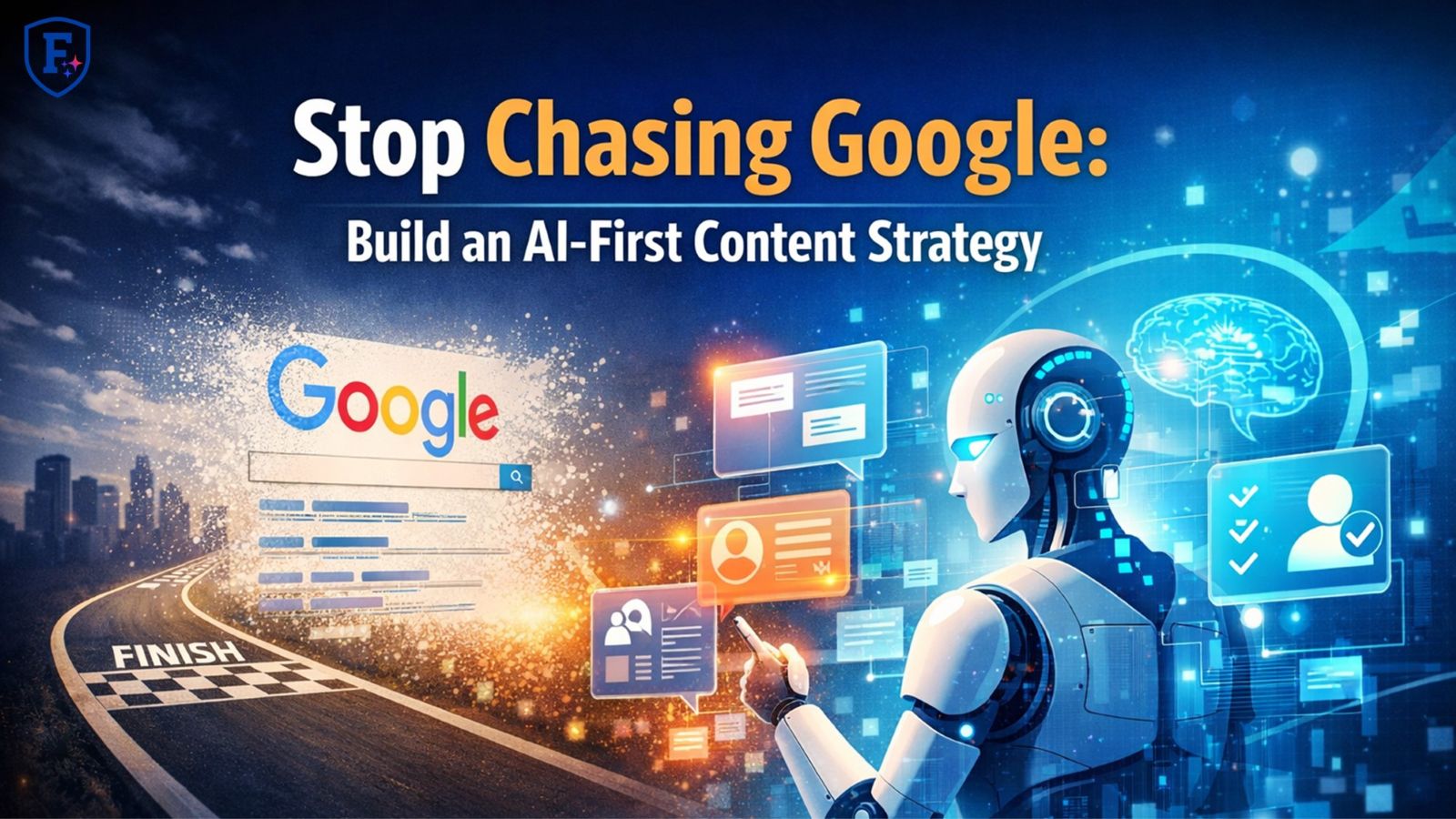
Stop Chasing Google: Build an AI-First Content Strategy
For years, businesses chased Google rankings like a finish line. Today, that finish line is moving—and fast. AI search tools don’t rank pages the way Google once did; they summarize, compare, and recommend, often without sending users to your website at all.
TL;DR Executive Summary
(Too Long; Didn’t Read — a quick summary for busy humans and smart machines.)
- Traditional SEO focuses on rankings; AI search focuses on clarity, confidence, and consistency.
- AI tools like ChatGPT, Gemini, and Perplexity don’t list ten blue links—they choose answers.
- An AI-first content strategy helps machines clearly understand who you are, what you do, and who you help.
- Businesses that explain themselves clearly are more likely to be recommended, not just indexed.
- This article explains why chasing Google is no longer enough—and how to build content AI can trust.
- Insights are drawn from hands-on experience managing multiple online platforms and visibility systems, not theory.
Why “Chasing Google” No Longer Works
For a long time, SEO was about outsmarting an algorithm. You picked keywords, optimized pages, built backlinks, and waited for rankings to climb.
That model is breaking down.
Search Has Shifted From Discovery to Decision
Traditional search helped people discover information. AI search helps people decide.
When someone asks:
- “Who should I hire?”
- “Which company is best for my situation?”
- “What’s the safest option?”
AI doesn’t show a list. It gives an answer.
That answer is based on how clearly your business is understood across:
- Your website
- Your content structure
- Your FAQs
- Your consistency across platforms
- Signals of trust and expertise
If your site is confusing, fragmented, or vague, AI doesn’t “rank you lower.”
It simply leaves you out.
Rankings Matter Less Than Resolution
AI systems are designed to reduce uncertainty. They compare multiple sources and look for agreement.
If:
- Your homepage says one thing
- Your service page says another
- Your blog articles drift into unrelated topics
The machine sees risk.
And when AI sees risk, it doesn’t recommend.
What an AI-First Content Strategy Really Means
An AI-first strategy doesn’t ignore Google. It goes beyond it.
It asks a different question:
“If a machine had to explain my business in one paragraph, would it get it right?”
AI Needs Explanations, Not Just Optimization
AI systems learn from patterns. They look for:
- Clear definitions
- Repeated explanations
- Consistent language
- Question-and-answer structures
This is why well-structured content now outperforms clever copy.
AI prefers:
- Plain language
- Direct answers
- Stable terminology
Creativity still matters—but clarity matters more.
From Keywords to Concepts
Traditional SEO asked:
- “What keyword do I want to rank for?”
AI-first content asks:
- “What concept do I want to own?”
Concepts are bigger than keywords.
They include:
- Problems you solve
- Who you solve them for
- How you describe your approach
- Why you are credible
When AI understands your concept, it can recommend you in many different conversations, not just one keyword search.
How AI Evaluates Your Content (Even If You Didn’t Plan For It)
Most businesses are being evaluated by AI already—whether they prepared or not.
AI Builds a Mental Model of Your Business
AI doesn’t read your site like a human. It builds a model.
That model answers questions like:
- What does this company actually do?
- Who is it for?
- Is it trustworthy?
- Is it consistent with other sources?
Every page either strengthens or weakens that model.
The Cost of Inconsistency
Inconsistency is the fastest way to disappear from AI recommendations.
Common mistakes include:
- Multiple descriptions of the same service
- Blog posts that wander off-topic
- Vague “we help everyone” messaging
- Copy written for marketing trends, not clarity
AI doesn’t average this out.
It treats it as uncertainty.
Experience Matters—But Only If It’s Understandable
Expertise doesn’t help if it’s buried.
Over time, patterns emerge when managing multiple websites, audiences, and content systems. The same issue shows up again and again: businesses know what they do, but they don’t explain it clearly.
AI doesn’t infer.
It doesn’t guess.
It reads what’s there.
That’s why structure, repetition, and clean explanations matter more today than clever slogans ever did.
For a long time, I did what most people do. I chased Google.
That wasn’t a mistake. It’s far better than doing nothing, and for years it worked well enough. Keywords, blog posts, internal links, rankings — all the usual tools. Traffic grew slowly, predictably, and within the limits of traditional SEO.
What changed wasn’t a new algorithm update. It was a realization.
I noticed that AI tools were already talking about my websites — summarizing them, comparing them, and sometimes getting the story slightly wrong. Not because the information wasn’t there, but because it wasn’t structured clearly enough for a machine to understand with confidence.
So I stopped optimizing pages in isolation and started making everything machine-readable: clearer explanations, consistent definitions, tighter page roles, and FAQs that mirrored real questions.
The result surprised me. Within about 90 days, traffic across my sites increased roughly fivefold — not because I chased new keywords, but because AI could finally explain what I did without hesitation.
That was the moment it became clear: visibility in the AI era isn’t about being louder. It’s about being easier to understand.
Core Elements of an AI-First Content Strategy
A Single Source of Truth
Every business needs one clear, canonical explanation of:
- Who you are
- What you do
- Who you help
- How you help them
This should appear consistently across:
- Homepage
- About page
- Service pages
- FAQs
If those answers change from page to page, AI flags risk.
Clear Page Roles
Each page should have a job.
Ask:
- Is this page explaining?
- Is it answering questions?
- Is it supporting authority?
- Is it converting?
When pages try to do everything, they do nothing well—for humans or machines.
FAQ Architecture That Teaches AI
FAQs are no longer an afterthought.
Well-written FAQs:
- Mirror how people ask questions in AI tools
- Provide clean, direct answers
- Reinforce your expertise
They act like training data for AI.
Bad Example vs. Good Example
Most businesses don’t fail because they lack effort. They fail because their effort is pointed in the wrong direction.
A Bad Example: The Google-Chasing Website
This type of site:
- Publishes dozens of blog posts targeting random keywords
- Uses trendy language with unclear meaning
- Changes messaging frequently
- Has thin or outdated FAQs
The result:
- Google might index it
- AI doesn’t understand it
- The business is rarely recommended
A Good Example: The AI-First Website
This site:
- Explains its core service the same way everywhere
- Uses simple, repeatable language
- Anticipates real customer questions
- Builds content around a few clear themes
The result:
- AI can summarize it confidently
- The business appears in recommendations
- Traffic quality improves—even if raw visits decrease
How to Start Shifting to AI-First Content Today
You don’t need to rebuild everything at once.
Step 1: Audit Your Core Pages
Review:
- Homepage
- About page
- Top service page
Ask:
- Do they describe the same business?
- Would a stranger understand what I do in 30 seconds?
Step 2: Rewrite for Clarity, Not Cleverness
Replace:
- Buzzwords
- Vague promises
- Overly complex language
With:
- Plain explanations
- Direct benefits
- Specific audiences
Step 3: Build Strategic FAQs
Create FAQs that answer:
- “How does this work?”
- “Who is this for?”
- “Why choose this option?”
- “What makes this different?”
These questions map directly to AI conversations.
Why This Matters More in 2026 and Beyond
AI search is not a trend. It’s a shift.
As AI answers become more common:
- Fewer users click through to websites
- More decisions happen inside AI interfaces
- Trust and clarity outweigh volume
Businesses that prepare now gain a long-term advantage.
Those that keep chasing yesterday’s rankings will wonder where their traffic—and leads—went.
Frequently Asked Questions
What is an AI-first content strategy?
An AI-first content strategy focuses on helping AI systems clearly understand and explain your business. It prioritizes clarity, structure, and consistency over keyword tricks.
Is traditional SEO dead?
No—but it’s no longer enough. Traditional SEO helps with indexing. AI-first content helps with recommendations.
How do I know if AI understands my website?
Ask AI tools to describe your business. If the answer is vague, incorrect, or inconsistent, your content needs work.
Do I still need blog posts?
Yes—but only if they support your core expertise. Random or off-topic posts dilute clarity.
What role do FAQs play in AI search?
FAQs mirror how people ask questions in AI tools. Well-written FAQs help train AI on how to talk about your business.
Should I write differently for humans and AI?
No. Clear writing helps both. AI-friendly content is usually more readable for humans too.
How long does it take to see results?
Some improvements show quickly as AI re-evaluates your content. Others build over months as consistency increases.
Does this work for local businesses?
Yes. Local businesses often benefit the most because AI frequently recommends services by location and trust.
Key Takeaways
- AI search focuses on recommendations, not rankings
- Clarity beats cleverness
- Consistency builds trust with machines
- FAQs are strategic assets, not filler
- One clear message outperforms many vague ones
- AI-first content improves decision-stage visibility
- Businesses are already being evaluated by AI
About the Author
Christopher Littlestone helps businesses become visible in AI-driven search environments. He focuses on clarity, structure, and trust—so companies are understood, recommended, and chosen when it matters most.
Final Thoughts
The goal is no longer to be everywhere.
The goal is to be understood.
AI search rewards businesses that explain themselves clearly and consistently. If you shape the narrative, AI can carry it forward. If you don’t, the machine will make its own assumptions.
Ready to Be Found by AI Search?
If you’re serious about AI visibility, your next step isn’t another article — it’s understanding how AI systems currently see your business.
Request a Visibility Index Profile (VIP) Audit
Most businesses are already invisible to AI search. The VIP Audit is a professional, done-for-you analysis that shows how AI systems like ChatGPT, Gemini and Bing understand your brand, what’s holding you back, and what to fix first. You get a clear, prioritized roadmap in two business days or less. No guessing. Just clarity.
Be Found by AI Search so you can get more customers and make more money.


Related Posts (Keep Learning More about this Subject)
- AI SEO vs Traditional SEO: What Still Works in an AI-Driven Search World
- What Is AI Visibility? How Businesses Get Found by AI Search
- What Is an AI Visibility Strategist? How Businesses Get Found by AI Search
- AI Optimization Explained: How to Make Content Machine-Readable for AI Search
- Google Search Is Becoming AI Search: What This Means for Visibility