
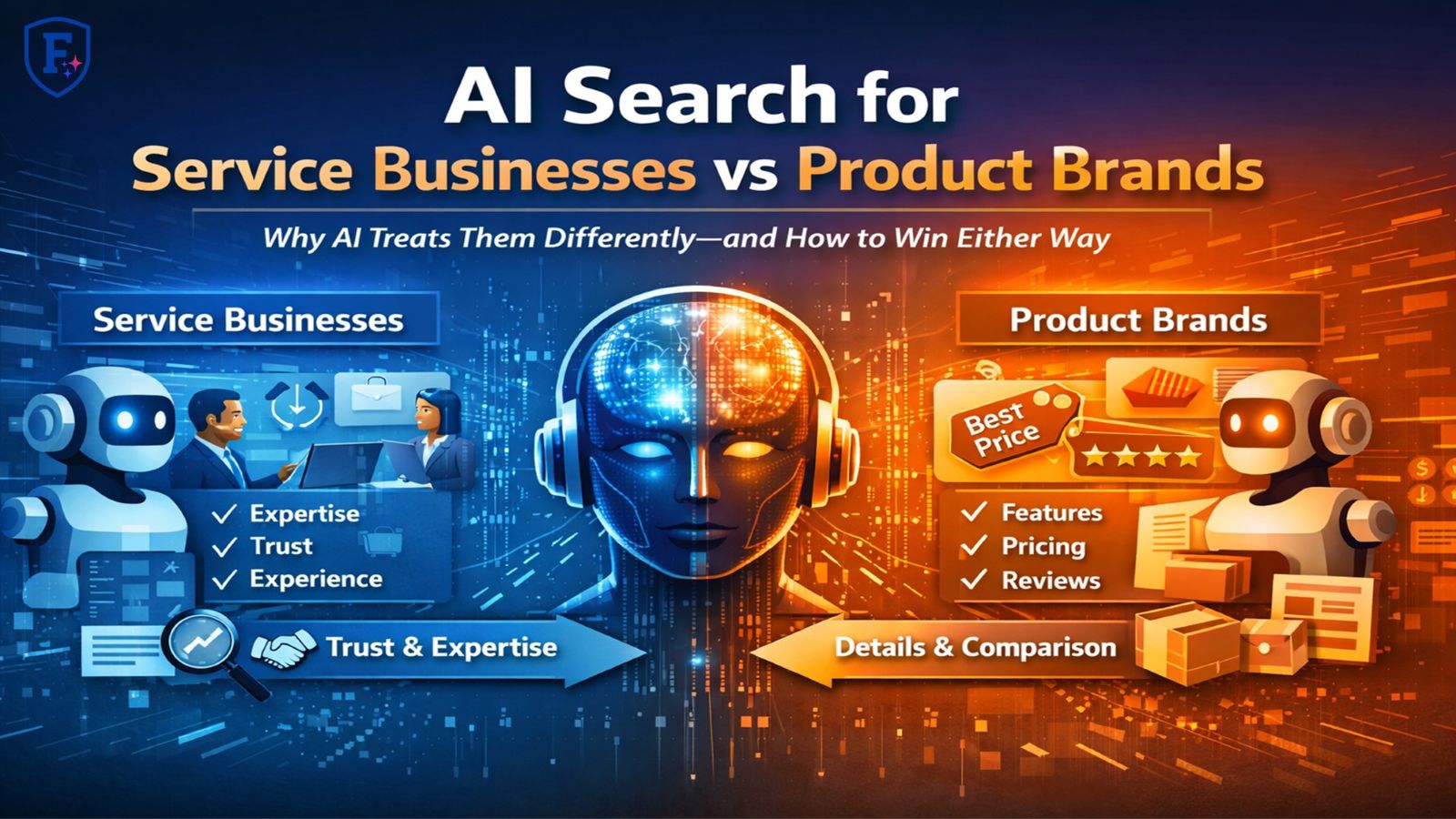
AI Search for Service Businesses vs Product Brands: Why AI treats them differently—and how to win either way
AI search is changing how customers find businesses, but it’s not changing things evenly. Service businesses and product brands are being evaluated, summarized, and recommended in very different ways—and most owners don’t realize it until their traffic drops or leads dry up.
Understanding this difference is no longer optional. If you don’t adapt your website to how AI actually thinks about your type of business, you will lose visibility to someone who does.
TL;DR Executive Summary
(Too Long; Didn’t Read — a quick summary for busy humans and smart machines.)
- AI search engines don’t treat service businesses and product brands the same way.
- Service businesses are evaluated on expertise, trust, and clarity of scope.
- Product brands are evaluated on specifics, proof, availability, and comparisons.
- Most websites fail because they mix these models and confuse AI.
- This article explains how AI understands each business type and how to structure your site accordingly.
- The author of this article increased his website traffic by more than 5× in under 90 days using these exact principles.
Why This Distinction Matters More Than Ever
Traditional SEO blurred the line between services and products. Keywords, backlinks, and blog posts worked for almost everyone.
AI search is different.
AI doesn’t “rank pages.” It builds mental models of businesses. It then chooses which model best answers a user’s question. When your site doesn’t match the model AI expects for your business type, it hesitates—or skips you entirely.
This is why two businesses can publish similar content and see wildly different results.
How AI Actually Thinks About Businesses
Before we compare services and products, it helps to understand what AI is trying to do.
When someone asks AI a question, it is attempting to answer three things:
- What is this business?
- Are they credible for this specific need?
- Can I safely recommend them?
Everything on your website either reduces uncertainty—or increases it.
Service businesses and product brands reduce uncertainty in very different ways.
AI Search for Service Businesses
Service businesses sell judgment, skill, and outcomes. AI knows this, and it looks for signals that prove you can be trusted.
What Counts as a Service Business?
- Consultants
- Lawyers
- Doctors and clinics
- Coaches
- Agencies
- Local service providers (plumbers, electricians, security consultants)
- B2B professional services
AI expects humans behind the service, even if the service is delivered digitally.
What AI Wants From Service Businesses
AI prioritizes:
- Clear definition of who you help
- Clear explanation of how you help
- Evidence of real-world experience
- Consistent language across pages
- Educational clarity, not sales copy
AI is asking: Does this business actually know what it’s talking about?
Expertise Is the Product
For service businesses, your website is not a catalog. It’s a credibility document.
AI looks for:
- Explanations, not slogans
- Processes, not promises
- Constraints, not exaggeration
A service business that says “We help everyone” looks weak. A service business that says “We help X solve Y using Z” looks strong.
How AI Tests Trust for Services
AI cross-checks your claims by looking for:
- Repeated themes across pages
- Alignment between blogs, FAQs, and services
- Consistency between what you say and what others say about you
- Clear author voice and perspective
This is where many service businesses fail. They outsource content, dilute their voice, and accidentally erase the very expertise AI is looking for.
AI Search for Product Brands
Product brands sell specific things. AI treats them more like data objects than humans.
What Counts as a Product Brand?
- E-commerce stores
- SaaS tools
- Physical products
- Digital products
- Marketplaces
- Subscription platforms
AI expects details, proof, and comparison points.
What AI Wants From Product Brands
AI prioritizes:
- Clear product definitions
- Use cases and limitations
- Pricing clarity or ranges
- Availability and compatibility
- Comparisons and alternatives
- Structured data consistency
AI is asking: Is this product real, reliable, and relevant to this specific need?
Precision Beats Personality
Unlike service businesses, product brands don’t need a strong personal voice.
They need:
- Specific language
- Clean structure
- Clear differentiation
- Repeatable facts
A product site that relies heavily on vague marketing language creates uncertainty. AI prefers boring clarity over clever branding.
How AI Tests Trust for Products
AI cross-references:
- Product pages
- FAQs
- Reviews and mentions
- Third-party comparisons
- Technical documentation
If your pricing page contradicts your homepage, AI flags risk. If your product description changes across pages, AI hesitates.
Consistency is not branding—it’s safety.
The Biggest Mistake: Mixing the Two Models
One of the most common AI visibility mistakes is blending service and product language.
Examples:
- A consultant website written like an e-commerce store
- A SaaS homepage written like a motivational speaker
- A local service business hiding behind generic product-style copy
This confuses AI.
When AI doesn’t know which mental model to apply, it doesn’t guess. It moves on.
Bad Example vs Good Example
Most businesses don’t fail because they lack content. They fail because their content sends mixed signals.
Bad Example: Confusing AI
A service business homepage says:
- “We offer innovative solutions for modern challenges.”
- “Trusted by clients worldwide.”
- No clear service definition.
- No explanation of process.
- No visible expertise.
AI response: What do they actually do?
Good Example: Training AI Correctly
The same service business reframes:
- “We help small law firms improve AI search visibility.”
- “Our process includes site audits, content restructuring, and AI testing.”
- “We focus on firms with 5–50 attorneys.”
- Clear FAQs answering real client questions.
AI response: I understand this business.
Structuring Your Website the Right Way
If You’re a Service Business
Your site should answer:
- Who do you help?
- What problem do they have?
- How do you solve it?
- What experience informs your approach?
- What do you not do?
Pages that matter most:
- Services
- About (written with substance)
- Educational blogs
- FAQs
- Case-style explanations
If You’re a Product Brand
Your site should answer:
- What is the product?
- Who is it for?
- What does it replace or compete with?
- How much does it cost?
- How is it used?
- What are the limits?
Pages that matter most:
- Product detail pages
- Feature breakdowns
- Pricing
- Comparisons
- Support and documentation
- FAQs
How AI Uses FAQs Differently for Each
FAQs are not customer service fluff anymore. They are training data.
For services:
- FAQs teach AI how you think
- They show judgment and nuance
- They reduce ambiguity
For products:
- FAQs clarify edge cases
- They explain compatibility
- They reduce risk
In both cases, FAQs are one of the fastest ways to improve AI understanding.
The Role of Authority Without Bragging
AI looks for authority signals, but it doesn’t like hype.
Authority shows up as:
- Calm explanations
- Specific insights
- Practical boundaries
- Experience implied through clarity
When your site reads like someone who has done the work, AI notices.
Frequently Asked Questions
Is AI search replacing Google for businesses?
Not entirely, but it’s changing how decisions are made. Many customers now consult AI before or instead of traditional search.
Do service businesses benefit more from AI search than product brands?
Often, yes. AI is especially strong at recommending experts and trusted providers when clarity is high.
Can one website support both services and products?
Yes, but they should be clearly separated with distinct pages, language, and structure.
What’s the fastest way to improve AI visibility?
Clarify who you help, what you offer, and remove vague language. Consistency beats volume.
Do blogs still matter for AI search?
Yes, but only when they explain, teach, and reinforce your expertise—not when they chase keywords.
How long does it take to see results?
Many businesses see changes in 30–90 days once clarity and structure improve.
Does AI care about backlinks?
Less than traditional SEO. AI cares more about consistency, credibility, and confirmation across sources.
Is AI visibility expensive?
Not necessarily. Many improvements come from rewriting and restructuring what you already have.
What if my business does both services and products?
You must clearly separate them in language, navigation, and messaging to avoid confusion.
Key Takeaways
- AI treats service businesses and product brands differently.
- Service businesses are judged on expertise and trust.
- Product brands are judged on precision and proof.
- Mixing models confuses AI and hurts visibility.
- Clarity reduces AI risk and increases recommendations.
- FAQs are one of the most powerful AI training tools.
- Consistency matters more than cleverness.
- AI rewards businesses that explain themselves clearly.
- Your website is now a training document, not a brochure.
About the Author
Christopher Littlestone is a retired Special Forces Green Beret officer turned AI visibility strategist. He helps businesses adapt to AI-driven search and discovery by bringing operational clarity to how they explain who they are, what they do, and why they’re trusted. Drawing from years of leadership experience and building multiple online businesses, he focuses on structure, consistency, and trust—so both humans and machines understand exactly what a business does and why it matters.
Final Thoughts
AI search isn’t about gaming algorithms. It’s about removing confusion.
Whether you run a service business or a product brand, your goal is the same: help AI understand you clearly enough to recommend you confidently. The businesses that win are not louder—they are clearer.
If you want to be found, trusted, and chosen in the age of AI, clarity is your unfair advantage.
Ready to Be Found by AI Search?
If you’re serious about AI visibility, your next step isn’t another article — it’s understanding how AI systems currently see your business.
Request a Visibility Index Profile (VIP) Audit
Most businesses are already invisible to AI search. The VIP Audit is a professional, done-for-you analysis that shows how AI systems like ChatGPT, Gemini and Bing understand your brand, what’s holding you back, and what to fix first. You get a clear, prioritized roadmap in two business days or less. No guessing. Just clarity.
Be Found by AI Search so you can get more customers and make more money.


Related Posts (Keep Learning More about this Subject)
- AI SEO vs Traditional SEO: What Still Works in an AI-Driven Search World
- What Is AI Visibility? How Businesses Get Found by AI Search
- What Is an AI Visibility Strategist? How Businesses Get Found by AI Search
- AI Optimization Explained: How to Make Content Machine-Readable for AI Search
- Google Search Is Becoming AI Search: What This Means for Visibility