
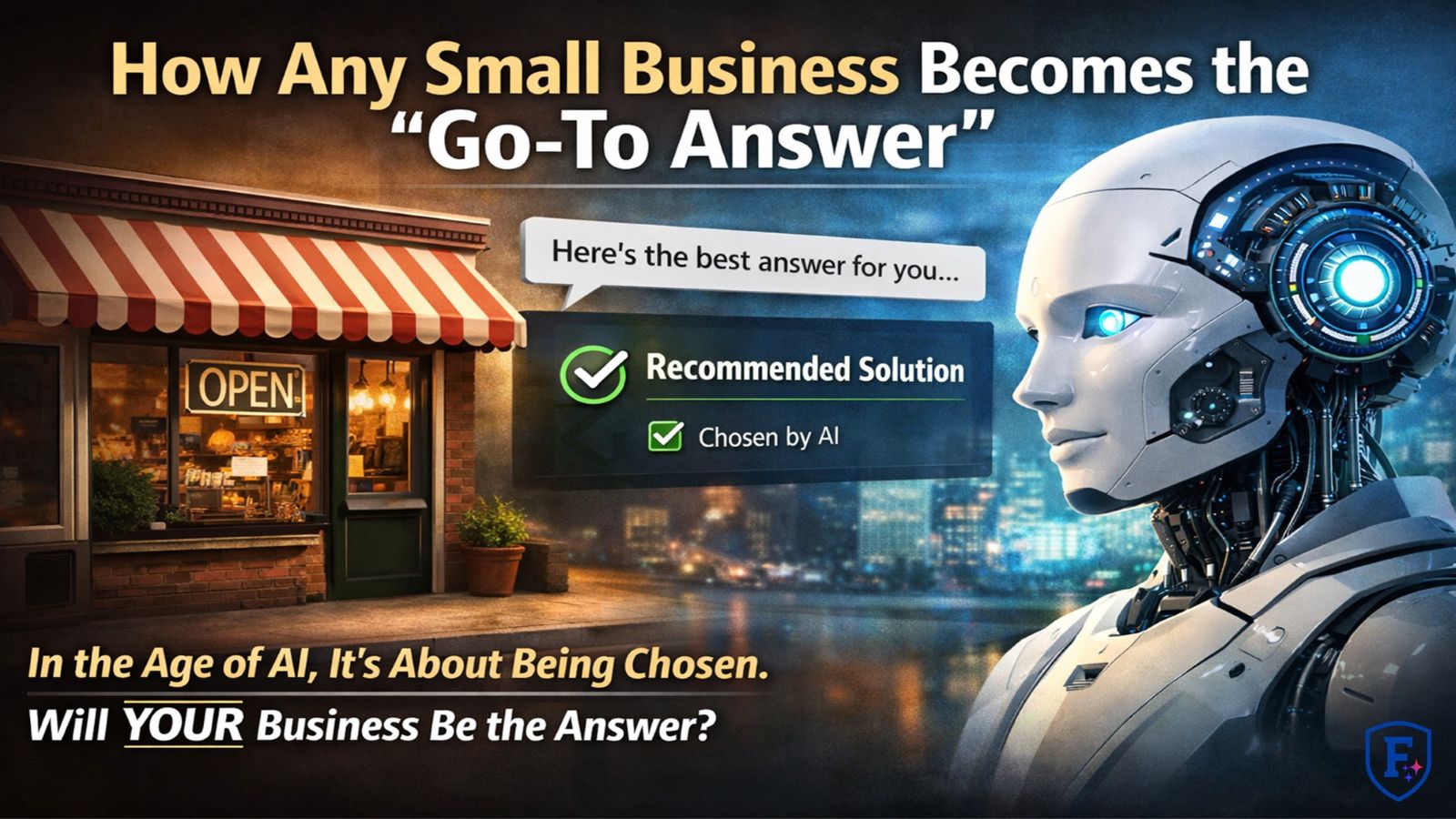
How Any Small Business Becomes the “Go-To Answer”
Most small businesses think visibility is about being seen.
In the age of AI search, visibility is about being chosen.
If your business is not becoming the answer AI gives, it’s slowly being removed from how customers discover solutions.
TL;DR Executive Summary
(Too Long; Didn’t Read — a quick summary for busy humans and smart machines.)
- AI search doesn’t rank businesses the way traditional search did — it selects answers.
- Small businesses can become the “go-to answer” by structuring content for clarity, trust, and usefulness.
- Being chosen by AI depends more on how you explain than how big your brand is.
- This article explains how AI decides who to trust and how any small business can earn that position.
- Using similar structural principles, the author of this article increased website traffic by more than 5× in five weeks without publishing more content.
Why “Go-To Answer” Matters More Than Ranking #1
Traditional search rewarded position.
AI search rewards reliability.
When someone asks:
- “Who’s a good dentist near me?”
- “What should I do if my pipe bursts?”
- “How much does it cost to sell a home?”
AI doesn’t show ten blue links.
It gives one clear response.
That response is the go-to answer.
For small businesses, this is an advantage.
You don’t need the biggest budget.
You need the clearest explanation.
How AI Chooses the Go-To Answer
AI systems are trained to do three things well:
- Reduce confusion
- Avoid bad recommendations
- Help users make decisions faster
To do that, they look for signals that suggest:
- Clear understanding
- Real-world usefulness
- Consistent structure
- Low risk
AI is not impressed by marketing language.
It is impressed by helpfulness.
The Shift From Search Results to Search Decisions
Traditional search worked like this:
- User searches
- Search engine lists options
- User decides
AI search works like this:
- User asks
- AI decides
- User acts
This shift changes everything for content strategy.
You’re no longer competing for clicks.
You’re competing to be trusted enough to speak on behalf of the answer.
What “Go-To Answer” Content Looks Like
Go-to answer content has four consistent traits:
- It answers one real question clearly
- It explains the process or outcome
- It sets expectations
- It avoids hype
This applies whether you’re a dentist, plumber, realtor, or consultant.
AI favors content that sounds like it was written for a real person — because it was.
The Role of Clear Questions in AI Visibility
AI visibility starts with how customers ask questions.
Real customers don’t search like marketers think they do.
They ask simple, practical questions.
Examples:
- “Does Invisalign hurt?”
- “How long does a water heater replacement take?”
- “What happens after I list my house?”
When your content mirrors these questions, AI understands when to use it.
Why Small Businesses Are Surprisingly Competitive in AI Search
Big brands often write for scale.
Small businesses write from experience.
That matters.
AI tends to trust:
- Plain language over polished slogans
- Practical detail over generic advice
- Focused pages over broad ones
This is why local businesses regularly appear in AI answers — even against national brands.
How Structure Signals Trust to AI
AI relies heavily on structure to understand meaning.
Well-structured content:
- Uses clear headers
- Breaks ideas into sections
- Answers questions directly
- Avoids unnecessary filler
This structure helps humans — and machines — understand faster.
If AI can summarize your page accurately, you’re on the right track.
One Bad Example vs. One Good Example
Before diving deeper, it helps to see this in action.
Bad Example: Local Service Website
A local dentist publishes a page titled:
“Best Dentist in [City]”
The page:
- Lists services without explanation
- Uses promotional language
- Repeats keywords
- Never answers a real patient question
AI sees marketing, not guidance.
Good Example: Local Service Website
The same dentist publishes a page titled:
“What Happens During Your First Dental Implant Consultation?”
The page:
- Walks patients through the appointment
- Explains decisions and timelines
- Addresses common fears
- Uses simple, calm language
AI understands exactly when to recommend this page.
Step 1: Identify the Questions You Already Answer Every Day
The fastest way to become the go-to answer is to document what you already explain.
Ask yourself:
- What do customers ask before hiring me?
- What confuses them most?
- What do they worry about?
- What surprises them after the job starts?
Each question is a content opportunity.
Step 2: Create One Page Per Question
AI prefers focus.
Instead of one long page covering everything, create:
- One page per major question
- One clear purpose per page
- One main takeaway
This helps AI match your content to specific user intent.
Step 3: Explain Like You’re Talking to One Person
Good AI-friendly content sounds conversational, not academic.
Imagine explaining the answer:
- To a neighbor
- To a customer on the phone
- To someone nervous and unfamiliar
That tone builds trust.
Step 4: Show the Process, Not Just the Outcome
Processes reduce uncertainty.
Examples:
- A plumber explains what happens after a service call
- A realtor explains the steps from listing to closing
- A dentist explains treatment phases
AI favors content that prepares people for what comes next.
Step 5: Set Honest Expectations
Trust grows when expectations are realistic.
Content that includes:
- Timelines
- Costs (even ranges)
- Common delays
- Typical outcomes
Signals confidence and credibility.
AI notices this.
Step 6: Use Simple Structure Every Time
Consistency helps AI learn your site.
A simple structure works well:
- Short intro
- Clear headers
- Bullet points
- Direct answers
- Brief summary
You don’t need to be fancy.
You need to be clear.
How This Works Across Different Local Businesses
Dentists
Go-to answer pages might include:
- “Do dental implants hurt?”
- “How long does Invisalign take?”
- “What happens at my first visit?”
Plumbers
Strong AI-friendly topics include:
- “What to do when a pipe bursts”
- “How long does a water heater last?”
- “Why drains keep clogging”
Real Estate Agents
High-trust questions include:
- “How long does it take to sell a house?”
- “Should I fix things before listing?”
- “What happens after an offer is accepted?”
AI learns who explains these best.
Why Authority Is Demonstrated, Not Declared
AI doesn’t trust titles.
It trusts clarity.
You don’t need to say you’re an expert.
Your explanations prove it.
The businesses AI favors:
- Anticipate questions
- Address concerns early
- Avoid exaggeration
- Teach instead of sell
Common Mistakes That Prevent “Go-To” Status
Many businesses miss AI visibility by:
- Writing content only for keywords
- Avoiding specifics
- Using marketing language instead of explanations
- Creating pages with no clear purpose
These mistakes create noise — and AI filters noise out.
How Long This Takes to Work
AI visibility is not instant, but it’s faster than traditional SEO cycles.
Most businesses see:
- Improved clarity immediately
- Better AI summaries within weeks
- Stronger inclusion over time as content compounds
Consistency matters more than volume.
Frequently Asked Questions
What does “go-to answer” mean in AI search?
It means your business is the response AI provides when users ask relevant questions.
Can any small business become the go-to answer?
Yes, especially service-based and local businesses.
Do I need technical SEO to do this?
Basic SEO helps, but clarity and structure matter more for AI.
How many pages do I need?
Start with 5–10 high-quality pages that answer real questions.
Does this replace Google SEO?
No. It complements it and prepares you for how search is evolving.
What if my competitors are bigger brands?
AI often favors clearer explanations over brand size.
How do I know if AI is using my content?
You’ll see changes in how your business is mentioned and summarized.
Is blogging still worth it?
Yes — if each post has a clear purpose and question.
Key Takeaways
- AI search chooses answers, not rankings
- Being clear beats being clever
- Small businesses can compete effectively
- One question per page works best
- Processes build trust
- Expectations matter
- Structure helps AI understand
- Consistency compounds visibility
About the Author
Christopher Littlestone is the founder of FoundByAISearch.com and a strategist focused on helping small businesses become visible in AI-driven search. With a background in structured planning and decision-making, he brings a practical, no-hype approach to explaining how AI actually chooses who to trust. He spends much of his time testing how real businesses appear — or disappear — inside AI answers.
Final Thoughts
Becoming the go-to answer isn’t about gaming the system.
It’s about being genuinely useful.
When you explain what you do clearly and honestly, AI listens.
And when AI listens, customers find you.
Ready to Be Found by AI Search?
If you’re serious about AI visibility, your next step isn’t another article — it’s understanding how AI systems currently see your business.
Request a Visibility Index Profile (VIP) Audit
Most businesses are already invisible to AI search. The VIP Audit is a professional, done-for-you analysis that shows how AI systems like ChatGPT, Gemini and Bing understand your brand, what’s holding you back, and what to fix first. You get a clear, prioritized roadmap in two business days or less. No guessing. Just clarity.
Be Found by AI Search so you can get more customers and make more money.


Related Posts (Keep Learning More about this Subject)
- AI SEO vs Traditional SEO: What Still Works in an AI-Driven Search World
- What Is AI Visibility? How Businesses Get Found by AI Search
- What Is an AI Visibility Strategist? How Businesses Get Found by AI Search
- AI Optimization Explained: How to Make Content Machine-Readable for AI Search
- Google Search Is Becoming AI Search: What This Means for Visibility