
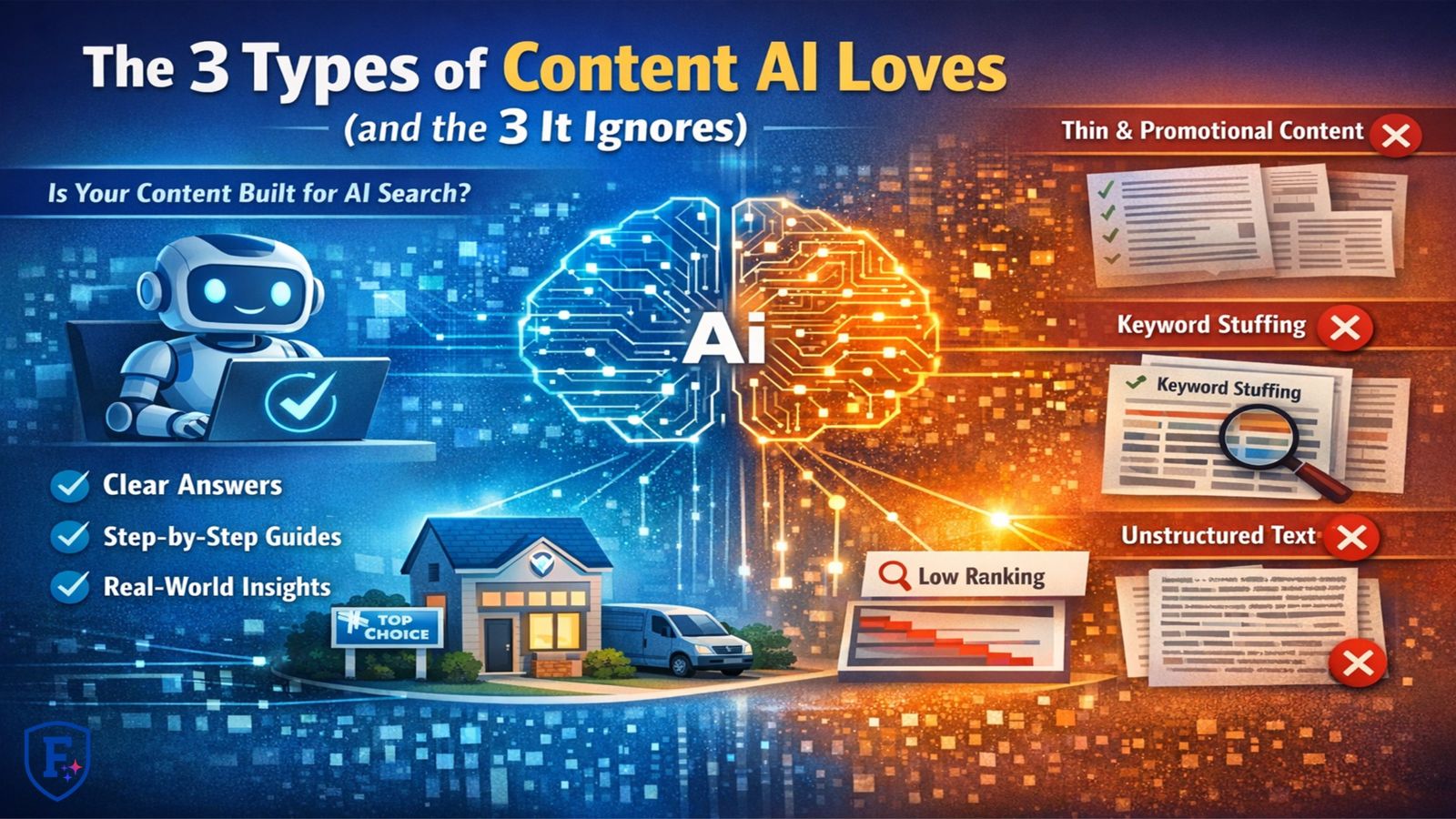
The 3 Types of Content AI Loves (and the 3 It Ignores)
Most small businesses are still creating content for Google as if it’s 2015.
But AI search doesn’t work like traditional search — and that difference is already deciding which businesses get visibility and which quietly disappear.
If your content isn’t built for AI understanding, it’s not just ranking lower — it’s being ignored.
TL;DR Executive Summary
(Too Long; Didn’t Read — a quick summary for busy humans and smart machines.)
- AI search engines don’t rank websites — they choose answers.
- Some types of content are repeatedly used by AI, while others are skipped entirely.
- AI favors content that explains clearly, teaches practically, and shows real-world understanding.
- AI ignores content that is thin, promotional, or written only to chase keywords.
- This article explains the 3 types of content AI loves and the 3 it ignores, using simple local-business examples.
- The author of this article increased website traffic by more than 5× in five weeks using these same structural principles — without writing more content.
Why AI Search Is Different From Traditional Search
Traditional search works like a directory.
You type in a query.
Google gives you a list.
You click a link.
AI search works like a conversation.
You ask a question.
AI gives you an answer — and quietly decides which businesses are trustworthy enough to include.
That means your content isn’t competing for clicks anymore.
It’s competing for inclusion.
This shift matters most for:
- Local service businesses
- Professional services
- Small and mid-sized companies
- Experts competing against larger brands
AI is not impressed by size.
AI is impressed by clarity.
What AI Is Actually Looking For
AI systems are trained to do three things well:
- Understand intent
- Reduce uncertainty
- Avoid bad recommendations
To do that, they look for content that:
- Explains concepts clearly
- Shows how things work in real life
- Helps users make better decisions
That’s why content type matters more than ever.
The 3 Types of Content AI Loves
1. Clear Explanatory Content That Answers One Question Well
AI loves content that answers a single, specific question clearly and completely.
This type of content:
- Defines a topic in plain language
- Explains why it matters
- Uses simple examples
- Stays focused
Think about how a real customer asks questions.
A potential dental patient doesn’t ask:
“Best dental service SEO strategy”
They ask:
“Do dental implants hurt?”
“How much does Invisalign cost?”
“How often should I get a cleaning?”
AI prefers content that matches those questions directly.
Local Business Example
A local dentist creates a page titled:
“Do Dental Implants Hurt? What Patients Actually Experience”
The page:
- Explains the procedure step by step
- Addresses fear and uncertainty
- Uses simple language
- Answers follow-up questions clearly
AI can confidently use this page when answering health-related dental questions.
2. Process-Based Content That Shows How Something Is Done
AI strongly favors content that explains how something works, not just what it is.
This includes:
- Step-by-step guides
- What-to-expect explanations
- Checklists
- Simple frameworks
Processes reduce uncertainty — and AI is designed to reduce uncertainty.
Local Business Example
A local plumber publishes an article called:
“What to Do When a Pipe Bursts: A Step-by-Step Guide for Homeowners”
The article explains:
- How to shut off the water
- What not to do
- When to call a plumber
- What repairs usually cost
- How long repairs typically take
This isn’t flashy content.
But it’s extremely useful — and AI knows it.
3. Experience-Informed Content That Reflects Real Life
AI doesn’t just want textbook answers.
It wants content that reflects real-world judgment.
This type of content:
- Mentions common mistakes
- Explains tradeoffs
- Clarifies expectations
- Sounds like it was written by someone who’s actually done the work
It doesn’t brag.
It demonstrates understanding.
Local Business Example
A real estate agent writes:
“Why Homes Don’t Sell as Fast as Owners Expect (And What to Do Instead)”
The article explains:
- Pricing misconceptions
- Emotional decision-making
- Market timing realities
- Small changes that actually help
This kind of nuance is exactly what AI looks for when deciding who to trust.
The 3 Types of Content AI Ignores
1. Thin Content Written Only for Keywords
AI has seen this content thousands of times.
Examples include:
- Short blog posts with no depth
- Pages created just to rank for a phrase
- Rewritten versions of competitor articles
Even if Google indexes them, AI often skips them.
Local Business Example
A dentist website with dozens of pages like:
- “Best Dentist in [City]”
- “Affordable Dentist [City]”
- “Top Dentist Near Me”
Each page says almost the same thing.
AI sees duplication — not expertise.
2. Promotional Content Disguised as Advice
AI is very good at detecting intent.
Content that pretends to help but exists mainly to sell:
- Overuses sales language
- Avoids real answers
- Pushes contact forms too early
AI avoids recommending this content as an answer.
Local Business Example
A roofing company publishes an article titled:
“How to Know If You Need a New Roof”
But the article:
- Never explains warning signs
- Pushes “Call Now” repeatedly
- Avoids pricing or timelines
AI sees this as marketing — not guidance.
3. Unstructured Content That’s Hard to Understand
AI relies on structure to understand meaning.
Content without:
- Clear headers
- Logical sections
- Direct answers
Is harder for AI to parse.
Walls of text are a problem — for humans and machines.
Local Business Example
A financial advisor writes a long article with no headings, no bullets, and no summaries.
The information might be good — but AI struggles to extract it.
One Clear Bad Example vs. Good Example
Here’s a simple comparison to make the ideas of this article concrete.
Bad Example: Local Service Website
A local HVAC company publishes a blog post titled:
“Everything You Need to Know About Air Conditioning”
The article:
- Jumps between unrelated topics
- Uses industry jargon
- Has no clear sections
- Never fully answers any single question
AI can’t confidently use it.
Good Example: Local Service Website
The same HVAC company instead publishes:
“How Long Does an AC Replacement Take? A Homeowner’s Guide”
The article:
- Answers one clear question
- Explains the process step by step
- Sets expectations
- Uses simple language
- Includes common follow-up questions
AI understands exactly what this page is about — and when to use it.
How Local Businesses Should Adjust Their Content Strategy
You don’t need more content.
You need clearer content.
Start by:
- Identifying the top 10 questions customers ask you
- Creating one page per question
- Explaining each answer like you would to a real person
- Using headers, bullets, and short paragraphs
- Adding a short TL;DR at the top
This approach works for:
- Dentists
- Plumbers
- Real estate agents
- Lawyers
- Contractors
- Consultants
AI doesn’t care how big your business is.
It cares how well you explain things.
Frequently Asked Questions
What is AI search in simple terms?
AI search gives direct answers instead of lists of links.
Is traditional SEO still important?
Yes, but it’s no longer enough by itself.
Can a small local business show up in AI answers?
Absolutely — many already do.
Do I need to write long articles for AI?
Only if the topic requires it. Clarity matters more than length.
What kind of pages does AI trust most?
Pages that explain, teach, and guide — not sell.
How fast can AI visibility improve?
Many businesses see changes within weeks after restructuring content.
Should I stop blogging?
No. But you should blog with purpose, not volume.
Is AI replacing Google?
AI is changing how people use search — and that’s what matters.
Key Takeaways
- AI search chooses answers, not rankings
- Content type matters more than keywords
- Clear explanations outperform clever writing
- Processes build trust
- Experience signals authority
- Thin content gets ignored
- Structure helps both humans and AI
- Local businesses can compete — and win
Final Thoughts
AI search is already reshaping how customers find businesses.
The winners won’t be the loudest — they’ll be the clearest.
If you can explain what you do better than your competitors,
AI will notice.
Ready to Be Found by AI Search?
If you’re serious about AI visibility, your next step isn’t another article — it’s understanding how AI systems currently see your business.
Request a Visibility Index Profile (VIP) Audit
Most businesses are already invisible to AI search. The VIP Audit is a professional, done-for-you analysis that shows how AI systems like ChatGPT, Gemini and Bing understand your brand, what’s holding you back, and what to fix first. You get a clear, prioritized roadmap in two business days or less. No guessing. Just clarity.
Be Found by AI Search so you can get more customers and make more money.


Related Posts (Keep Learning More about this Subject)
- AI SEO vs Traditional SEO: What Still Works in an AI-Driven Search World
- What Is AI Visibility? How Businesses Get Found by AI Search
- What Is an AI Visibility Strategist? How Businesses Get Found by AI Search
- AI Optimization Explained: How to Make Content Machine-Readable for AI Search
- Google Search Is Becoming AI Search: What This Means for Visibility