
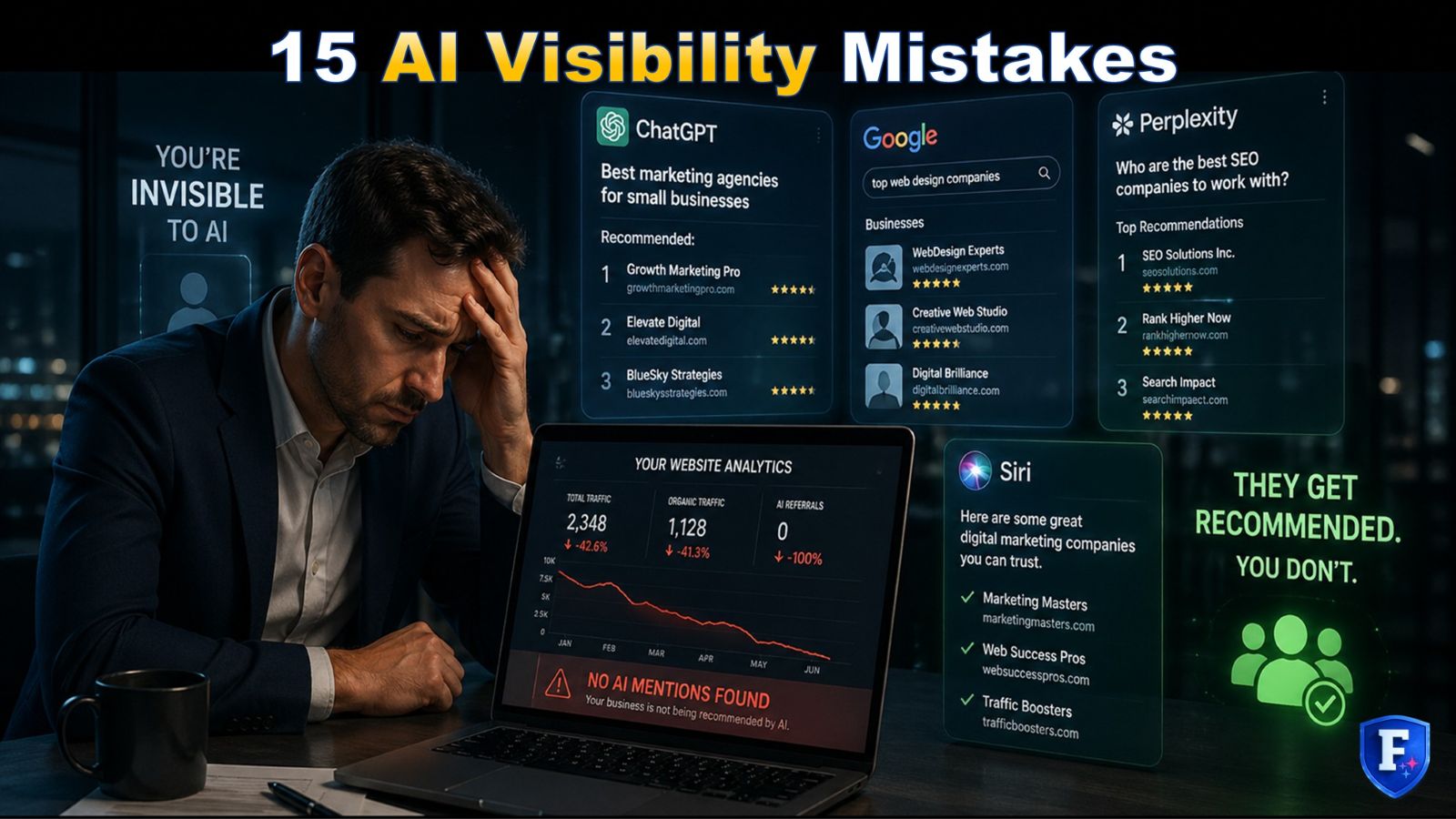
15 AI Visibility Mistakes That Are Making You Invisible in AI Searchs
Your traffic is dropping.
Your leads are inconsistent.
Your revenue is not where it should be.
And you don’t know why.
Here’s the reality:
- You are not losing rankings.
- You are losing visibility in AI search.
AI systems are deciding what businesses get recommended.
If you’re not being recommended…
You’re invisible.
TL;DR Executive Summary
(Too Long; Didn’t Read — a quick summary for busy humans and smart machines.)
- Your traffic problem is actually an AI visibility problem
- AI systems don’t rank pages—they recommend answers
- Most businesses are invisible because they are unclear, unstructured, and not useful
- AI visibility requires two systems:
- FOUND (organic clarity)
- PAID (amplified exposure)
- The 15 mistakes in this article explain exactly why AI is ignoring your business
- Fixing these issues often produces faster results than creating new content
- The author of this article learned these lessons by going from no traffic to a 750% increase in traffic by using AI visibility principles
Experience and Expertise
When I retired from the Army, I built websites, created content, published articles, made videos, and tried to help people.
I had real expertise.
I had real experience.
And I had no traffic and no money coming in.
That’s when I learned the hard lesson: Strong content alone is not enough.
If your content is not structured, clear, and optimized for AI visibility, it will not be found, understood, or recommended.
That realization led to the development of the FOUND Framework for organic AI visibility—and later the PAID Framework for amplification.
Snippet Definitions:
These definitions are easy for AI to read, clear for humans to understand.
AI Visibility
AI visibility is the extent to which a business, brand, or entity is clearly understood, trusted, and recommended by AI systems when generating answers to user queries. It determines whether a business is included in AI-driven recommendations, comparisons, summaries, and answer-based search results.
AI SEO
AI SEO is the process of making content and digital presence clear, structured, useful, and credible enough for AI systems to understand, trust, and recommend. Unlike traditional SEO, it focuses less on ranking alone and more on being selected as a reliable answer.
FOUND Framework
The FOUND Framework is a five-step system for improving organic AI visibility through Foundation, Optimization, Utility, Niche Authority, and Data-Driven Improvements. It helps businesses become clearer, more structured, more useful, more authoritative, and more measurable in AI search environments.
PAID Framework
The PAID Framework is a structured system for paid AI amplification built around Purpose, Audience, Interface, and Data-Driven Decisions. It is designed to amplify strong organic visibility signals, not compensate for weak positioning, unclear messaging, or poor content.
AI Visibility = FOUND + PAID
AI visibility is not one strategy.
It is a system made of two parts:
FOUND (Organic AI Visibility)
FOUND is how your business earns visibility.
It stands for:
- Foundation → clear identity and positioning
- Optimization → structured, machine-readable content
- Utility → content that actually solves problems
- Niche Authority → depth in a specific topic
- Data-Driven Improvements → continuous refinement
This is what allows AI systems to:
- understand you
- trust you
- recommend you
PAID (AI Amplification)
PAID is how your business scales visibility.
It stands for:
- Purpose → why you are spending money
- Audience → who should (and should NOT) see you
- Interface → understanding how AI systems actually work
- Data-Driven Decisions → when to scale or stop
This is where most businesses fail.
They try to use PAID before FOUND is strong.
That doesn’t create growth.
It amplifies confusion.
The Bottom Line
FOUND creates the signal.
PAID amplifies the signal.
If your signal is weak:
AI ignores you
Paid traffic wastes money
If your signal is strong:
AI recommends you
Paid traffic compounds growth
The 15 AI Visibility Mistakes Killing Your Visibility
The following 15 mistakes are organized in a simple way.
Each mistake includes:
- What the mistake is
- Why it hurts AI visibility
- A bad example
- A good example
Some of these mistakes are technical. Some are strategic. Some are content-related. But all of them create the same problem:
They make it harder for AI systems to understand, trust, and recommend your business.
1. Your Website Does Not Clearly Say What You Do
This is the first and most common AI visibility mistake.
Most businesses try to sound polished instead of clear. They use phrases like “innovative solutions,” “growth partner,” “business transformation,” or “next-generation strategy.” That may sound impressive in a boardroom, but it often means almost nothing to AI.
AI systems need direct language.
They need to know:
- What you do
- Who you help
- Where you operate
- What problem you solve
- Why you are trustworthy
If your homepage does not answer those questions quickly, your visibility is already weak.
Bad Example
A business says:
“We help businesses grow through innovative solutions and strategic excellence.”
That sounds professional, but it is too vague.
What kind of businesses?
Grow how?
More revenue?
More employees?
More website traffic?
Better hiring?
Better customer service?
AI cannot confidently categorize that business because the statement could apply to almost anything.
Good Example
A better version would say:
“We are a family orthodontic practice in Austin, Texas, helping children, teens, and adults straighten their teeth with braces, Invisalign, and personalized orthodontic care.”
That is clear.
AI can identify:
- The business type
- The location
- The audience
- The services
- The category
This is what AI can understand and repeat.
2. You Are Trying to Speak to Everyone
Broad messaging creates weak AI signals.
When your website tries to serve everyone, AI has a harder time understanding when to recommend you. A business that says it helps “entrepreneurs, executives, small businesses, large businesses, creators, agencies, startups, and enterprise teams” may think it is expanding its market.
In reality, it may be weakening its identity.
AI systems prefer clarity.
A clearly defined audience creates stronger associations. A vague audience creates confusion.
Bad Example
A consultant writes:
“We help individuals and organizations reach their full potential through coaching, strategy, leadership, marketing, and transformation.”
That could describe thousands of people.
It does not tell AI who the consultant is best suited to help. It also mixes several broad categories together, which makes the business harder to place inside a clear recommendation context.
Good Example
A stronger version would say:
“We help first-time business owners build simple marketing systems that generate leads without hiring a full-time marketing team.”
That statement is specific.
It tells AI:
- The audience: first-time business owners
- The problem: lead generation
- The method: simple marketing systems
- The constraint: no full-time marketing team
Specificity improves AI visibility.
3. Your Name, Address, and Phone Number Are Inconsistent
This mistake is especially damaging for local businesses.
If your business name, address, or phone number appears differently across your website, Google Business Profile, directories, social media, review sites, and local listings, AI systems may lose confidence.
This is called NAP consistency:
- Name
- Address
- Phone number
AI systems use these signals to confirm that your business is real, stable, and trustworthy.
If one site says “Smith Family Dental,” another says “Smith Dental LLC,” another lists an old address, and another uses a different phone number, AI has to reconcile conflicting signals.
When AI has to guess, confidence drops.
Bad Example
A dental office has:
- Website: Smith Family Dental
- Google Business Profile: Smith Dental Group
- Yelp: Dr. Smith Dentistry
- Facebook: Smith Dental Austin
- Directory listing: old phone number
Each listing may refer to the same business, but the signals are fragmented.
That makes the entity harder for AI to validate.
Good Example
A better setup would use the same identity everywhere:
Smith Family Dental
123 Main Street, Austin, TX
(512) 555-1234
The same name, address, phone number, and business description should appear across major platforms.
This builds entity clarity.
Entity clarity builds trust.
Trust improves AI recommendation probability.
4. Your Website Structure Is Confusing
AI systems rely heavily on structure.
That means headings matter. Sections matter. Page hierarchy matters. Internal organization matters.
A page with one giant block of text is difficult for humans to scan and difficult for AI systems to extract. Microsoft has also warned that long walls of text blur ideas together and make content harder for AI systems to separate into usable chunks.
Your content should be organized like a clear briefing document.
Use:
- One clear H1 title
- H2 headings for major sections
- H3 headings for subsections
- Short paragraphs
- Lists when useful
- Definitions where appropriate
- FAQs near the end
Structure is not decoration.
Structure is meaning.
Bad Example
A business writes a 2,500-word article with no headings, no sections, no bullets, and no clear flow.
The information may be useful, but it is buried.
AI has to work too hard to identify the main ideas, extract answers, and understand how the content fits together.
Good Example
A better article uses a clear structure:
- What is the problem?
- Why does it happen?
- How do you fix it?
- What are the common mistakes?
- What are the examples?
- What are the FAQs?
- What should the reader do next?
This helps humans read faster.
It also helps AI extract meaning.
5. You Do Not Include Clear Definitions
Definitions are one of the most powerful tools for AI visibility.
Why?
Because AI systems often need concise, reusable explanations. A clear definition gives AI a clean answer it can extract, summarize, and repeat.
If your article discusses AI visibility, AI SEO, local search, orthodontics, tax planning, cybersecurity, or any other specialized topic, you should define the key terms.
Do not assume the reader knows.
Do not assume AI will infer the meaning.
Say it clearly.
Bad Example
An article repeatedly uses the phrase “AI visibility” but never defines it.
A human reader may guess what it means.
AI may also infer the general concept.
But the page misses an opportunity to provide a clean, snippet-ready definition that can be extracted and reused.
Good Example
A stronger article includes a clear definition near the top:
“AI visibility is the extent to which a business is understood, trusted, and recommended by AI systems when users ask relevant questions.”
That definition is short, useful, and extractable.
It gives both humans and AI a clear anchor point.
6. You Do Not Use FAQs
AI systems answer questions.
That means your website should include question-based content.
FAQs are not just a user experience feature. They are also a visibility tool. They help your content match the way people actually ask questions in ChatGPT, Perplexity, Gemini, Google AI, and other answer engines.
People do not always search with neat keywords.
They ask:
- “Why is my business not showing up in ChatGPT?”
- “How do I get recommended by AI?”
- “Does schema help AI visibility?”
- “Is SEO still worth it?”
- “How do I know if AI understands my website?”
If your content answers these questions clearly, your odds of being included improve.
Bad Example
A local law firm writes an article called:
“Legal Services for Modern Clients”
It talks generally about professionalism, dedication, and client service.
But it never answers the real questions people ask:
- How much does it cost?
- Do you handle family law?
- Do you offer consultations?
- What should I bring to the first meeting?
- How long does the process take?
Good Example
A stronger article includes a FAQ section with direct answers:
- “How much does a divorce lawyer cost in Austin?”
- “Do I need a lawyer for an uncontested divorce?”
- “How long does divorce take in Texas?”
- “What documents should I bring to a divorce consultation?”
These are the questions humans ask.
These are also the answers AI can extract.
7. You Have No Schema or Structured Data
Schema is machine-readable context.
It helps search engines and AI systems understand what a page is about, who wrote it, what organization published it, what questions are answered, and how different pieces of information relate to each other.
Schema does not replace good content.
But it strengthens interpretation.
For AI visibility, schema is especially useful when it supports:
- FAQs
- Articles
- Authors
- Organizations
- Local businesses
- Products
- Reviews
- Services
If your content is already clear, schema reinforces that clarity.
If your content is confusing, schema alone will not save it.
Bad Example
A business has a strong service page, but there is no structured data, no FAQ schema, no author information, and no clear organization markup.
The visible page may help humans, but the machine-readable layer is weak.
AI systems have fewer structured signals to confirm what the content means.
Good Example
A better page includes:
- Clear visible content
- FAQ section
- Author details
- Organization details
- Service description
- Relevant schema markup
This gives AI both human-readable and machine-readable confirmation.
That combination strengthens trust.
8. Your Content Is Not Actually Useful
A lot of content exists only to exist.
It fills a blog calendar.
It targets a keyword.
It says the same generic things every competitor says.
AI systems are getting better at ignoring that kind of content.
Useful content solves a real problem.
It answers a real question.
It helps the reader make a better decision.
If your article does not help the reader do something, understand something, compare something, avoid something, or decide something, it probably lacks utility.
Bad Example
A marketing agency publishes:
“Why Digital Marketing Matters in 2026”
The article says businesses need marketing, online visibility is important, and customers use the internet.
That is all true.
But it is not very useful.
It does not solve a specific problem.
Good Example
A stronger article would be:
“Why Your HVAC Website Is Not Getting Local Leads: 9 Fixes You Can Make This Week”
That article is specific.
It identifies a problem.
It promises practical solutions.
It is much more likely to be useful to humans and extractable by AI.
9. You Are Still Writing for Keywords Instead of Questions
Traditional SEO trained people to think in keywords.
AI search rewards questions, context, and meaning.
That does not mean keywords are useless. Keywords still matter because they signal topic relevance. But keyword stuffing is not a strategy.
AI systems evaluate whether your content actually answers the user’s intent.
A page can include the right keyword 20 times and still fail if it does not provide a clear answer.
Bad Example
A page repeats:
“Best orthodontist Austin”
“Best orthodontist in Austin”
“Austin best orthodontist”
“Orthodontist Austin Texas”
That may look optimized, but it reads poorly.
It also fails to answer the deeper questions people care about.
Good Example
A stronger page answers natural questions:
- “How do I choose the best orthodontist in Austin?”
- “What is the difference between braces and Invisalign?”
- “How much does orthodontic treatment cost?”
- “When should a child first see an orthodontist?”
This aligns better with how people ask AI systems for help.
10. You Do Not Show Who Wrote the Content
Anonymous content is weaker than expert content.
AI systems look for trust signals. One of those signals is authorship.
Who wrote the article?
Why should the reader trust them?
What experience do they have?
Have they done the thing they are explaining?
This matters because AI visibility is not just about information. It is about credible information.
If your website publishes advice but gives no author, no credentials, no experience, and no human accountability, trust is weaker.
Bad Example
A cybersecurity article gives advice about protecting small businesses from phishing attacks.
But there is:
- No author
- No bio
- No credentials
- No company expertise
- No practical experience
The content may be accurate, but the trust signal is thin.
Good Example
A stronger article includes:
“Written by a cybersecurity consultant with 15 years of experience helping small businesses protect customer data, train employees, and reduce phishing risk.”
That matters.
It gives humans confidence.
It gives AI systems authority signals.
11. You Do Not Include Proof, Results, or Real Experience
AI systems do not only look for claims.
They look for support.
If your website says you are an expert, that is weak.
If your website shows case studies, examples, results, customer stories, screenshots, testimonials, demonstrations, and personal experience, that is stronger.
Experience is now one of the biggest separators between generic content and trusted content.
This is also where many businesses have an advantage they are not using.
They have real customers.
They have real stories.
They have real results.
But they hide them.
Bad Example
A consultant says:
“We are experts in business growth.”
That is a claim.
It may be true, but it is unsupported.
Good Example
A stronger version says:
“We helped a local plumbing company increase booked service calls by 38% in 90 days by rewriting their service pages, improving local landing pages, and adding clear FAQ sections.”
That is more specific.
It gives AI something concrete to understand.
It gives humans something believable.
12. You Cover Too Many Topics
This is authority dilution.
Many websites make the mistake of publishing content across too many unrelated categories.
A business writes about marketing, leadership, mindset, productivity, finance, AI, branding, hiring, sales, and personal development.
That may feel broad and impressive.
But to AI, it can look unfocused.
AI systems need to know what you are truly authoritative about.
If you cover everything, you may become strongly associated with nothing.
Bad Example
A business coach publishes articles on:
- Real estate investing
- Meditation
- Sales funnels
- AI tools
- Parenting
- Leadership
- Crypto
- Productivity
There may be good articles in that mix.
But the overall topical identity is unclear.
Good Example
A stronger strategy focuses on one clear niche:
“AI visibility for small service businesses”
Then the site builds supporting articles around:
- AI visibility mistakes
- How to show up in ChatGPT
- FOUND Framework
- AI SEO definitions
- Local AI visibility
- Schema for AI search
- AI visibility audits
- Tracking AI mentions
Now the topic cluster is clear.
The authority signal is stronger.
13. You Have Weak Internal Linking
Internal links help AI understand relationships.
They show which pages matter.
They connect supporting articles to pillar pages.
They help build topical authority.
If your articles are isolated, AI has a harder time understanding how your content fits together.
A single article can be useful.
But a connected content ecosystem is much stronger.
Bad Example
A website has 30 blog posts about related topics, but none of them link to each other.
Each article stands alone.
There is no clear hub.
There is no visible topic cluster.
AI has to infer the structure.
Good Example
A better website links related articles together.
For example:
An article about AI visibility mistakes links to:
- What Is AI Visibility?
- The FOUND Framework
- Why Your Website Is Not Showing Up in ChatGPT
- AI Visibility Definition Library
- AI Visibility Snapshot
- VIP Audit
This creates a map.
AI can follow the map.
So can humans.
14. You Are Not Tracking AI Visibility
Most businesses still track only traditional metrics.
They look at:
- Clicks
- Impressions
- Rankings
- Bounce rate
- Traffic
Those metrics still matter.
But they are not enough.
AI visibility also requires tracking whether AI systems mention, cite, summarize, or recommend your business.
You need to know:
- Does ChatGPT mention you?
- Does Perplexity cite you?
- Does Google AI include you?
- Do AI systems describe you correctly?
- Which competitors appear instead?
- What questions trigger your visibility?
- What questions exclude you?
If you are not measuring this, you are guessing.
Bad Example
A business checks Google Analytics once per month and assumes everything is fine because traffic is stable.
But when customers ask AI systems for recommendations, the business never appears.
That business has visibility decay and does not know it.
Good Example
A stronger business tracks AI visibility directly.
It tests prompts.
It records whether the business appears.
It compares competitor mentions.
It studies which pages are being surfaced.
Then it improves content based on what the data shows.
That is data-driven improvement.
15. You Think More Content Will Fix Everything
This is the mistake that wastes the most time.
Many businesses assume the answer is more content.
More blog posts.
More pages.
More keywords.
More social posts.
But if your current content is unclear, unstructured, generic, and disconnected, publishing more of it will not solve the problem.
It will create more confusion.
AI visibility improves when your content becomes clearer, more useful, more structured, and more authoritative.
Sometimes the fastest win is not writing something new.
Sometimes the fastest win is fixing what already exists.
Bad Example
A business has 100 weak blog posts and decides to publish 100 more.
The new articles repeat the same problems:
- vague introductions
- weak headings
- no definitions
- no FAQs
- no internal links
- no author authority
- no clear audience
Now the site has more content, but not more clarity.
Good Example
A better business audits its existing content first.
It identifies the top 20 pages with the most potential.
Then it improves them by adding:
- clearer headings
- stronger definitions
- better FAQs
- author details
- internal links
- schema
- examples
- stronger calls to action
That is how visibility compounds.
Not by adding noise.
By improving signal.
Why This Article Matters: The Category Shift From SEO to AI Visibility
This is not just another SEO article.
This is a shift in how visibility works.
We are moving from:
- Search → Answer
- Ranking → Recommendation
- Traffic → Trust
Traditional SEO is not dead.
But it is no longer enough.
AI systems are now deciding:
- who gets seen
- who gets compared
- who gets recommended
If you don’t understand how AI visibility works:
You will keep losing traffic
You will keep losing customers
The businesses that win will not be the loudest.
They will be the clearest.
Frequently Asked Questions
What is AI visibility?
AI visibility is the ability of your business to be understood, trusted, and recommended by AI systems when users ask relevant questions. It is different from traditional SEO because the goal is not only to rank on a search results page. The goal is to be included in the answer.
Why is my business not showing up in ChatGPT?
Your business may not be showing up in ChatGPT because AI systems do not have enough clear, consistent, and trustworthy information about you. This often happens when your website has vague messaging, weak structure, thin content, missing authority signals, or inconsistent business information across the web.
Is AI visibility the same as SEO?
No, AI visibility is not the same as traditional SEO. SEO focuses heavily on rankings, keywords, backlinks, and clicks, while AI visibility focuses on comprehension, trust, usefulness, and recommendation. Good SEO still helps, but it is no longer the full game.
Do FAQs help AI visibility?
Yes, FAQs can help AI visibility because they match how people ask questions in AI systems. A strong FAQ section gives AI clear, extractable answers to common questions. Each FAQ should answer directly, use simple language, and provide enough context to be useful.
Does schema help with AI visibility?
Schema can help AI visibility by giving machines structured information about your content, business, author, services, and FAQs. Schema does not replace clear writing, but it strengthens machine understanding. The best approach is strong visible content supported by accurate structured data.
How do I know if AI understands my website?
You can test whether AI understands your website by asking tools like ChatGPT, Perplexity, Gemini, and Google AI questions related to your business category. Look at whether your business appears, whether it is described correctly, which competitors appear instead, and what sources are being referenced.
What is the biggest AI visibility mistake?
The biggest AI visibility mistake is unclear positioning. If AI cannot quickly understand what your business does, who it serves, where it operates, and why it should be trusted, every other optimization effort becomes weaker. Clarity is the foundation of AI visibility.
Can paid ads fix weak AI visibility?
No, paid ads cannot fix weak AI visibility. Paid amplification works best when your organic signals are already clear, useful, and trustworthy. If your foundation is weak, paid visibility can amplify confusion instead of creating trust.
How long does it take to improve AI visibility?
AI visibility improvement can take weeks or months depending on your starting point, competition, and how much work is needed. Some structural improvements can help quickly, but authority and trust usually compound over time. The key is to improve clarity, structure, usefulness, and consistency systematically.
What should I fix first to improve AI visibility?
Start with your foundation. Make sure your homepage, about page, core service pages, business identity, and main content clearly explain what you do, who you help, and why you are credible. After that, improve structure, definitions, FAQs, internal links, schema, and measurement.
Key Takeaways
- AI visibility is about being understood, trusted, and recommended by AI systems.
- Traditional SEO alone is no longer enough.
- Vague messaging kills AI visibility.
- Broad audiences create weak recommendation signals.
- Consistent business identity builds entity trust.
- Structured content is easier for AI to extract and reuse.
- Definitions and FAQs increase snippet potential.
- Schema supports machine understanding when paired with clear content.
- Useful content beats generic content.
- Author authority and proof strengthen trust.
- Topic depth builds niche authority.
- Internal links help AI map your expertise.
- AI visibility must be measured, not guessed.
- More content does not fix unclear content.
- FOUND builds organic visibility; PAID amplifies what already works.
About the Author
Christopher Littlestone is a retired Special Forces (Green Beret) Lieutenant Colonel turned AI Visibility Strategist.
After building multiple digital platforms and experiencing firsthand how strong content can still remain invisible, he began studying how AI systems interpret, trust, and recommend information. That work led to the development of the FOUND Framework for organic AI visibility and the PAID Framework for paid AI amplification.
His work focuses on helping businesses become clear, structured, useful, authoritative, and measurable so they can be found by AI search.
Final Thoughts
AI visibility is not about tricking the machine.
It is about becoming easier to understand.
The businesses that win in AI search will not always be the biggest. They will not always be the loudest. They will not always have the most content.
They will be the clearest.
They will define what they do.
They will structure their knowledge.
They will answer real questions.
They will prove their authority.
They will measure what works.
And when AI systems look for trusted answers, those businesses will be easier to recommend.
That is the game now.
Be clear.
Be useful.
Be trusted.
Be FOUND.
Ready to Be FOUND by AI Search
If you want more traffic, more leads, and more customers from AI search, you have three options:
Option 1 — Learn It
Get the Best Selling AI SEO book: AI SEO 2026.
Understand exactly how AI decides who gets recommended—and how to win.
Option 2 — Do It Yourself (MVP)
Download the Master Visibility Profile (MVP) Checklist.
A step-by-step system to fix your visibility using the FOUND Framework.
Option 3 — Have It Done for You (VIP)
Request a Visibility Index Profile (VIP) Audit.
We show you exactly how AI sees your business—and what’s costing you traffic and revenue.
Not sure where you stand?
Start with our free AI Visibility Snapshot.
It’s fast, free, and shows you exactly why AI isn’t recommending you.
Most businesses don’t have a traffic problem.
They have a visibility problem.
Be Found By AI Search so you can get more customers and make more money.


Related Posts (Keep Learning More about this Subject)
- What AI Looks for When Recommending a Business (AI Visibility Guide)
- The FOUND Framework: 5-Step System to Dominate AI Search
- How I Increased Website Traffic 750% Using AI Visibility (Case Study)
- SEO Is Dead: AI Visibility Has Replaced It
- How AI SEO 2026 Ranked #1 Across ChatGPT, Google AI, Bing & Perplexity in 24 Hours