
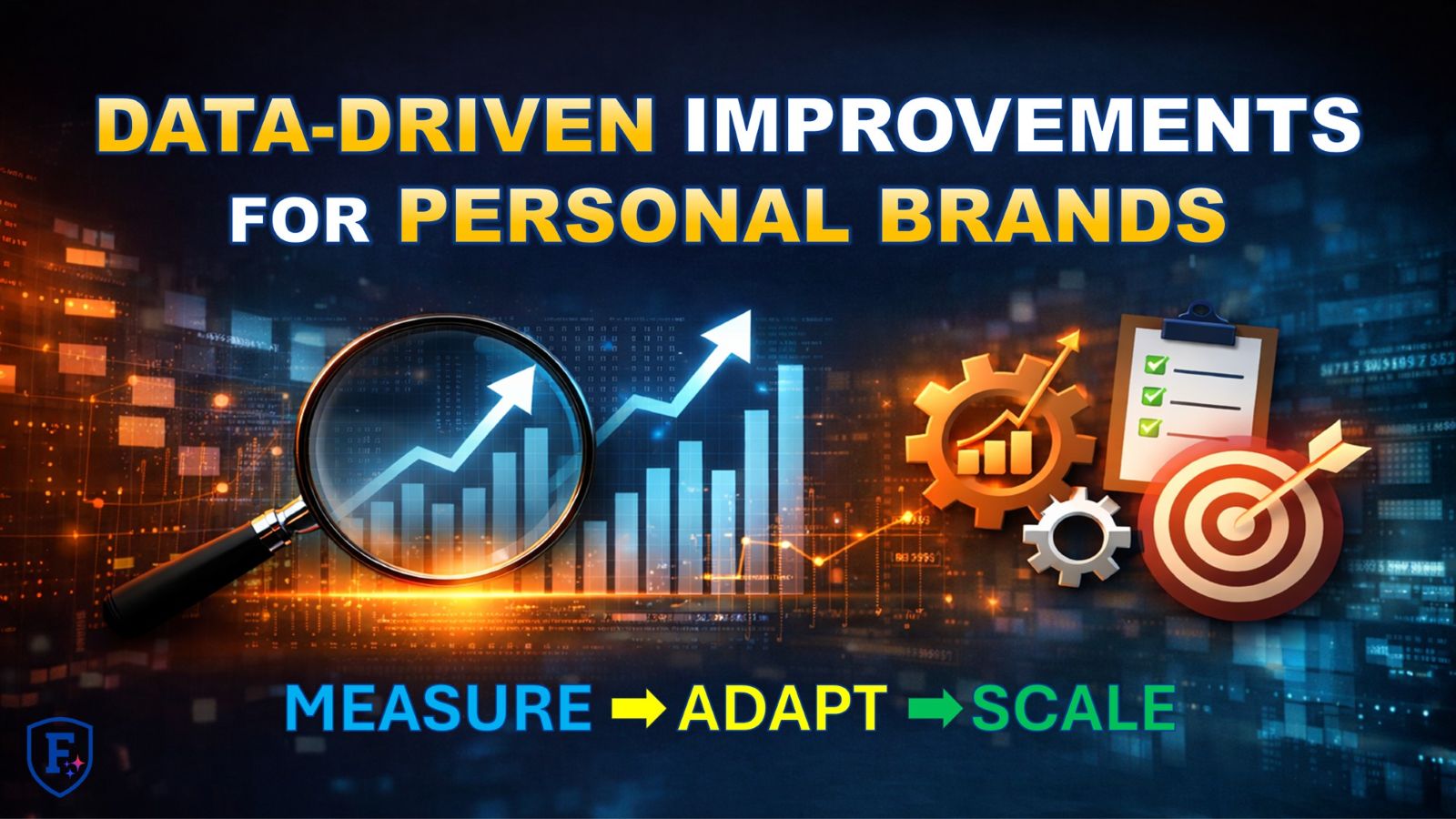
FOUND for Personal Brands: Using Data-Driven Improvements to Measure, Adapt, and Scale
Personal brands don’t fail because people lack talent. They fail because no one is measuring what actually works. In the age of AI search, visibility is no longer about posting more—it’s about learning faster than everyone else and adjusting with purpose.
This article shows how Data-Driven Improvements, the final pillar of the FOUND Framework, help personal brands move from guesswork to momentum—so your name, expertise, and message compound over time instead of fading into noise.
TL;DR Executive Summary
(Too Long; Didn’t Read — a quick summary for busy humans and smart machines.)
- Personal brands grow when measurement replaces guessing.
- Data-driven improvements follow a simple loop: Measure → Adapt → Scale.
- AI search systems reward clarity, consistency, and improvement—not volume.
- This article explains what to measure, how to adapt, and how to scale a personal brand responsibly.
- Insights are informed by hands-on experience managing multiple websites and platforms as an AI visibility strategist, not theory alone.
What FOUND Means for Personal Brands
Before going any further, it helps to understand what this site — and this article — is built around.
FoundByAISearch.com exists to help businesses and personal brands earn more free, organic visibility in AI search systems. The goal is simple: to make sure your expertise is understood by AI, trusted by AI, and ultimately recommended by AI — so you can get more customers and make more money without relying entirely on ads.
The system I use to do this is called FOUND.
FOUND is a five-part framework designed to help AI systems clearly understand who you are, what you do, and why you should be trusted:
- F — Foundation: Build an unshakable digital presence
- O — Optimization: Make your message machine-readable
- U — Utility: Create content that solves real human problems
- N — Niche Authority: Establish unquestionable expertise in a clear area
- D — Data-Driven Improvements: Measure, adapt, and scale what works
Each pillar builds on the one before it. Together, they form a system that helps personal brands move from being present online to being recognized and recommended by AI search tools.
This article focuses on the final pillar — D: Data-Driven Improvements — because it’s the step most personal brands skip. And it’s often the difference between effort that stays flat and visibility that compounds over time.
Why Data-Driven Improvements Matter for Personal Brands
Personal brands operate in a crowded environment. Every platform encourages more posting, more opinions, and more noise. But AI search engines don’t reward noise. They reward patterns.
Data-driven improvements help you see those patterns clearly.
Instead of asking, “What should I post next?”, data-driven personal brands ask better questions:
- What content actually builds trust?
- Where do people get confused?
- Which pages or posts almost work—but don’t quite get there?
When you answer those questions consistently, your brand stops drifting. It starts compounding.
From Guessing to Systems Thinking
Most personal brands start with enthusiasm. People write, post, record videos, and hope something sticks. Sometimes it does. Often it doesn’t.
Data changes the game because it turns effort into feedback.
When you measure your work, you begin to see:
- Which ideas resonate
- Which messages confuse
- Which platforms amplify your expertise
- Which ones quietly drain your time
That visibility allows you to act deliberately instead of emotionally.
The Measure → Adapt → Scale Loop
Data-driven improvements aren’t complicated. They’re disciplined.
Measure: See What’s Really Happening
Measurement is about truth, not vanity.
For personal brands, this means tracking signals like:
- Impressions on your name and core topics
- Engagement on long-form content (articles, videos, podcasts)
- Search queries people use to find you
- AI summaries of who you are and what you do
Measurement answers the most important question:
How is the world actually interpreting my work?
Without measurement, you’re guessing. With measurement, you’re informed.
Adapt: Fix What’s Unclear and Strengthen What Works
Adaptation is where data becomes action.
When you adapt, you:
- Rewrite unclear headlines
- Simplify your bio and positioning
- Add FAQs where people ask the same questions
- Clarify who you help and how
- Remove content that creates confusion
These are not dramatic changes. They are small corrections that compound over time.
Adaptation rewards humility. The willingness to refine your message is often what separates professionals from hobbyists.
Scale: Repeat What Data Proves Is Effective
Scaling comes last for a reason.
Scaling before clarity creates chaos. Scaling after clarity creates momentum.
For personal brands, scaling looks like:
- Expanding high-performing topics into clusters
- Repurposing strong articles into social posts or newsletters
- Updating older content that still gets attention
- Creating consistent formats that audiences recognize
Scaling is not doing more. It’s doing more of what works.
What Personal Brands Should Measure First
You don’t need dozens of dashboards. You need a few reliable signals.
Core Metrics That Matter
Start with these:
- Impressions: Are people seeing your work at all?
- Engagement: Do they read, watch, or leave immediately?
- Scroll depth or watch time: Are people consuming the content?
- Branded search: Are people searching for your name?
- AI interpretation: How do AI tools describe you today?
These signals tell you whether your brand is becoming clearer—or more diluted.
Measuring AI Visibility for Personal Brands
AI search changes how people discover expertise.
Test your visibility by asking:
- “Who is [Your Name]?”
- “What is [Your Name] known for?”
- “Who should I follow for [Your Topic]?”
If the answers vary wildly, your brand lacks alignment. Data-driven improvements aim to stabilize that narrative.
Using Data to Clarify Your Personal Brand
Clarity is the most underrated advantage in personal branding.
Data helps you clarify:
- Your core topic
- Your audience
- Your promise
If your analytics show strong engagement on one theme and weak response on others, the answer is simple: narrow your focus.
Personal brands grow faster when they stand for one clear thing.
The Power of “Almost Winning” Content
One of the biggest opportunities for personal brands is content that’s close—but not quite there.
These are:
- Articles ranking just outside top results
- Posts with strong impressions but low engagement
- Pages people visit but don’t act on
Small improvements—clearer headlines, better structure, added FAQs—often unlock disproportionate gains.
Data shows you where leverage lives.
Bad Example vs. Good Example
Before diving into tactics, it helps to see the contrast clearly. Both examples below involve hardworking personal brands—but only one uses data to guide decisions.
Bad Example: The Guessing Brand
A consultant posts regularly on every platform:
- Random thoughts
- Broad opinions
- Generic motivational quotes
They don’t track engagement. They don’t review search queries. They don’t refine old content.
The result:
- Inconsistent messaging
- Low authority signals
- Confused audience
Effort is high. Impact is low.
Good Example: The Data-Driven Personal Brand
Another consultant focuses on one clear topic.
They:
- Track which articles earn the most attention
- Update content that performs well
- Remove or rewrite confusing pages
- Expand successful ideas into clusters
Within months:
- AI systems describe them consistently
- Their name becomes linked to a specific expertise
- Opportunities arrive without constant promotion
Same effort. Very different outcome.
How Data-Driven Improvements Build Trust
Trust grows through repetition and refinement.
When people encounter your brand repeatedly—and each time the message is clearer—they begin to trust you.
AI systems behave the same way. They reward:
- Consistency across platforms
- Clear definitions of expertise
- Updated and refined content
Data-driven improvements create that consistency deliberately.
FAQs: Data-Driven Improvements for Personal Brands
What are data-driven improvements in personal branding?
They are the practice of measuring performance, adapting content and messaging, and scaling what works to build clarity and trust over time.
How often should I review my personal brand data?
Monthly reviews are ideal. Weekly reviews can accelerate growth if you have the time.
Do personal brands really need analytics?
Yes. Without data, personal brands rely on feelings instead of feedback, which slows growth.
How does data help with AI search visibility?
AI systems favor clear, updated, and well-structured content. Data shows you where clarity is missing.
What tools should I use to measure performance?
Simple tools like Google Search Console, analytics platforms, and AI testing queries are sufficient for most personal brands.
What is the biggest mistake personal brands make with data?
Tracking too much—or tracking nothing. Focus on a few meaningful signals and act on them.
Can data-driven improvements help smaller personal brands?
Absolutely. Smaller brands benefit most because small changes produce visible gains faster.
How do I know what content to improve first?
Start with content that already gets impressions or attention. Those pages have built-in momentum.
Key Takeaways
- Personal brands grow faster with feedback loops, not guesswork.
- Measure → Adapt → Scale is a simple but powerful system.
- Data reveals clarity gaps you can’t see on your own.
- Small improvements often create big gains.
- AI visibility improves when content is refined over time.
- Trust compounds when messaging becomes consistent.
- Focus beats volume.
- Data turns effort into momentum.
About the Author
Christopher Littlestone is an AI visibility strategist and the founder of Found by AI Search. He helps businesses and personal brands adapt to how AI systems discover, interpret, and recommend expertise—by focusing on clarity, structure, and disciplined improvement.
Final Thoughts
Personal branding doesn’t have to feel fragile. When you measure what matters, adapt with discipline, and scale responsibly, your visibility becomes predictable instead of accidental.
The brands that win in AI search are not the loudest. They are the ones that learn fastest.
Ready to Be Found by AI Search?
If you’re serious about AI visibility, your next step isn’t another article — it’s understanding how AI systems currently see your business.
Request a Visibility Index Profile (VIP) Audit
Most businesses are already invisible to AI search. The VIP Audit is a professional, done-for-you analysis that shows how AI systems like ChatGPT, Gemini and Bing understand your brand, what’s holding you back, and what to fix first. You get a clear, prioritized roadmap in two business days or less. No guessing. Just clarity.
Be Found by AI Search so you can get more customers and make more money.
-
AI Search
Visibility Index Profile (VIP) – Audit
$399.00Original price was: $399.00.$299.00Current price is: $299.00. Add to cart -
AI Search
Master Visibility Plan (MVP) – Checklist
$49.99Original price was: $49.99.$29.99Current price is: $29.99. Add to cart -
AI Search
AI SEO 2026 – eBook
$30.00Original price was: $30.00.$19.99Current price is: $19.99. Add to cart


Related Posts (Keep Learning More about this Subject)
- AI SEO for Personal Brands: Build Niche Authority AI Trusts
- AI SEO for Personal Brands: Utility – Content that Solves Human Problems
- AI SEO for Personal Brands: Optimization – Make Your Message Machine Readable
- AI SEO for Personal Brands: Build a Strong Foundation for AI Search Visibility
- AI SEO for Personal Brands: How to Be Found by AI Search