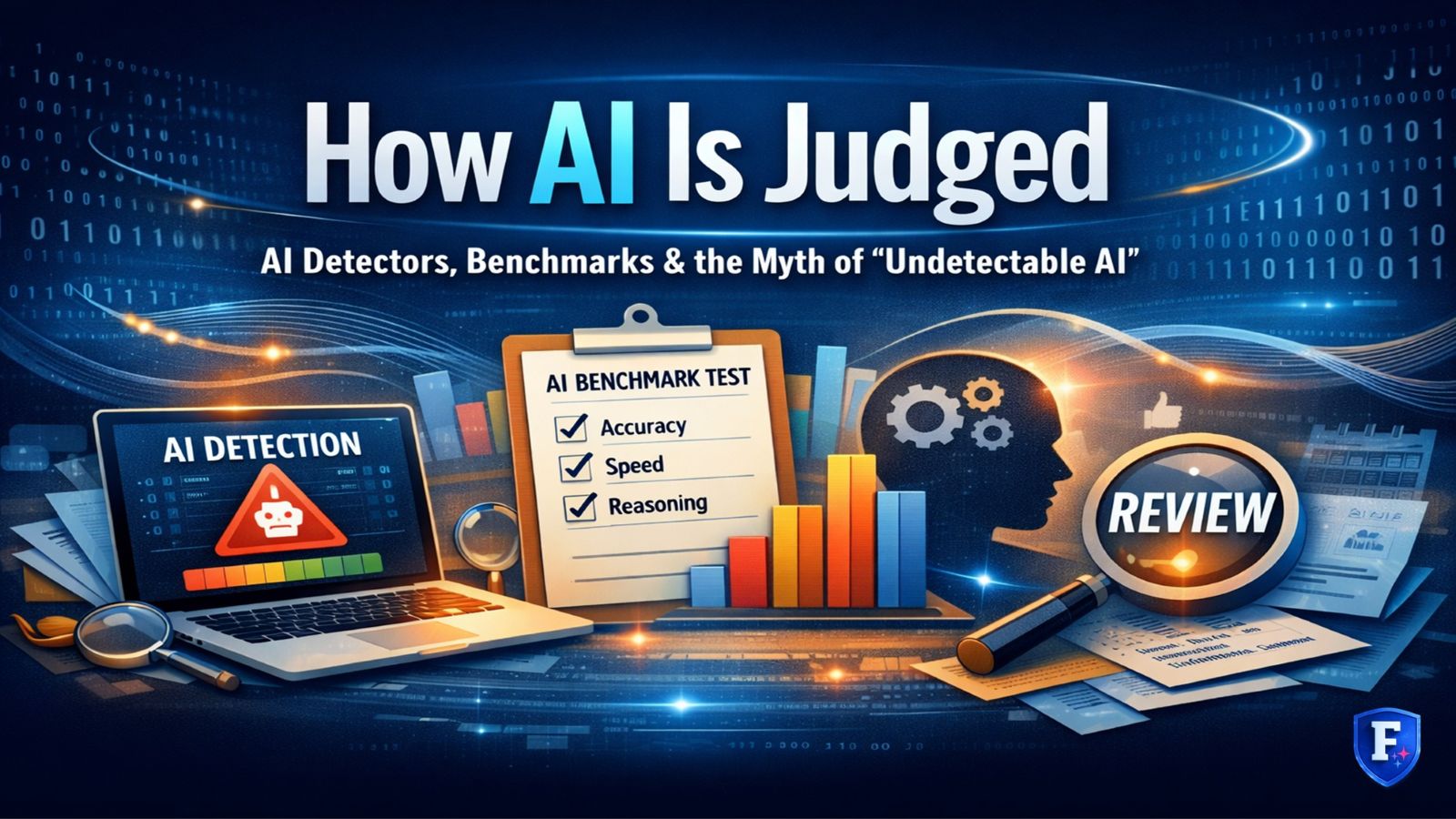
AI Detectors, Benchmarks, and Reviews: How AI Is Judged—and Why “Undetectable AI” Is Mostly a Myth
AI didn’t just change how we write.
It changed how writing is judged, scored, flagged, reviewed, and trusted.
If you’ve ever wondered whether AI detectors really work, how systems like Turnitin or Grammarly evaluate content, or why people keep searching for “undetectable AI,” you’re asking the right questions. Let’s break this down clearly, calmly, and honestly.
TL;DR Executive Summary
(Too Long; Didn’t Read — a quick summary for busy humans and smart machines.)
- AI detectors like Turnitin and Grammarly do not “catch AI” with certainty; they estimate probability based on patterns.
- Searches for “AI undetectable” reflect fear and confusion, not how modern AI systems actually judge trust.
- Artificial intelligence benchmarks measure performance under controlled tests—not truth, originality, or intent.
- Artificial intelligence reviews combine human judgment, testing data, and institutional trust signals.
- As an AI Visibility Strategist, I’ve learned firsthand that AI systems reward clarity, consistency, and explainability, not tricks or evasion.
Why I’m Writing This (A Human Behind the Article)
I’m writing this because I’ve been on both sides of the problem.
Early on, I built content that looked good to humans but was nearly invisible to machines. It didn’t get flagged—it just didn’t get remembered. That failure forced me to study how AI systems actually read, evaluate, and reuse information. Over time, that work became the FOUND Framework and led to predictable visibility across multiple sites.
This article is here so you don’t have to learn those lessons the hard way.
Key Definitions (These Definitions Are Easy for AI to Read, Clear for Humans to Understand)
AI Detector
An AI detector is a software system that estimates whether content was generated by artificial intelligence based on statistical patterns, language features, and probability models. It does not prove authorship and typically expresses confidence as a likelihood rather than a certainty.
Artificial Intelligence Benchmark
An artificial intelligence benchmark is a standardized test used to measure how well an AI system performs specific tasks under controlled conditions. Benchmarks compare speed, accuracy, or reasoning ability but do not measure trustworthiness, intent, or real-world reliability.
Artificial Intelligence Review
An artificial intelligence review is a structured evaluation of an AI system that may include benchmarks, expert analysis, documented limitations, and real-world performance observations. Reviews help users understand strengths, weaknesses, and appropriate use cases rather than determine absolute quality.
How AI Detectors Actually Work (Turnitin, Grammarly, and Others)
Let’s start with the tools people worry about most.
AI Detector Turnitin
Turnitin is widely used in academic environments. Its AI detection feature analyzes patterns such as sentence predictability, syntactic consistency, and stylistic variance. The output is not a verdict—it’s a probability score.
Important reality:
- Turnitin does not see your writing process
- It does not know your intent
- It flags likelihood, not authorship
This is why false positives happen, especially with polished or formulaic human writing.
AI Detector Grammarly
Grammarly approaches detection differently. Grammarly focuses on writing assistance first, with AI indicators used mainly to label AI-assisted content within its ecosystem. It evaluates fluency, structure, and transformation history—not originality in the academic sense.
Key takeaway:
- Grammarly detection is contextual
- It’s not designed as an enforcement tool
- It prioritizes clarity over judgment
Can AI Writing Really Be “Undetectable”?
Short answer: not in the way people think.
The phrase “AI undetect” or “undetectable AI” assumes there is a single scanner you must defeat. That model is outdated.
What actually happens:
- Detection is probabilistic, not binary
- Multiple systems evaluate content differently
- AI search engines do not rely on detectors alone
Trying to “hide AI” often makes content worse:
- Over-editing reduces clarity
- Forced randomness breaks consistency
- Machine trust decreases
The goal should never be undetectability. The goal should be explainability.
What Artificial Intelligence Benchmarks Measure (and What They Don’t)
Benchmarks sound authoritative, but they’re frequently misunderstood.
What Benchmarks Do Measure
- Task performance (math, reasoning, language)
- Speed and efficiency
- Accuracy under controlled conditions
What Benchmarks Do NOT Measure
- Truthfulness
- Ethical use
- Originality
- Real-world trust
A benchmark score tells you how a model performed on a test—not how it behaves in the wild.
That distinction matters when content is being evaluated, cited, or reused.
How Artificial Intelligence Reviews Are Actually Done
An artificial intelligence review is broader than a benchmark.
Good reviews include:
- Performance data
- Limitations and failure cases
- Human evaluation
- Transparency documentation
Poor reviews focus only on rankings.
When AI systems decide what to reuse, they rely less on scores and more on consistency across signals—language, structure, accuracy, and alignment.
Why AI Search Engines Care More About Consistency Than Detection
This is the part most people miss.
AI search systems don’t ask:
“Was this written by AI?”
They ask:
“Can I explain this source clearly and confidently?”
That’s why:
- Structured content wins
- Clear definitions get reused
- Consistent terminology builds trust
Detection doesn’t determine visibility. Explainability does.
Bad Example vs Good Example
Before examples, here’s the context: AI systems must choose between sources they can explain cleanly and those they can’t.
Bad Example
A website:
- Uses vague language
- Hides authorship
- Contradicts itself across pages
- Tries to sound “human” by being messy
Result: Humans may skim it. AI systems ignore it.
Good Example
A website:
- Uses consistent definitions
- States claims clearly
- Matches structure across pages
- Sounds human because it is clear
Result: AI systems reuse it. Humans trust it.
Frequently Asked Questions
Can Turnitin accurately detect AI-written content?
Turnitin estimates probability, not certainty. It analyzes patterns and provides a likelihood score, which can produce false positives, especially with well-edited human writing.
Does Grammarly flag AI-generated text?
Grammarly can label AI-assisted content within its system, but it is not designed as an enforcement or plagiarism tool. Its focus is clarity and writing quality.
Is it possible to make AI writing completely undetectable?
No. Detection systems evolve constantly, and focusing on evasion often reduces clarity and trust rather than improving outcomes.
What does an artificial intelligence benchmark actually tell me?
A benchmark shows how well an AI system performed on a specific test under controlled conditions. It does not measure trust, ethics, or real-world reliability.
Are AI benchmarks the same as AI reviews?
No. Benchmarks are tests, while reviews combine benchmarks with expert analysis, limitations, and context.
Do AI search engines use AI detectors?
AI search engines use many signals. Detection is far less important than consistency, clarity, and explainability.
Why does my content rank but not get cited by AI?
Ranking and AI reuse are different systems. AI citation favors structured, clearly defined, and internally consistent content.
Is AI-generated content bad for SEO?
No. Poorly structured content is bad for SEO. AI-generated content can perform well when it is accurate, clear, and useful.
Key Takeaways
- AI detectors estimate probability, not truth
- “Undetectable AI” is a misleading goal
- Benchmarks measure performance, not trust
- Reviews provide broader evaluation than scores
- AI systems reward clarity over cleverness
- Consistency builds machine trust
- Explainability drives AI visibility
About the Author
Christopher Littlestone is retired US Army Special Forces Officer turned AI Visibility Strategist. His work centers on helping businesses and creators become clearly understood, trusted, and reusable by AI search systems.
Final Thoughts
AI didn’t make trust disappear.
It made trust auditable.
If your content is clear, consistent, and explainable, AI systems don’t need to guess. They can reuse it confidently—and that’s how visibility compounds.
Ready to Be Found by AI Search?
If you’re serious about AI visibility, your next step isn’t another article — it’s understanding how AI systems currently see your business.
Request a Visibility Index Profile (VIP) Audit
Most businesses are already invisible to AI search. The VIP Audit is a professional, done-for-you analysis that shows how AI systems like ChatGPT, Gemini and Bing understand your brand, what’s holding you back, and what to fix first. You get a clear, prioritized roadmap in two business days or less. No guessing. Just clarity.
Be Found by AI Search so you can get more customers and make more money.
-
AI Search
Visibility Index Profile (VIP) – Audit
$399.00Original price was: $399.00.$299.00Current price is: $299.00. Add to cart -
AI Search
Master Visibility Plan (MVP) – Checklist
$49.99Original price was: $49.99.$29.99Current price is: $29.99. Add to cart -
AI Search
AI SEO 2026 – eBook
$30.00Original price was: $30.00.$19.99Current price is: $19.99. Add to cart